Home / Blog Details
Take your digital marketing to the next level with data-driven strategies and innovative solutions. Let’s create something amazing together!


From Google search results to AI chatbots, we optimize your website so customers can find you faster — and choose you over competitors.
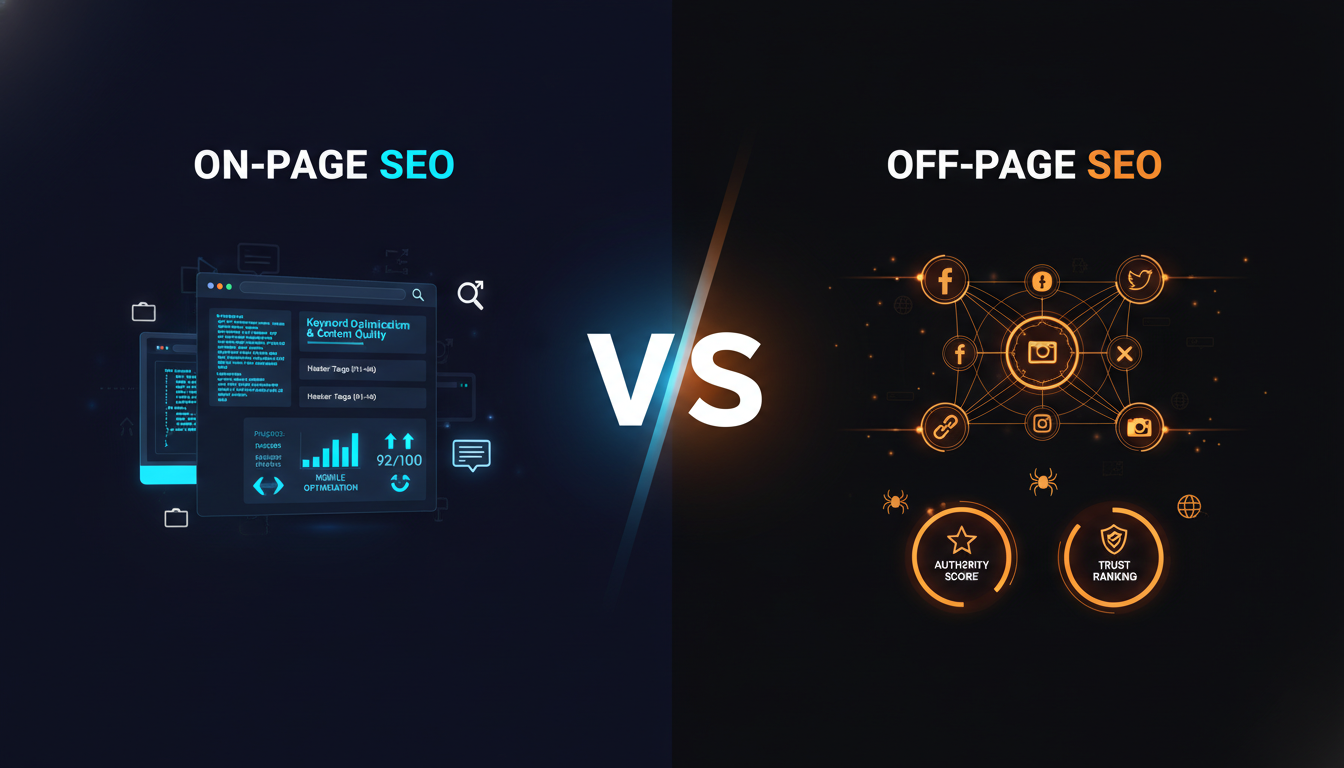
On page SEO vs. off page SEO is one of the most searched comparisons in digital marketing — and for good reason. On-page SEO refers to optimizations you make directly on your website, including content, keywords, and site structure. Off-page SEO involves external signals like backlinks and brand mentions that build your site’s authority. Both work together to improve search rankings, but they require different strategies, timelines, and resources.
On-page SEO: the practice of optimizing individual web pages to rank higher in search results by improving elements you control directly on your site.
This includes everything a visitor and a search engine can see when they land on a page: the words, the headings, the images, the links, and the page speed. If it lives on your website, it falls under on-page SEO.
Google’s job is to show the most relevant, helpful result for any given search query. On-page SEO is how you prove to Google that your page deserves that spot.
Without strong on-page optimization, even a site with hundreds of backlinks can underperform. According to a 2024 study by Semrush, content quality and keyword relevance consistently rank among the top three factors that determine whether a page reaches the first page of search results.
Think of it this way: backlinks are votes, but your on-page content is the candidate. Voters won’t back a weak candidate, and Google won’t rank a poorly optimized page, regardless of how many sites link to it.
Content optimization means writing content that fully answers a searcher’s question, matches their intent, and provides more depth or clarity than competing pages.
Google’s Helpful Content system, updated in 2024, specifically rewards content written for people first. That means your content needs to be accurate, well-structured, and genuinely useful, not just keyword-dense.
Keyword optimization is not about repeating a phrase as many times as possible. It means placing your target keyword in strategic positions: the page title, the first paragraph, at least one subheading, and naturally throughout the body.
Use related terms, synonyms, and entity names to help Google understand the full topic of your page.
Your title tag is the blue link users see in search results. Google uses it to understand your page’s topic, and users click it based on how relevant it looks. Keep titles between 50 and 60 characters and include your primary keyword near the front.
Meta descriptions do not directly influence rankings, but they significantly affect click-through rates. A well-written description with a clear benefit can increase your organic traffic without changing a single ranking.
Clean, descriptive URLs help both users and search engines understand what a page is about before clicking. A URL like /services/seo-optimization/ tells Google and visitors exactly what they will find. Avoid URL strings with random numbers, dates, or meaningless parameters.
Internal links connect your pages to each other, helping search engines discover content and helping users navigate your site. They also pass PageRank, Google’s measure of page authority, from stronger pages to newer or lower-authority ones.
A strategic internal linking structure can significantly improve rankings for pages that would otherwise struggle to compete.
Every image on your site should have a descriptive file name and an alt tag that describes what the image shows. This improves accessibility, helps Google understand your visual content, and gives you an additional ranking opportunity in Google Image Search.
Compress images before uploading to prevent them from slowing down your page load time.
Schema markup: structured data code added to your HTML that helps search engines understand the context of your content.
Adding schema to a local business page, a service page, or a blog post can generate rich results in Google Search, including star ratings, FAQs, and breadcrumb trails, all of which increase your visibility without changing your actual ranking position.
Core Web Vitals are Google’s set of performance metrics that measure real-world user experience: how fast your page loads, how quickly it becomes interactive, and how stable the layout is as it loads.
As of 2026, Core Web Vitals remain an official Google ranking factor. A slow or unstable page can lose rankings to a faster competitor with comparable content.
On-page optimization is your starting line. Once it is solid, everything else you do in SEO becomes more powerful.
Off-page SEO: actions taken outside your website to build authority, trust, and reputation in Google’s eyes.
While on-page SEO tells Google what your site is about, off-page SEO tells Google how much the rest of the internet trusts your site. These are two very different conversations.
Google’s original PageRank algorithm was built on a simple idea: if other reputable sites link to you, your content must be valuable. Two decades later, that logic still holds, though it has grown far more sophisticated.
According to Moz’s annual ranking factors research, backlinks remain one of the strongest predictors of where a page will rank, particularly for competitive keywords. A page with strong on-page SEO but zero external authority will rarely outrank a competitor with both.
A backlink is a link from another website pointing to yours. Not all backlinks are equal. A link from a high-authority, topically relevant site carries far more weight than dozens of links from low-quality directories.
Quality matters far more than quantity. One editorial link from a respected industry publication can outperform 50 links from unrelated or spammy sites.
Google tracks mentions of your brand name across the web, even when those mentions do not include a link. Consistent, positive brand mentions signal that your business is real, recognized, and trustworthy.
This is sometimes called an “implied link,” and it plays a growing role in how Google evaluates authority.
Digital PR involves earning media coverage, interviews, expert quotes, and feature placements in online publications. When a news outlet or industry blog mentions your business and links back to your site, you earn a high-authority backlink and broader brand exposure simultaneously.
Social shares, comments, and engagement do not directly influence Google rankings. However, they amplify your content’s reach, increasing the likelihood that journalists, bloggers, and other site owners discover and link to it.
Social media activity supports off-page SEO indirectly by expanding your content’s audience.
Online reviews on Google, Yelp, and industry-specific platforms influence how Google evaluates your business’s trustworthiness. For local businesses especially, review volume, recency, and average rating all contribute to local search rankings.
Responding to reviews, both positive and negative, also signals active engagement and business legitimacy.
A citation is any online mention of your business name, address, and phone number (NAP). Consistent citations across directories like Yelp, Yellow Pages, and industry-specific listings help Google verify your business location and improve local map pack rankings.
Off-page SEO takes longer to build, but once you have it, it becomes one of your most durable competitive advantages.
Technical SEO and on-page SEO are often confused, but they operate at different levels of your website.
On-page SEO focuses on what your content says and how it is structured for readers. Technical SEO focuses on how your website functions for search engine crawlers. You can have perfect on-page content, but if your site has crawl errors or slow server response times, Google may never properly index your pages.
Technical SEO and off-page SEO rarely overlap, but they are connected by one important relationship: a technically broken site can waste the authority earned through backlinks.
If Google cannot crawl or index your pages correctly, no amount of external linking will push them to the top of search results. Technical SEO clears the path; off-page SEO builds the momentum.
Crawlability refers to how easily search engine bots can discover and access your pages. Common crawlability issues include blocked pages in your robots.txt file, broken internal links, and redirect chains that slow bots down.
A page being crawled does not guarantee it will be indexed. Indexability issues arise from accidentally left noindex tags on pages accidentally, duplicate content problems, or thin pages that Google determines are not worth storing in its index.
An XML sitemap is a file that lists all the important URLs on your site, helping Google discover and prioritize them. Submitting your sitemap through Google Search Console is a basic but necessary step for any new or updated site.
Canonical tags tell Google which version of a page is the “original” when multiple URLs display similar content. Without them, you risk splitting your ranking signals across duplicate pages, weakening all of them.
Technical SEO may feel invisible, but it determines whether all your on-page and off-page work pays off.
On-page SEO aims to make your content relevant and useful to both users and search engines. Off-page SEO aims to prove to Google that your site is trustworthy and authoritative based on what others say about you.
These are two different arguments you are making to Google, and you need to win both.
| Factor | On-Page SEO | Off-Page SEO |
| Primary signal | Content relevance | Domain authority |
| Key elements | Keywords, structure, UX | Backlinks, citations, reviews |
| Google system | Helpful Content | PageRank, Trust signals |
| Measurement | Rankings, CTR, dwell time | DA/DR, backlink profile |
| Controlled by | You | Third parties |
On-page SEO gives you complete control. You decide what to write, how to structure it, and which keywords to target. You can make changes and see results within days or weeks.
Off-page SEO is largely out of your hands. You can create link-worthy content and pitch publications, but the decision to link to you belongs to someone else.
On-page improvements typically show measurable results within 4 to 12 weeks, depending on how competitive your keywords are and how established your site is.
Off-page SEO takes longer. Building a meaningful backlink profile can take 6 to 12 months before you see significant ranking improvements.
On-page SEO requires skilled writers, SEO knowledge, and time. Off-page SEO requires outreach, relationship-building, PR skills, and often a larger budget for link acquisition through legitimate campaigns.
Both strategies compound over time. Well-optimized content continues to rank for years. Strong backlinks continue to pass authority even if no new links are acquired. The combination creates rankings that are extremely difficult for competitors to displace.
Both strategies exist to improve your position in Google’s search results. They simply attack that goal from different angles: one from within your site, one from outside it.
Strong on-page content builds trust with readers. Off-page signals like reviews and press mentions build trust with both Google and potential customers. Both ultimately serve the same purpose: making people feel confident enough to choose your business.
Whether a user finds you through a well-optimized service page or clicks your result because your brand appeared in a trusted publication, the end result is the same: greater visibility and more traffic.
Google uses on-page signals to determine relevance: does this page actually answer the query? Keyword placement, content depth, and semantic coverage all feed into this determination.
Google uses off-page signals to determine authority: should this page be trusted? Backlink quality, domain reputation, and brand mentions all contribute to this score.
Trust comes from both sides. On-page trust comes from author credentials, cited sources, and transparent business information. Off-page trust comes from editorial coverage, review scores, and consistent citations.
E-E-A-T stands for Experience, Expertise, Authoritativeness, and Trustworthiness. Google introduced this framework in its Search Quality Evaluator Guidelines, and it now shapes how both on-page content and off-page authority are assessed.
For businesses in competitive niches, demonstrating E-E-A-T across both on-page and off-page signals is not optional. It is the baseline for first-page rankings.
Search intent alignment: matching your content format and depth to what the searcher actually wants to find.
A person searching “how to fix a leaking AC unit” wants a step-by-step guide, not a sales page. Misreading intent is one of the fastest ways to rank poorly despite having good content.
Content quality encompasses accuracy, depth, readability, and originality. Google’s Helpful Content system, refined in 2024, actively downgrades content that is written primarily to rank rather than to help.
A strong internal linking structure distributes authority across your site and helps Google understand which pages are most important. Pages with more internal links pointing to them tend to rank better.
Google measures how users interact with your page. High bounce rates, short dwell time, and low click-through rates all signal that your page may not be satisfying the query.
Pages that load fast, respond quickly to user input, and maintain visual stability during loading perform better in Google’s ranking systems. Use Google PageSpeed Insights to identify specific improvements.
A backlink from a site with a Domain Authority of 70+ carries exponentially more weight than one from a DA 10 blog. Focus on earning links from sites your industry respects.
A backlink from a topically relevant site signals to Google that your content belongs in that subject area. An HVAC company linked to from a home improvement publication carries more weight than a link from a fashion blog.
Brand authority grows when your name appears repeatedly across trusted sources: press coverage, expert directories, podcast interviews, and industry associations.
Review scores, response rates, and review recency all feed into how Google evaluates a local business’s credibility. A 4.8-star average with recent reviews consistently outperforms a 3.2-star average in local search results.
Topical authority refers to how comprehensively a website covers a specific subject. A site with 30 well-written, interlinked articles on HVAC topics will outrank a site with one HVAC page, even if the latter has more backlinks.
A Lafayette plumbing company rewrites its “Emergency Plumber Lafayette” service page to include the primary keyword in the title tag, first paragraph, one H2, and the meta description. They add an FAQ section with schema markup and compress their images. Within six weeks, the page moves from position 14 to position 5.
A law firm’s personal injury page was ranking for the firm’s name but not for “Lafayette personal injury attorney.” After adding location-specific content, client outcome examples, and a clear content structure targeting search intent, organic visibility increased by 40% within two months.
A marketing agency adds internal links from its high-traffic blog posts to its lower-ranking service pages. The service pages gain authority and start appearing for keywords they were previously invisible for.
A Lafayette restaurant is featured in a “Best Restaurants in Lafayette, LA” roundup on a regional food blog with a DA of 65. That single backlink drives 200 referral visits in the first month and boosts the restaurant’s map pack ranking by three positions.
A local law firm’s attorney is quoted as a legal expert in a regional news article. Even without a direct link, the brand mention strengthens Google’s trust signals for the firm’s website.
A Lafayette-based tech startup issues a press release announcing a community initiative. Three local news outlets publish the story and link back to the company’s website, generating three high-quality backlinks in 48 hours.
Keyword stuffing: forcing a target keyword into a page so many times that the content becomes unreadable or unnatural.
Google’s algorithms have penalized keyword stuffing since the 2012 Penguin update. Modern on-page SEO rewards natural language and semantic coverage, not repetition.
Thin content pages contain fewer than 300 words or provide no real value beyond what any other page already offers. Google actively filters these pages out of competitive rankings.
Publishing the same or nearly identical content across multiple pages confuses Google about which version to rank and splits your ranking signals. Use canonical tags or consolidate duplicate pages.
Leaving pages without internal links, called “orphan pages,” means Google may rarely crawl them and users will never find them organically. Every important page on your site should have at least one internal link pointing to it.
A page that takes more than three seconds to load loses approximately 53% of mobile users before it even fully appears, according to Google’s research. Page speed is both a ranking factor and a conversion factor.
Buying links violates Google’s Webmaster Guidelines and can result in a manual penalty that removes your pages from search results entirely. No short-term ranking gain is worth the risk of a penalty that can take months to recover from.
Participating in private blog networks, link exchanges, or automated link-building schemes exposes your site to algorithmic penalties. Google’s spam detection has grown increasingly sophisticated.
Businesses that do not actively encourage satisfied customers to leave reviews fall behind competitors who do. A steady flow of recent, positive reviews is one of the most actionable local SEO signals available.
Inconsistent NAP information across directories confuses both Google and potential customers. Even small differences, like “St.” versus “Street,” can dilute your local authority.
Google needs to see two things before ranking any page highly: proof that it is relevant to the query, and proof that it is trustworthy enough to recommend. On-page SEO provides relevance. Off-page SEO provides authority. Neither alone is enough for competitive keywords.
A page optimized on-page but lacking backlinks will plateau quickly. A page with many backlinks but poor content will see those rankings erode as user behavior signals tell Google the page is not satisfying searchers. The combination is what sustains rankings over time.
Think of it as a two-engine system. On-page SEO is the engine that converts traffic into results once people arrive. Off-page SEO is the engine that brings people to your site in the first place. Stall either engine and the whole vehicle loses speed.
If your site is new, recently redesigned, or has never been properly optimized, on-page SEO must come first. Sending traffic or links to a poorly structured site is like running paid ads to a broken landing page: the budget is wasted.
Fix your content, your structure, your technical foundation, and your internal links before you invest heavily in off-page strategies.
If your on-page SEO is already solid and your content is high quality, but you are stuck on page two or three despite all your efforts, your missing ingredient is almost certainly authority.
That is when off-page efforts, backlink outreach, digital PR, and local citation building become your highest-leverage investment.
For most small and mid-sized businesses, the practical answer is 70% on-page in the first six months, then shifting to a 50/50 balance once your content foundation is strong. This sequence prevents the common mistake of building authority on top of a weak foundation.
Local on-page SEO means making your website explicitly relevant to searches that include a geographic modifier. For businesses in Lafayette, this means including location-specific keywords in page titles, H1 tags, and the first paragraph of key service pages.
Create dedicated landing pages for each service you offer in Lafayette rather than one generic services page. A page titled “AC Installation in Lafayette, LA” will consistently outperform a generic “Services” page for location-specific searches.
Local off-page SEO builds your authority specifically within your geographic market. The goal is to appear as the most trusted, recognized business in Lafayette for your category.
Your Google Business Profile (GBP) is the single most powerful tool for local search visibility. A complete, accurate GBP with photos, service listings, regular posts, and Q&A responses significantly improves your chances of appearing in the Google Map Pack, the three local results that appear above organic listings.
Every time your business name, address, and phone number appears consistently across directories, it reinforces Google’s confidence in your business’s legitimacy. Audit your citations across Yelp, Yellow Pages, Apple Maps, and industry-specific directories at least once per quarter.
Lafayette consumers, like consumers everywhere, read reviews before choosing a local service provider. A business with 150 reviews averaging 4.7 stars will outperform a competitor with 20 reviews at 4.9 stars in most local searches, because review volume signals consistent activity and customer satisfaction over time.
Links from other Lafayette-based businesses, local news sites, and regional blogs carry strong local relevance signals. Partner with complementary businesses, sponsor local events, and make yourself available as a local expert source for regional media.
Sponsoring a local sports team, community event, or charity often results in a backlink from the organization’s website and a mention in local press coverage. These signals are particularly valuable because they combine local relevance with editorial credibility.
For small businesses working with limited SEO budgets, allocate 60 to 70% toward on-page and technical SEO in your first year. The returns are faster, more controllable, and lay the foundation that makes future off-page efforts more efficient.
As your content improves and your site gains traction, begin shifting budget toward link-building and local off-page strategies in year two.
These on-page and off-page tasks can show measurable results within 30 to 60 days:
Track these metrics monthly to assess whether your SEO strategy is working:
On-page SEO and off-page SEO are not competing priorities. They are complementary systems that answer two different questions Google asks about every page: Is this content relevant? And is this source trustworthy?
On-page optimization gives you relevance. Off-page authority gives you trust. Together, they give you rankings that last.
The businesses that dominate local search in Lafayette, and in competitive markets everywhere, are not the ones who do one thing well. They are the ones who build strong content, earn real authority, maintain consistent citations, and generate steady reviews across a 12 to 24-month horizon.
If you are a Lafayette business owner wondering where to start, begin with your on-page foundation and build outward. Visit SitesNApps’ SEO optimization services to see exactly how a structured SEO strategy is built from the ground up.
You now know the difference between on-page SEO vs. off-page SEO, which ranking factors matter most, and how local businesses in Lafayette can use both to grow their search visibility.
The next step is taking action. Whether your site needs a content overhaul, a technical audit, or a local link-building campaign, SitesNApps has helped Lafayette businesses across industries build rankings that generate real leads.
Call today to book a free SEO consultation and find out exactly where your site stands and what it will take to get you where you want to be.
On-page SEO should always come first for a new website. Before you can earn meaningful backlinks, you need pages worth linking to. Build strong content, optimize your structure, and fix technical issues first. Off-page efforts become far more effective once your on-page foundation is solid.
Most on-page improvements show measurable results within 4 to 12 weeks, depending on how competitive your keywords are and how authoritative your domain already is. Simple changes like title tag updates can produce visible ranking shifts in as little as two to four weeks after Google recrawls your pages.
Yes, particularly for low-competition keywords in niche markets or local searches. A well-optimized Google Business Profile and strong on-page content can rank a local business in map pack results without a substantial backlink profile. However, for competitive keywords, backlinks remain necessary for reaching and holding first-page positions.
A citation is any online mention of your business name, address, and phone number, even without a link. A backlink is a clickable hyperlink from another website to yours. Both matter for local SEO, but backlinks carry more weight for organic rankings while citations have a stronger influence on Google Maps visibility.
E-E-A-T (Experience, Expertise, Authoritativeness, Trustworthiness) is Google’s framework for evaluating content quality and source credibility. On-page SEO demonstrates expertise through well-written, accurate content. Off-page SEO demonstrates authority through third-party recognition like backlinks and press mentions. Strong E-E-A-T requires both working together.
Audit your most important pages every three to six months. Search intent evolves, competitors update their content, and Google’s algorithms shift. Refreshing your top-performing content with updated data, expanded sections, and improved structure is one of the highest-return activities in long-term SEO.
Struggling to compete for high-search-volume keywords? We help businesses like yours increase visibility, drive more traffic, and dominate competitive search terms—all while keeping your costs low. Our proven strategies focus on long-term growth and measurable results.