Home / Blog Details
Take your digital marketing to the next level with data-driven strategies and innovative solutions. Let’s create something amazing together!
From Google search results to AI chatbots, we optimize your website so customers can find you faster — and choose you over competitors.
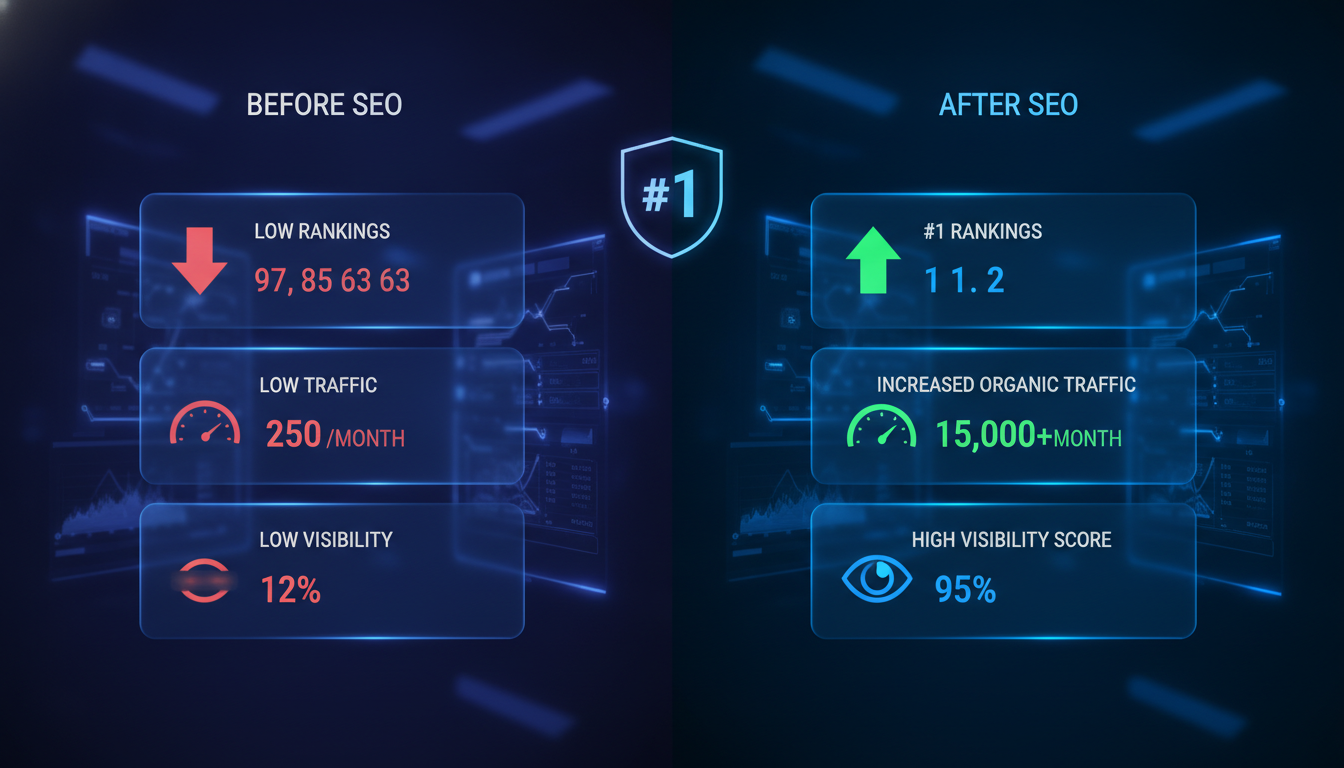
SEO boosts your online visibility by improving where your website ranks on Google and other search engines. Higher rankings mean more people see your business before they see your competitors. For Lafayette, LA businesses, that visibility directly drives more website traffic, phone calls, and paying customers through organic search.
Your competitors are getting found online. Are you?
Every day, people in Lafayette search Google for exactly what your business offers. If your website does not appear in those results, those customers go to a competitor. That is not a traffic problem. It is a visibility problem, and SEO is the solution.
Most business owners assume SEO is too technical or too slow to be worth the effort. That assumption is costing them customers. According to BrightEdge research, organic search drives 53% of all website traffic across industries. Businesses that invest in SEO consistently outgrow those that rely only on paid ads or word-of-mouth.
This guide explains exactly how SEO boosts your online visibility, what factors drive those results, and what Lafayette businesses should do right now to compete. You will leave with a clear picture of your next steps.
SEO (Search Engine Optimization) is the practice of improving your website so it ranks higher in search engine results pages, known as SERPs. Search visibility is a metric that reflects how often your website appears in organic search results for the keywords your target audience uses.
Think of it this way. If 1,000 people search for “HVAC repair Lafayette LA” every month, and your website appears for none of those searches, your search visibility for that keyword is zero. No visibility means no organic traffic, no leads, and no revenue from search.
Visibility and traffic are related but not the same thing. You can have high visibility with low traffic if your rankings appear on page two of Google. You can also have decent traffic from social media or paid ads while having near-zero organic visibility.
SEO focuses specifically on improving organic visibility, which is your presence in unpaid search results. That distinction matters because organic visibility compounds over time, while paid visibility stops the moment you stop paying.
More visibility means more people encounter your brand during their search process. Research from Google shows that 76% of people who search for a local business on their smartphone visit that business within 24 hours. For Lafayette businesses, capturing that search moment is often the difference between a new customer and a missed opportunity.
Visibility also builds brand familiarity. Even when users do not click your result the first time, they remember seeing your name. That brand recognition influences their decision later in the buying process.
Measuring SEO progress requires tracking a specific set of metrics consistently. Here are the primary indicators:
Google Search Console is the most reliable free tool for tracking organic traffic. It shows impressions, clicks, average CTR, and average position for every keyword your site ranks for. You should check this data monthly and compare it to the previous period to identify trends.
Traffic spikes tied to specific content updates confirm that your SEO efforts are working. Drops tied to algorithm updates signal areas that need attention.
A high impression count with a low CTR means your site appears in search results but is not compelling enough to earn the click. Improving your meta titles and descriptions can directly increase CTR without changing your ranking position. Even a 1% CTR improvement across high-volume keywords can significantly increase monthly traffic.
Keyword rankings show where your pages land in Google’s results for specific search queries. Moving from position 15 to position 5 for a target keyword can multiply your traffic dramatically. According to data from Backlinko, the first organic result on Google receives an average CTR of 27.6%, compared to just 2.4% for position 10.
Rankings and traffic are intermediate metrics. The goal is business results. Connecting Google Analytics with your contact forms, phone tracking, and e-commerce data lets you see exactly how much revenue your SEO investment is generating. This data also helps you prioritize which pages and keywords deserve the most attention.
SEO improves your search engine rankings by signaling to Google that your content is trustworthy, relevant, and useful for specific search queries. That involves a combination of content quality, technical performance, and authority signals from other websites linking to yours.
Rankings directly control visibility. A business ranking in position 1 gets seen by far more searchers than one ranking in position 11, even though the difference is just one page. Consistent SEO work moves your pages up those rankings over time.
Each page you optimize for a different keyword adds a new entry point for customers to discover your business. A law firm might rank for “personal injury lawyer Lafayette LA,” “car accident attorney Acadiana,” and “slip and fall lawyer Louisiana” simultaneously. Each ranking expands exposure to a different segment of their audience.
This is why content strategy is central to SEO. More well-optimized pages mean more keywords, which means broader visibility across the entire spectrum of searches your customers perform.
Consistent visibility in search results builds brand authority, even among people who are not ready to buy yet. When your business name appears repeatedly for relevant searches, potential customers begin to associate your brand with the topic. That association influences their decision when they are finally ready to contact someone.
Brand awareness through SEO is cost-effective. Unlike paid display advertising, your organic presence does not require ongoing spending to remain visible.
Organic search captures customers at the exact moment they express a need. Someone searching “best SEO agency Lafayette LA” is actively looking for help. That intent-driven moment is significantly more valuable than interrupting someone with an ad while they are doing something else entirely.
Matching your content to high-intent keywords puts your business in front of buyers who are already in decision-making mode, which increases conversion rates compared to most other marketing channels.
Paid advertising generates traffic only while you run campaigns. SEO-optimized content continues generating traffic for months or years after publication. A well-written article that ranks for a competitive keyword can drive consistent leads without additional investment.
This compounding effect makes SEO one of the highest-ROI digital marketing strategies available to small and mid-sized businesses. The work you do today builds an asset that pays dividends long into the future. That long-term value is a core reason to explore SEO optimization services built specifically for business growth.
Search intent is the underlying goal a user has when typing a query into Google. Google categorizes intent as informational (learning), navigational (finding a site), commercial (comparing options), or transactional (ready to buy). Your content must match the intent behind your target keywords, or Google will not rank it, regardless of how well-written it is.
A page selling services should not rank for an informational “how-to” query without also addressing the educational need behind it. Misaligned intent is one of the most common reasons pages fail to rank despite strong technical SEO.
Google’s algorithms evaluate whether your content genuinely satisfies a user’s search query better than competing pages. Thin content, outdated information, and generic writing all signal low quality. In contrast, thorough, accurate, and well-structured content earns higher rankings and more clicks.
Quality also means covering a topic completely. A comprehensive guide that answers every question a reader might have tends to outrank a shorter page that only addresses the surface level.
Domain authority is a concept that reflects how much trust Google has assigned to your website based on the quality and quantity of backlinks pointing to it. A newer site with few backlinks typically has lower authority than an established site with links from credible sources.
Trust signals include HTTPS security, a professional About page, clear contact information, author credentials, and positive user engagement signals. Google evaluates these signals to determine whether your site is a credible source.
Google monitors how users interact with search results. If users click your result and return immediately to Google, that behavior signals that your page did not satisfy their query. Conversely, if users stay on your page, click through to other pages, and spend time reading, that signals strong relevance.
Improving navigation, page layout, readability, and internal linking all contribute to better engagement, which in turn supports stronger rankings.
Technical SEO covers the behind-the-scenes elements that determine whether Google can find, crawl, and index your pages efficiently. Slow loading times, broken links, poor mobile performance, and crawl errors all reduce your visibility ceiling, regardless of content quality.
A technically sound website gives every other SEO effort a stronger foundation to build on.
High-value content answers real questions, solves actual problems, and provides information users cannot easily find elsewhere. That type of content earns backlinks naturally, gets shared on social media, and ranks for multiple related keywords simultaneously.
The bar for high-value content in 2025 and 2026 has risen significantly. Google’s Helpful Content system rewards content written for people first and search engines second. Writing content that genuinely serves your reader’s needs is now the most reliable path to sustained rankings.
A topic cluster is a content strategy where one comprehensive “pillar” page covers a broad topic, and multiple supporting “cluster” pages cover related subtopics. Internal links connect them. This structure signals to Google that your website has deep expertise in a subject area.
For example, a Lafayette digital marketing agency might create a pillar page on SEO, then build cluster pages on local SEO, keyword research, link building, and technical SEO. That interconnected content architecture builds topical authority and improves rankings across the entire cluster. You can explore this approach further through the SEO guide for businesses developed by Sites N Apps.
Content decays. Statistics become outdated, competitor pages improve, and search intent shifts. Refreshing existing content by updating data, adding new sections, and improving on-page optimization can recover rankings that have declined and push performing pages even higher.
A content refresh typically delivers results faster than creating an entirely new page because the URL has already accumulated some authority and indexed history.
Featured Snippets are the boxed answer blocks that appear at the top of Google’s results above all other organic rankings. AI Overviews are Google’s AI-generated summaries that pull from multiple trusted sources. Both are won by providing clear, direct, well-structured answers to specific questions.
To target these positions, use question-based headings, follow them immediately with concise direct answers, use numbered lists and definition formats, and maintain high content accuracy. Pages that achieve Featured Snippet positions see dramatically higher CTR and visibility.
Title tags are the clickable blue headline that appears in search results. Meta descriptions are the short summary beneath it. Together, they are your first impression on a potential visitor. A compelling title tag with a clear value proposition directly increases CTR, which in turn improves ranking signals.
Best practices for 2026 include keeping title tags between 50 and 60 characters, front-loading the primary keyword, and writing meta descriptions between 140 and 155 characters that speak directly to the reader’s intent.
Strategic keyword placement means including your primary keyword in the title tag, H1, first 100 words, at least one H2, the meta description, and the URL slug. Supporting keywords and LSI terms should appear naturally throughout the body content.
Avoid placing keywords in every heading or forcing them into sentences where they do not fit naturally. Keyword stuffing actively harms your rankings and makes content harder to read.
Internal links connect pages within your website, helping both users and search engine crawlers navigate your content. They also distribute page authority across your site. A well-structured internal linking strategy ensures your most important pages receive the most internal link equity.
When you publish new content, link to it from relevant existing pages. This signals to Google that the new page is important and accelerates its indexation and ranking potential.
Images with descriptive file names and alt text help search engines understand visual content. Optimized images also load faster, which improves Core Web Vitals scores. Search engines index images separately, giving you an additional channel for visibility through Google Image Search.
Always compress images before uploading, use descriptive alt text that reflects the content of the image, and use modern file formats like WebP where possible.
Structured data is code added to your website that helps Google understand the content on each page. It enables Rich Results, which are enhanced search listings that include star ratings, FAQs, event dates, and other visual elements directly in the SERP.
Rich Results stand out visually in search results and significantly increase CTR. Schema markup for Local Business, FAQ, Article, and Review content types are especially valuable for small and local businesses.
Crawlability is Google’s ability to access and read your website’s pages. Indexability is whether those pages are eligible to appear in search results. If Google cannot crawl a page, it cannot rank it, regardless of content quality.
Common crawlability issues include blocked pages in robots.txt, redirect chains, broken internal links, and pages with a “noindex” tag applied accidentally. A regular technical audit catches these issues before they cause ranking losses.
Core Web Vitals are a set of page experience metrics Google uses as ranking signals. They measure Largest Contentful Paint (how fast the main content loads), Interaction to Next Paint (how quickly the page responds to user input), and Cumulative Layout Shift (how stable the page layout is during loading).
Pages that pass Core Web Vitals thresholds have a ranking advantage over those that fail. You can check your scores for free using Google PageSpeed Insights or Google Search Console’s Core Web Vitals report.
Google uses mobile-first indexing, meaning it evaluates the mobile version of your website to determine rankings, even for desktop searches. A site that looks good on desktop but performs poorly on mobile loses ranking visibility across all devices.
Mobile optimization includes responsive design, tap-friendly buttons, readable font sizes, fast mobile load times, and content that displays correctly on small screens.
HTTPS encrypts the connection between your website and its visitors, protecting user data. Google confirmed HTTPS as a ranking signal in 2014, and it remains one today. Browsers also display security warnings on non-HTTPS sites, which increases bounce rates and reduces trust.
If your website still runs on HTTP, migrating to HTTPS is one of the fastest technical fixes available, with immediate credibility benefits and a modest ranking improvement.
Backlinks are links from other websites pointing to yours. They function as votes of confidence in your content’s authority. Google treats backlinks from high-authority, relevant websites as strong trust signals. More quality backlinks generally mean higher rankings and broader visibility.
Earning backlinks requires creating content worth linking to, reaching out to industry publications, guest posting on reputable sites, and building relationships with other local businesses and organizations in your community.
Digital PR involves getting your business mentioned in online news publications, industry blogs, and authoritative websites. Even unlinked brand mentions contribute to your online presence and can be converted into backlinks with outreach. According to Search Engine Journal, digital PR is one of the most effective link-building strategies for building domain authority in competitive niches.
A Lafayette business featured in The Acadiana Advocate or a regional business publication gains both local credibility and an SEO benefit when that coverage includes a link to their website.
Domain authority is a third-party metric, developed by Moz, that predicts how well a website will rank in search results based on its backlink profile. While Google does not use domain authority directly as a ranking factor, the underlying signals it reflects, quality backlinks and overall site trust, do influence rankings.
Building domain authority takes time. Focus on earning links from relevant, reputable sources rather than chasing volume from low-quality directories or link farms.
The Local Pack is the group of three business listings that appears at the top of Google’s results for location-based searches, accompanied by a map. Ranking in the Local Pack for Lafayette searches puts your business directly in front of customers who are ready to act.
Factors that influence Local Pack rankings include your Google Business Profile completeness, the consistency of your business name, address, and phone number across the web, the volume and quality of your customer reviews, and your proximity to the searcher’s location.
Your Google Business Profile (GBP) is the free listing that appears when someone searches for your business or a category your business falls into. A fully optimized GBP increases your chances of appearing in the Local Pack and Google Maps significantly.
Optimization includes selecting the most accurate primary and secondary categories, writing a keyword-rich business description, uploading high-quality photos regularly, adding your service areas, posting updates weekly, and responding to every review promptly.
Local citations are online mentions of your business name, address, and phone number, collectively known as NAP. They appear in directories like Yelp, Yellow Pages, Facebook, and industry-specific sites. Consistent NAP information across all citations signals to Google that your business is legitimate and properly located.
Inconsistent citations, such as a different phone number or suite number variation across directories, can confuse Google’s local algorithms and reduce your Local Pack visibility.
Reviews are a direct local ranking factor. Businesses with more positive reviews and higher average ratings tend to rank higher in the Local Pack than competitors with fewer reviews. Beyond rankings, reviews heavily influence whether a searcher chooses your business over a competitor.
Encourage satisfied customers to leave Google reviews by making it easy. Send a follow-up text or email with a direct link to your review page. Respond to every review, positive and negative, to demonstrate that your business values customer feedback.
Hyper-local keyword targeting means including Lafayette, Acadiana, Broussard, Youngsville, Carencro, and other local place names in your content, meta tags, and GBP. Phrases like “SEO company Lafayette LA,” “website design Acadiana,” or “digital marketing near me Lafayette” capture searches from people specifically looking for local providers.
Localizing your content also includes referencing local landmarks, events, and neighborhoods where relevant. This geographic specificity helps Google match your pages to local searchers.
Local backlinks from Lafayette-based organizations, chambers of commerce, event sponsors, local news sites, and community blogs carry significant weight for local SEO. These links confirm your geographic relevance to Google’s local algorithms.
Sponsoring local events, joining the Greater Lafayette Chamber of Commerce, partnering with neighboring businesses, and contributing expert commentary to local media are all effective ways to earn local backlinks that strengthen your community authority.
Thin content, generic blog posts, and pages that fail to satisfy user intent are consistently outranked by more thorough, better-structured competitors. Google’s Helpful Content system specifically targets content created primarily for rankings rather than genuine reader value.
If your website has pages with fewer than 500 words, no clear purpose, or no original insights, those pages may be actively dragging down your overall domain quality score.
Keyword over-optimization, also called keyword stuffing, is the practice of repeating a keyword so frequently that it disrupts the natural flow of content. Google’s algorithms detect this practice and may penalize pages that use it. Worse, it damages the reader’s experience, increasing bounce rates.
Use your primary keyword where it fits naturally: the title, first paragraph, at least one subheading, and a few times in the body. Beyond that, let synonyms and related terms carry the semantic weight.
Even exceptional content cannot rank if Google cannot crawl and index it properly. Broken pages, slow load times, duplicate content issues, and misconfigured redirects all create technical barriers that limit your visibility ceiling.
A semi-annual technical SEO audit, using tools like Screaming Frog, Google Search Console, or Semrush, is the minimum standard for maintaining a healthy site that ranks consistently.
With mobile-first indexing, a poor mobile experience directly reduces your Google rankings. Pages that load slowly on mobile, display content incorrectly, or force users to zoom and scroll horizontally create a poor experience that Google’s algorithms penalize through lower rankings.
Test your mobile performance using Google’s free Mobile-Friendly Test tool and address any issues immediately.
Many Lafayette businesses invest in general SEO while neglecting local signals entirely. Without a fully optimized Google Business Profile, consistent local citations, and locally relevant content, those businesses will not appear in Local Pack results, missing the highest-intent traffic available through search.
Local SEO is not optional for businesses serving a specific geographic area. It is the primary channel through which local customers find and choose service providers.
SEO timelines depend on several variables: your website’s current authority, the competitiveness of your target keywords, the quality of your existing content, your link profile, and how aggressively you implement improvements. A new website with no backlinks targeting competitive keywords will take longer to see results than an established site with existing authority.
The niche also matters. Local Lafayette markets are significantly less competitive than national markets, which means local SEO results often arrive faster than broader campaigns.
Short-term SEO wins typically appear within 3 to 6 months and include technical fixes, local citation corrections, improved Google Business Profile performance, and CTR improvements from better meta titles. These changes produce measurable movement without requiring months of new content creation.
Long-term SEO results, including ranking for competitive primary keywords and earning consistent organic traffic, typically develop over 6 to 12 months of sustained effort. Content that ranks for high-volume keywords often does so 6 to 9 months after publication.
For a local Lafayette business starting from scratch, realistic expectations include:
These timelines assume consistent monthly effort. SEO does not reward sporadic effort; it rewards sustained, strategic investment.
Paid advertising, through Google Ads or Meta Ads, generates immediate visibility but only while you are paying. The moment you pause a campaign, your visibility drops to zero. Organic visibility built through SEO continues generating traffic and leads even when you are not actively spending.
Organic results also carry more trust for many users. According to research from SparkToro, approximately 70% of clicks go to organic results rather than paid ads for most search queries, reflecting a persistent preference among searchers for non-sponsored content.
The cost-per-lead from organic search decreases over time. Your initial investment in content and optimization continues generating returns long after the work is done. By contrast, paid advertising costs remain constant or increase as competition drives up cost-per-click rates.
A page that earns a top-3 ranking for a high-intent keyword can generate dozens or hundreds of leads per month at no additional cost. Multiply that across multiple pages and keywords, and the compounding ROI becomes one of the most compelling financial arguments for SEO.
SEO and paid search work best together. Use PPC to capture immediate traffic for high-converting keywords while your SEO strategy builds long-term organic rankings for those same terms. Once organic rankings mature and take over, you can reduce PPC spend on those specific keywords and redirect budget to new targets.
This approach maximizes visibility in both the short and long term, captures both organic and paid search real estate simultaneously, and reduces your long-term customer acquisition cost as SEO compounds. The Sites N Apps homepage provides a starting point for exploring both services together.
SEO boosts your online visibility by working across every layer of your digital presence. From technical foundations to local citation consistency to high-value content, every element reinforces your ability to appear in front of the right customers at the right time. Visibility in search is not passive. It requires deliberate, consistent effort applied strategically across all the areas covered in this guide.
For Lafayette, LA, businesses, the opportunity is significant. Local markets are less saturated than national ones, and most local competitors are not investing seriously in SEO. That gap is your advantage, but only if you act on it. Businesses that start optimizing now will build an organic presence that compounds in value while competitors remain invisible in search results.
At Sites N Apps, we specialize in helping Lafayette businesses build and sustain the kind of online visibility that generates consistent, qualified leads from organic search. Whether you are starting from scratch or ready to accelerate an existing strategy, we are here to help. Schedule a consultation today to discuss your business goals and receive a customized SEO strategy built for your market. You can also request a free website audit to identify exactly where your current visibility gaps are and what it will take to close them.
SEO visibility measures how often your website appears in search results for relevant keywords. Website traffic measures how many people actually visit your site. High visibility does not always produce high traffic if your title tags and meta descriptions do not earn clicks. Both metrics matter and are tracked separately using Google Search Console and Google Analytics.
Local SEO services for small businesses typically range from $500 to $2,500 per month depending on the competitiveness of your market, the number of keywords targeted, and the scope of work. The cost per lead from organic search typically decreases over time as rankings improve and content compounds, making SEO one of the more cost-efficient channels for sustained lead generation.
Basic on-page SEO, such as updating title tags, adding alt text, and claiming your Google Business Profile, is manageable without an agency. However, technical SEO, link building, and competitive keyword strategy require expertise and tools that most business owners do not have time to develop. A qualified local SEO agency can accelerate results significantly compared to a DIY approach.
Regular SEO focuses on ranking in organic search results broadly. Local SEO focuses specifically on appearing in location-based searches and the Google Local Pack. It involves optimizing your Google Business Profile, building local citations, earning local backlinks, and creating location-specific content. For service-area businesses in Lafayette, local SEO typically drives higher-quality leads than broader organic SEO.
Sudden ranking drops are most commonly caused by a Google algorithm update, a technical issue such as pages being accidentally set to noindex, a loss of important backlinks, or a competitor significantly improving their content. Check Google Search Console for manual actions, crawl errors, and traffic drop dates, then cross-reference with known Google algorithm update dates to identify the likely cause.
Track organic impressions, keyword rankings, organic sessions, and conversions from organic traffic monthly. Improvement in all four metrics over a 3 to 6-month period confirms that your SEO investment is producing results. A single metric in isolation can be misleading. For example, traffic can increase while rankings drop if you add new low-competition content, so always evaluate the full picture.
Struggling to compete for high-search-volume keywords? We help businesses like yours increase visibility, drive more traffic, and dominate competitive search terms—all while keeping your costs low. Our proven strategies focus on long-term growth and measurable results.