Home / Blog Details
Take your digital marketing to the next level with data-driven strategies and innovative solutions. Let’s create something amazing together!
From Google search results to AI chatbots, we optimize your website so customers can find you faster — and choose you over competitors.
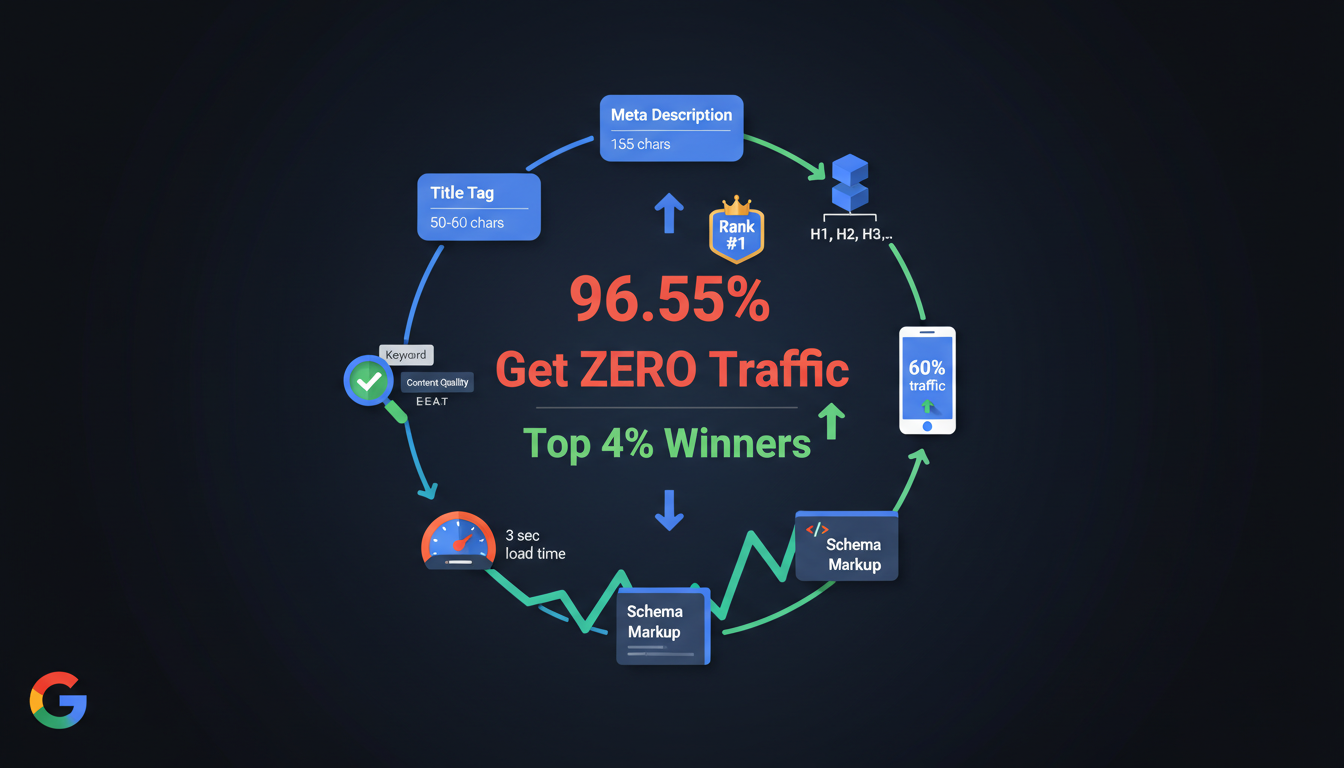
On-page SEO best practices is the process of optimizing individual web pages so they rank higher in search engines and attract more qualified traffic. It covers everything you control directly on the page: content quality, keyword placement, metadata, internal links, page experience, and structured data. Done right, it is your most reliable path to sustainable organic growth.
Most business owners assume publishing more content is the answer. It rarely is. Google’s systems have grown sophisticated enough to distinguish between pages that genuinely answer a question and pages that simply contain a keyword. If your pages are not ranking, the problem is almost always on-page: misaligned intent, incomplete coverage, or technical friction that prevents Google from reading your content clearly.
On-page SEO closes that gap. It gives you a structured way to audit every element on a page, fix what Google penalizes, and build what it rewards. The best part? You do not need to wait for backlinks or domain authority to grow. On-page changes show measurable results within weeks.
This guide covers every major on-page SEO factor in 2026. You will learn how to structure content for both users and search engines, optimize technical elements that most marketers overlook, align your pages with AI search behavior, and apply local SEO strategies specific to Lafayette, LA.
On-page SEO refers to all optimization actions taken directly on a webpage to improve its position in organic search results. This includes your content, HTML source code, metadata, internal links, images, and page experience signals. Every element you control on the page itself falls under on-page SEO.
Unlike off-page SEO, which depends on external signals like backlinks, on-page SEO is entirely within your control. That makes it the most efficient starting point for any ranking improvement effort.
Search engines send automated crawlers to read, interpret, and index your pages. On-page SEO tells those crawlers exactly what your page is about, who it is for, and why it should rank. Without it, even a well-designed site with strong content can remain invisible in search results.
According to Moz’s research on Google’s ranking factors, relevance signals derived from page content remain among the strongest predictors of ranking position. On-page factors account for a significant share of Google’s estimated 200+ ranking signals.
For small businesses and local service providers, on-page SEO levels the playing field. A carefully optimized service page from a local company in Lafayette, LA, can outrank a national competitor if it better serves the searcher’s intent.
On-page SEO directly influences multiple ranking signals, including:
These signals interact. A page with excellent content but poor Core Web Vitals scores will underperform. A technically perfect page with thin content will not rank at all. On-page SEO manages all of them together.
These three disciplines address different parts of the ranking equation:
| Discipline | What It Covers | Who Controls It |
| On-Page SEO | Content, keywords, metadata, internal links, images, schema | You |
| Off-Page SEO | Backlinks, brand mentions, social signals | Mostly external |
| Technical SEO | Site speed, crawlability, indexability, JavaScript rendering | You (with dev support) |
On-page SEO sits at the center. It creates the content that earns backlinks and gives technical infrastructure something worth indexing.
Think of your site as a physical store. Technical SEO makes sure the building is structurally sound and that customers can get through the door. On-page SEO organizes the shelves, writes the product descriptions, and guides customers to what they need. Off-page SEO is word-of-mouth: other people recommending your store to their networks.
Each layer depends on the others. Strong backlinks pointing to a technically broken page produce no ranking benefit. Perfectly fast load times with thin content produce no traffic. The disciplines reinforce each other.
For most local businesses and bloggers, on-page SEO produces the fastest measurable returns.
Search intent is the underlying reason a person types a specific query into Google. It is not what the words say on the surface. It is what the researcher actually wants to accomplish. Getting this wrong is the most expensive mistake in SEO. You can publish a technically perfect, well-written page and rank nowhere because you misread the intent.
Google organizes intent into four categories:
Each intent requires a different content format and structure. Informational queries reward comprehensive guides. Transactional queries reward clear service pages with direct calls to action.
Before writing, search for your target keyword and study the results. Look at:
The SERP is Google’s best answer to what the searcher wants. Match that format or give a better version of it.
Ask yourself one question before finalizing any page: “If someone arrives from this search query, will they find exactly what they expected?” If the answer is no, rewrite the page before optimizing it. No amount of keyword optimization fixes a fundamental mismatch between intent and content.
Yes, completely. Google’s helpful content system rewards pages that fully satisfy a searcher’s need rather than pages that target a keyword and move on. Topical completeness means addressing the main question, the follow-up questions, and the related concerns a researcher likely has.
A helpful internal benchmark: if a reader still has to visit another page to fully understand the topic, your content has a gap.
A keyword cluster is a group of related queries that share the same core topic and intent. Instead of writing one page per keyword, write one authoritative page that covers the full cluster. This consolidates your ranking signals and avoids competing with yourself.
For example, a page on “on-page SEO best practices” should also cover related queries like “how to optimize title tags,” “what is keyword placement,” and “how to write meta descriptions.” These supporting queries strengthen the main page.
Semantic keywords are words and phrases related in meaning to your primary keyword. Entities are real-world nouns (people, places, organizations, concepts) that Google associates with a topic through its Knowledge Graph.
Including semantic terms tells Google your page covers a topic completely. For this article, relevant terms include: crawlability, meta tags, anchor text, Core Web Vitals, structured data, E-E-A-T, SERP features, and search intent. Use them naturally. Do not force them.
Run a gap analysis by comparing your page against the top 3–5 ranking results. Look for:
Tools like Ahrefs, Semrush, or even a manual SERP review reveal these gaps quickly.
Google’s E-E-A-T guidelines (Experience, Expertise, Authoritativeness, Trustworthiness) explicitly reward content that demonstrates real-world experience. That means sharing specific scenarios, practical examples, and results you have actually seen rather than generic theory.
A guide written by someone who has audited hundreds of pages reads differently than one assembled from other articles. Readers and Google’s quality raters notice.
Content freshness is a ranking signal. Pages on fast-moving topics like SEO need updates at least annually, and ideally when major algorithm updates occur. Update your statistics, check every external link for validity, and revise any advice that no longer reflects current best practices.
Add a “Last Updated” date to signal freshness to both users and Google.
Start with a seed keyword and expand using keyword research tools (Google Keyword Planner, Ahrefs, Semrush). Evaluate each keyword on three criteria:
Choose one primary keyword per page. Select 3–5 secondary keywords that share the same intent and reinforce the main topic.
Your H1 tag is the most important on-page relevance signal after the title tag. It should contain your primary keyword, appear exactly once, and clearly describe what the page covers. Keep it specific. “On-Page SEO Best Practices” outperforms “SEO Guide” because it signals a tighter topic focus.
Never duplicate your H1 in any other heading on the page.
Place your primary keyword within the first 100 words of your page body. This early placement confirms relevance to Google’s crawler before it reads further. It also reassures the reader that they landed on the right page.
Do not force it awkwardly. The keyword should read naturally in its context.
Use H2 and H3 headings to cover secondary keywords and related questions. Each subheading should describe exactly what its section covers. Where possible, write subheadings as questions. This improves your chance of appearing in Google’s People Also Ask box and increases content scannability.
A clean, keyword-rich URL improves both click-through rates and crawlability. Follow these rules:
Example: /on-page-seo-best-practices beats /blog/post-1234?category=seo
Keyword stuffing is the practice of inserting a keyword unnaturally into content to manipulate rankings. Google’s algorithms detect and penalize it. A keyword density of 1–2% is a general benchmark, but your focus should be on natural language, not counting occurrences.
If a sentence sounds forced after inserting the keyword, rewrite the sentence.
Your title tag is the headline Google shows in search results. It is your primary CTR lever. A well-written title tag generates significantly more clicks than a generic one, even from the same ranking position.
Follow these rules:
According to Backlinko’s analysis of 5 million Google search results, title tags that match search queries closely correlate with higher click-through rates.
Meta descriptions do not directly influence rankings, but they powerfully influence click-through rates. Google uses CTR as a quality signal. A meta description that earns clicks helps your page maintain and improve its ranking position over time.
Write meta descriptions that:
Never write a meta description that simply restates the page title. Give the searcher a new reason to click.
Beyond title tags and meta descriptions, you can improve SERP visibility through:
Each improvement compounds. A page with strong metadata, schema markup, and fresh content occupies more visual real estate in the SERP.
Heading hierarchy tells both users and search engines how your content is organized. Use headings in a logical order: H1 (page title) once, H2 for major sections, H3 for subsections within H2s. Never skip levels or use headings for visual styling only.
A clear hierarchy helps Google understand topical relationships between sections, which strengthens overall page relevance.
Readable content keeps users on-page longer. Longer sessions signal quality to Google. Apply these readability practices:
Run your content through a readability tool (Hemingway Editor is free) and target a Flesch-Kincaid grade level of 6–8 for most audiences.
Most readers scan before they commit to reading. Give them clear entry points:
Scannability does not reduce quality. It increases the chance that readers reach your CTA.
Featured snippets are the boxed answers Google places above organic results. To target them:
Pages that already rank in positions 1–5 win featured snippets most often, but well-structured content from lower positions can claim them too.
Every image on your page is an additional keyword placement opportunity. Rename image files before uploading. Use descriptive, hyphenated names that include relevant keywords.
Good: on-page-seo-checklist.jpg Poor: IMG_20241103_094521.jpg
Descriptive file names help Google Image Search index your visuals and reinforce the page’s topical relevance.
Alt text serves two functions: it describes the image to search engine crawlers, and it reads aloud for visually impaired users relying on screen readers. Write alt text that describes the image accurately and includes the target keyword where it fits naturally.
Good alt text: on-page SEO checklist showing title tag, meta description, and heading optimization steps
Avoid keyword stuffing in alt text. It harms accessibility and triggers spam filters.
Large image files slow down page load times, which directly damages Core Web Vitals scores and rankings. Before uploading:
A 1-second delay in page load time can reduce conversions by 7%, according to research from Akamai.
For embedded videos:
Video content increases time-on-page, which correlates positively with rankings.
Accessibility improvements overlap directly with SEO best practices. Captions, transcripts, descriptive alt text, and logical heading structure all improve both accessibility compliance and search engine understanding. Accessible pages also rank better because they serve more users effectively.
Internal links connect related pages and distribute ranking authority across your site. They also help Google understand your site’s topical structure. A page about on-page SEO best practices should link to related pages on keyword research, technical SEO, and local SEO.
For Lafayette, LA businesses, the Sites N Apps website demonstrates how a well-structured site architecture uses internal links to support both user navigation and search engine crawling.
Anchor text is the clickable text in a hyperlink. Use descriptive, keyword-relevant anchor text that tells the reader exactly what they will find on the linked page.
Good anchor text: “on-page SEO checklist for small businesses.” Poor anchor text: “click here” or “read more.”
Descriptive anchor text passes topical relevance signals to the linked page and improves crawlability across your site.
Link equity (sometimes called PageRank) flows from pages with strong authority to linked pages. Prioritize internal links from your highest-traffic pages to your key conversion pages: service pages, landing pages, and cornerstone content.
Avoid wasting link equity on pages with no SEO value, like privacy policy pages, by adding rel=”nofollow” to those links.
Your blog posts and informational guides should link to your service or product pages. This creates a natural user journey and passes authority to the pages you most want to rank.
A reader who finishes a guide on SEO best practices should see a clear path to learning about your SEO services or scheduling a consultation.
Link only to authoritative, non-competing sources that add genuine value for the reader. Strong external links include:
External links signal to Google that your content connects to a trustworthy information ecosystem.
Every statistic, study result, or specific claim in your content should trace back to a verifiable source. Name it inline: “According to Google’s Search Central documentation” or “(Source: Backlinko, 2024).” This practice builds E-E-A-T credibility and increases the likelihood of AI tools citing your content.
Core Web Vitals are Google’s standardized metrics for measuring real-world page experience. Google confirmed them as ranking signals in 2021, and they remain active in 2026. Poor scores create ranking friction even when content quality is high.
LCP measures how long it takes the largest visible element on the page (usually a hero image or main heading) to fully load. Google’s target is under 2.5 seconds.
Improve LCP by:
INP replaced First Input Delay (FID) in March 2024. It measures how quickly the page responds to user interactions like clicks or keyboard input. The target is under 200 milliseconds.
Improve INP by reducing JavaScript execution time and minimizing third-party script load.
CLS measures visual stability. It scores how many page elements shift during loading. An ad loading after text and pushing content down is a CLS problem. The target score is under 0.1.
Reserve space for dynamic elements like images and ads. This prevents layout shifts.
Google uses mobile-first indexing, which means it primarily crawls and indexes the mobile version of your site. If your mobile experience is poor, your desktop rankings suffer.
Mobile optimization checklist:
Accessibility and SEO share a large common ground. Semantic HTML, proper heading structure, descriptive alt text, and sufficient color contrast all improve both. Pages that serve users with disabilities typically score higher on technical quality audits.
The Web Content Accessibility Guidelines (WCAG) 2.1 is the global standard. Compliance improves both legal protection and search performance.
Google measures behavioral signals that reflect how users interact with your page:
Pages that hold attention, answer questions clearly, and provide a smooth reading experience outperform pages that frustrate users.
Site architecture is the organizational structure of your pages and how they connect. A flat architecture, where important pages are reachable within 3 clicks from the homepage, is most efficient for crawling.
Use these principles:
Search engines follow links. Pages that no links reach are effectively invisible.
Canonical tags (rel=”canonical”) tell Google which version of a page is the primary one when duplicate or near-duplicate content exists. Use them to:
Incorrect canonical tags can accidentally de-index pages you want to rank.
Your XML sitemap is a roadmap for search engine crawlers. Include only indexable, canonical URLs. Remove:
Submit your sitemap through Google Search Console and monitor for any coverage errors.
An indexability check confirms that your target pages can actually be indexed by Google. Common indexability issues include:
Run a monthly crawl using Screaming Frog or Sitebulb to catch and resolve these issues before they cost you rankings.
Schema markup is a standardized code vocabulary (from Schema.org) that you add to your HTML to help search engines understand your content in detail. It enables rich results in the SERP and increases your eligibility for AI Overview citations.
The article schema tells Google your content is a journalistic or editorial piece. It signals the publication date, author, and headline, which Google uses to evaluate freshness and authority.
The FAQ schema enables expanded accordion-style results in the SERP, showing your questions and answers directly. This increases visual real estate and can improve CTR even without a ranking change.
Local Business schema is essential for Lafayette, LA businesses. It tells Google your business name, address, phone number, hours, and service area. Consistent schema data reinforces your Google Business Profile signals.
Review schema displays star ratings in the SERP. Review-rich results consistently earn higher CTRs than plain blue links. For service businesses, this can be a significant competitive advantage.
Entity-based SEO means optimizing for the real-world concepts your content covers, not just the keyword strings. Google’s Knowledge Graph recognizes entities (businesses, people, places, concepts) and uses them to understand content at a semantic level.
To strengthen entity optimization: mention your brand name consistently, create an author page with biographical information, and link to authoritative external sources that recognize the same entities.
Topical authority means publishing enough quality content on a subject that Google recognizes your site as a trusted source for that topic. It is built through:
A site with strong topical authority ranks new content faster than a general site covering the same keyword.
Google’s Search Quality Evaluator Guidelines define E-E-A-T as Experience, Expertise, Authoritativeness, and Trustworthiness. To strengthen these signals:
E-E-A-T is not a direct ranking factor, but it influences how quality raters assess your site, which feeds into algorithm updates.
Create a dedicated author page for every content contributor. Include:
Author authority is increasingly important as AI-generated content floods search results. Human expertise signals stand out.
AI Overviews are Google’s AI-generated answer summaries that appear above traditional organic results for many informational queries. They pull content from multiple sources, synthesizing answers in real time. A 2024 study by Search Engine Land found AI Overviews appeared in approximately 11% of all Google searches, with higher rates for informational and health-related queries.
Getting cited in AI Overviews builds brand authority even when users do not click through to your site.
AI systems favor content that is:
Every section of this guide is structured with AI retrieval in mind.
To earn featured snippets, target “what is,” “how to,” and “best X for Y” queries. Format your content to match the snippet type Google already shows for that query (paragraph, list, or table).
Rich results require valid structured data. Test your schema implementation using Google’s Rich Results Test tool before publishing.
Zero-click searches are queries where Google answers the question directly on the SERP, and the user never visits a website. While zero-click results reduce site traffic per search, appearing in them builds brand recognition.
Optimize for zero-click by:
Local search intent means the searcher is looking for a product or service in a specific geographic area. Queries like “SEO company Lafayette LA” or “web design near me” carry local intent. These queries require different optimization than national informational keywords.
To target local intent, include your city name and neighborhood naturally in your page title, H1, first paragraph, and meta description.
Every service you offer in Lafayette, LA deserves its own dedicated page. A strong service area page includes:
Generic service pages without geographic specificity rarely rank for local queries.
Your Google Business Profile (GBP) and your website reinforce each other. Consistent Name, Address, and Phone (NAP) data across both platforms strengthens your local ranking signals.
Optimize integration by:
Geographic relevance signals tell Google your site genuinely serves a specific location. Build it through:
Trust signals tell local searchers they can rely on your business. They include:
Use rank tracking tools (Semrush, Ahrefs, or Google Search Console) to monitor your target keywords weekly. Look for trends, not daily fluctuations. Track both your primary keyword and the secondary keywords in your cluster.
Google Analytics 4 (GA4) measures organic traffic at the page level. Track:
Engagement metrics that reflect on-page quality include:
Low engagement on a high-ranking page is a warning signal. It suggests the content is not delivering what the searcher expected.
Google Search Console shows your average CTR by query and page. A low CTR from a high position (ranking #3 but earning only 2% CTR) signals that your title tag or meta description needs improvement. A/B test title changes and monitor CTR improvement over 4–6 weeks.
AI search visibility is harder to measure than traditional rankings, since AI Overviews do not always appear consistently. Use tools like:
Publishing content that mismatches search intent means Google will not rank your page for the target query, regardless of how well-written it is. A transactional page cannot rank for an informational keyword. Intent alignment is not optional.
Thin content is content that does not fully satisfy the searcher’s need. It is short, generic, or repetitive. Google’s helpful content update specifically targets thin content, and pages that fail the helpfulness criteria lose rankings. Every page should leave the reader with no remaining questions on the topic it covers.
Keyword stuffing triggers Google’s spam detection and reduces content quality scores. It also repels readers, increasing bounce rates. Modern SEO rewards natural language and semantic completeness over keyword frequency.
Without internal links, important pages become orphaned and lose ranking potential. Link equity stagnates in one location rather than supporting your full site. A deliberate internal linking strategy distributes authority where you need it most.
Missing schema markup means missed rich results. Competitors with FAQ schema earn more SERP real estate than competitors without it. In 2026, structured data is a baseline expectation for competitive pages.
Mobile-first indexing means Google ranks your site based on its mobile version. A poor mobile experience directly reduces rankings. More than 60% of Google searches occur on mobile devices, according to StatCounter’s 2024 data.
Content that becomes outdated loses ranking positions over time as fresher, more accurate pages overtake it. Schedule content audits quarterly for fast-moving topics and annually for evergreen content.
On-page SEO best practices are not a checklist you complete once. They are an ongoing discipline that connects every element of your website, from the words on the page to the code underneath it, to the signals Google uses to rank your content. The businesses that consistently rank well are the ones that treat on-page optimization as a continuous process, not a one-time project.
The most effective on-page SEO strategies in 2026 integrate content quality, technical precision, and user experience into a single coordinated approach. When your pages match search intent, demonstrate genuine expertise, load quickly on mobile, and guide readers naturally to the next step, rankings follow. There is no shortcut around these fundamentals.
At Sites N Apps, we work with businesses in Lafayette, LA, and beyond to build websites that rank, convert, and grow. Whether you are starting from scratch or fixing an underperforming site, we bring the technical depth and content strategy expertise to move your pages where they belong. Schedule a website design consultation to evaluate your current site and build a customized strategy for higher rankings and consistent leads. Or, if you want a quick starting point, request a free website audit and project estimate to see exactly where your pages stand today.
Search intent alignment is the single most important on-page factor. A page that perfectly matches what the searcher wants to accomplish will outperform a technically superior page that misreads the intent. Before optimizing anything, confirm that your content format, depth, and angle match what the SERP already shows for your target keyword.
Word count should match what is needed to fully satisfy the search intent, not hit an arbitrary target. Informational guides on competitive topics typically range from 1,500 to 4,000 words. Check the top-ranking pages for your target keyword and aim to be more complete, not simply longer.
Focus on one primary keyword per page. Support it with 3–5 semantically related secondary keywords that share the same intent. Targeting multiple competing primary keywords on one page dilutes relevance signals and makes it harder for Google to determine what the page should rank for.
No. Meta descriptions are not a direct ranking factor. However, a well-written meta description improves click-through rate, and CTR influences how Google evaluates the relevance and quality of your page over time. Treat meta descriptions as your organic ad copy.
Structure your content so individual sections answer specific questions completely and concisely. Use definition-first formatting, numbered steps for processes, and comparison tables for evaluative topics. Include verifiable data points with named sources. AI systems favor content that is direct, structured, and independently citable at the paragraph level.
Audit time-sensitive content (industry guides, statistics-heavy posts, news-adjacent articles) at least annually. For fast-moving topics like SEO, check every 6 months. Update statistics, verify all external links, and revise any recommendations that no longer reflect current algorithm behavior. Add a visible “Last Updated” date to signal freshness to both users and Google.
Struggling to compete for high-search-volume keywords? We help businesses like yours increase visibility, drive more traffic, and dominate competitive search terms—all while keeping your costs low. Our proven strategies focus on long-term growth and measurable results.