Home / Blog Details
Take your digital marketing to the next level with data-driven strategies and innovative solutions. Let’s create something amazing together!




From Google search results to AI chatbots, we optimize your website so customers can find you faster — and choose you over competitors.
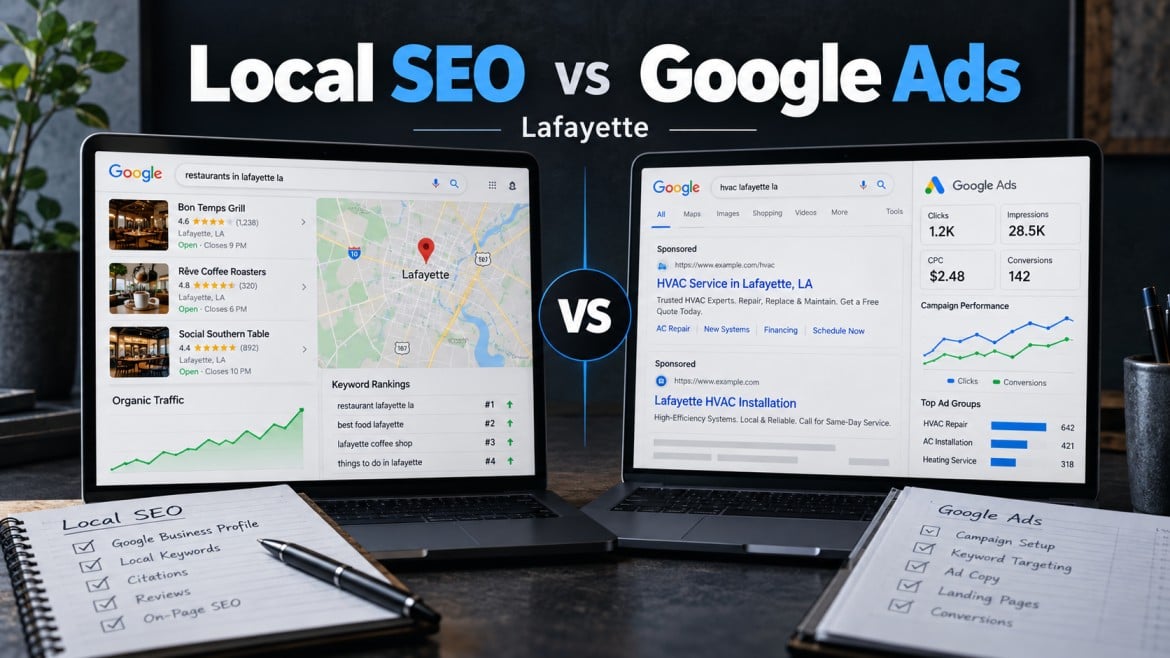
Neither channel wins for every Lafayette business. Google Ads buys visibility today and bills you for every click or lead. Local SEO costs a fixed monthly fee and builds visibility that keeps working after the invoice is paid, but it usually takes three to six months to move. If you need customers this quarter, ads are usually the faster route. If you can wait, and your category has steady local search demand, local SEO can build value that lasts. Neither channel guarantees a lower cost per customer.
Both put your business in front of someone searching in Lafayette. One earns the placement, the other rents it. That single difference drives almost every other comparison in this guide.
Local SEO is the work of making your business eligible to appear in unpaid results when someone searches with local intent, such as “plumber near me” or “dentist in Lafayette.” It covers two surfaces: the map pack that sits near the top of the page, and the regular organic results below it.
The work splits into a few recurring parts. Your Google Business Profile needs correct categories, service areas, hours, and photos. Your website needs service pages that state clearly what you do and where you do it. Your business details need to match across directories. And reviews need a steady process rather than an occasional push.
Google says local results are based mainly on three things: relevance, distance, and prominence. Relevance is how well your profile matches the search. Distance is how far you are from the searcher or the place they named. Prominence is how well known your business is, which Google ties to links, articles, directories, and your review count and score.
Two points matter commercially. Distance is largely fixed by your address, so no budget overrides it. And Google states there is no way to request or pay for a better local ranking.
Google Ads is an auction. You choose the searches you want to appear for, set a budget, and compete for a labeled ad slot above or below the organic results. You pay when someone clicks, not when your ad is shown.
What you pay per click is not simply your bid. Google weighs bid alongside ad quality and expected relevance, so a well-built campaign with tight keyword, ad, and landing page alignment often pays less per click than a sloppier competitor bidding more.
For local service categories, there is a second format, Local Services Ads, which sits above standard search ads and bills per lead rather than per click. It requires verification instead of keyword research, and it works differently enough that it gets its own section below.
The practical appeal is control and speed. You pick the searches, the service areas, the hours, and the daily spend, and you can be visible the same day. The practical limit is equally simple: visibility stops when the budget does.
| Local SEO | Google Ads | |
| How you appear | Earned placement in the map pack and organic results | Paid, labeled placement above or below organic results |
| What you pay for | A monthly fee for work, not for placement | Each click, or each lead with Local Services Ads |
| Time to first results | Typically 3–6 months for clear movement | Days |
| What happens when you stop | Pages and profile stay live; rankings can erode over time | New impressions stop |
| Control over targeting | Indirect; distance and prominence constrain you | Direct; you set keywords, radius, hours, and budget |
| Cost behavior as you grow | Fee is broadly fixed; more traffic does not cost more | Cost scales with every click |
| Attribution | Harder; mixes branded and non-branded demand | Clean, click-level reporting in the platform |
The table is a summary, not a verdict. The sections that follow explain where each line bends for particular business types.
The summary table gives you the shape. These six differences are where the money actually goes.
Paid results carry a label and sit in reserved slots. Google states that ads appear only at the top or bottom of the page and never inside the organic results themselves. Organic and map results are assigned by the ranking systems, and no payment moves them.
The placement difference is visual, and it matters on a phone. On a mobile search for a local service, a searcher may scroll past ads, a map pack, and a few organic listings before reaching the rest of the page. Winning one slot is not the same as owning the screen.
It also changes what you can target. Ads let you appear for a search even when your website has nothing to say about it. Local SEO requires a page that genuinely covers the topic, which is slower but produces an asset you keep.
Ads are the faster of the two for visibility. A campaign approved today can show impressions today. Inquiries are a separate question and arrive on no guaranteed schedule, and cost-per-lead figures only mean something once you have enough conversions to judge them.
Local SEO works on a different clock. Plan on three to six months for the first clear movement and six to twelve months for results worth calling meaningful. Some pieces move sooner. Fixing a wrong business category, correcting an address, or clearing an indexing problem can change visibility within weeks.
These are estimates, not promises. The timeline depends on your category’s competition, the condition of your website, and how fast recommendations actually get implemented. A provider who attaches a guaranteed date and position to that estimate is telling you something about their methods rather than about your market.
SEO is billed as a fee for work. Whether that work produces ten visits or ten thousand, the invoice is the same. Costs rise when you expand scope, not when you expand traffic.
Ads are billed as a unit cost. More visibility means more spend, every month, in direct proportion. That is a feature when a lead is profitable and a problem when it is not, because the meter does not slow down while you figure out which it is.
There is a timing difference too. Most of an SEO retainer’s heavy lifting happens early, and the return arrives late. With ads, cost and return arrive together. For a business watching cash flow closely, that symmetry is worth real money.
Google Ads gives you more direct control over geography. You can target Lafayette, exclude places you do not serve, and limit ads to your business hours. The controls are less simple than drawing a circle, though. Google’s location settings can include people who have shown interest in a place as well as people physically there, and bid changes by town do not behave the same way under automated bidding.
Local SEO gives you less direct control. Distance is one of the three main local ranking factors, and your address is what it is. A business on the south side of Lafayette will usually have a harder time appearing for searches made in Carencro, whatever the budget.
The workaround is not to spend more on the map pack. It is to compete in local organic results with pages that genuinely serve those markets, and to build the prominence signals Google describes through reviews, links, and local coverage. Copying one service page for every town and swapping the city name tends to produce thin pages that do not rank.
This is the clearest practical difference between the two. Pause your ads and new impressions stop that day, though inquiries already in your pipeline may still close. Pause your SEO retainer and your pages, profile, and reviews stay exactly where they are.
That is not the same as permanence. Rankings erode when competitors keep publishing, when a core update changes what the ranking systems reward, or when a profile goes stale. Treat SEO as an asset that depreciates slowly rather than one that holds its value on its own.
On paper, the cost structures differ in SEO’s favor over several years, since a page that ranks carries no cost per visit while a click costs the same in year three as it did in month one. That advantage only materializes if the rankings hold and the pages keep attracting searches that matter. Paid campaigns can also grow more efficient over time as targeting, landing pages, and conversion rates improve.
Claims about organic leads being inherently better than paid leads are mostly folklore, and the honest answer is that it depends on the search.
What is measurable is intent. A searcher typing “emergency ac repair lafayette” at 9 p.m. has the same intent whether they land on an ad or a map listing. What differs is which businesses can appear. The map pack favors proximity and reviews. The ad auction favors whoever is willing to pay and has built a relevant campaign.
For conversion, the stronger variable is usually what happens after the click. Reviews influence whether someone calls you rather than the listing above you, and they also feed the prominence signal Google uses for local ranking. A page that loads slowly or buries the phone number wastes expensive clicks and earned rankings at exactly the same rate.
Most of the confusion between these channels comes from the results page itself, where earned and paid placements sit inches apart and look increasingly similar.
The local pack is the block of three business listings with a map that appears for searches with local intent. For a phone search, it is frequently the first thing a customer sees and acts on, because it carries a call button and a directions link.
What gets you in is relevance, distance, and prominence. In practice, that means an accurate, complete Business Profile in the right primary category, a website that supports the same services, correct details across directories, and a review profile that keeps growing.
Reviews deserve particular attention because they do two jobs at once. Google states that review count and review score factor into local ranking, and reviews are also what a customer compares before choosing between the three listings in front of them.
Ads are not confined to the main search page. Google supports search ads on Google Maps, which can appear as promoted pins, square rather than round, or within Maps search results.
A few details matter before you plan around this. Maps is a serving surface for several campaign types rather than a standalone Maps product. Google currently lists Demand Gen, Performance Max, Smart Search, and Search with location assets. Location assets have to be enabled on the account, and Google notes you cannot serve ads exclusively in Google Maps.
Appearing there is not guaranteed either. It depends on your campaign type, your settings, and the auction. A sponsored Maps placement is also not the same as ranking in Maps. It does not buy a better organic map-pack position, and it disappears when the campaign pauses, so it sits alongside a strong Business Profile rather than replacing one.
Local Services Ads are a separate format for service businesses such as plumbers, electricians, HVAC contractors, lawyers, and cleaners. They appear near the top of search results, usually above standard text ads. Not every business can use them. Eligibility depends on your service category and location, and you have to pass Google’s verification, which can include license and insurance checks.
The difference buyers care about is billing. Standard search ads charge per click, so you pay whether or not the visitor contacts you. Local Services Ads charge per valid lead instead, so someone who taps the ad and leaves costs nothing. You set an average weekly budget, and spending is capped at a monthly maximum. Bidding options include automated maximize-leads, a target cost per lead, and a manual cap per lead.
What counts as a chargeable lead is defined fairly tightly. Google lists answered calls, missed calls during business hours where the caller stays on the line more than 20 seconds, text or email messages, voicemails, and booking requests, which are available in the United States and Canada only. Google publishes no lead prices. They vary by location, job type, lead type, and bidding mode. Message leads are typically priced lower than the matching phone lead, though Google says that is not always the case.
Credits exist, but they are not a guarantee. Google reassesses charged leads for about 30 days and may automatically credit ones it judges poor quality, duplicate, or invalid, and you can report bad leads through a feedback survey. Those credits are not available for health care verticals, tax specialists, or accounts in Europe. Keep in mind too that a chargeable lead is a contact, not a qualified sales opportunity, so compare the per-lead price against what a job is worth and how often you actually close.
Yes, and for many local businesses that is the normal state. A single search can show your Local Services Ad, your text ad, your map listing, and your website in the organic results.
What that overlap does not do is help your rankings. Google is explicit that running online ads has no impact on where your website appears in organic results, and that there is no way to request or pay for a better local ranking. Any lift you see is attributable to the extra visibility itself, not to a ranking benefit.
The real overlap question is commercial. If you already rank first in the map pack for a term, the ad above it may be buying clicks you would have received anyway. The gap has a name: incrementality, meaning the conversions that would not have happened without the ads. It is worth investigating, but pausing an ad group and comparing before and after rarely settles it, because seasonality, competitor activity, promotions, and attribution gaps all move the numbers at the same time. A carefully designed test, run long enough to collect real data, gives a more reliable answer.
No verified data exists on what Lafayette businesses actually spend on either channel. What does exist is provider-reported survey pricing, a few published agency rate cards, and platform benchmarks drawn from live campaigns. Each is useful. None of them is a local average, and anyone presenting one as such is guessing.
The most widely cited benchmark comes from Ahrefs, which polled 439 SEO service providers for its SEO pricing study. It reports local SEO averaging $1,557 per month, against $2,917 for SEO overall. The most common retainer band is 501–1,000, reported by 20.4% of respondents, and 78.2% bill as a monthly retainer. The average hourly rate is $111, with 75–100 the most common band for local work.
Two caveats travel with those figures. They are prices providers say they charge, not prices buyers report paying, and the sample is global rather than Louisiana-specific.
Published local rate cards give a second reference point. Some agencies marketing to Lafayette post tiers running from roughly $750 a month at entry level to $5,000 for competitive campaigns, with one-time setup fees between $500 and $2,000 attached to each tier. Those are one firm’s advertised prices, not a market rate.
For a full breakdown of what each budget band tends to include and how setup fees change a first-year total, see the detailed SEO cost guide for Lafayette. The short version for this comparison: a credible local campaign in Lafayette usually starts in the low four figures per month, and a quote well under that is buying maintenance rather than momentum.
Google Ads has no monthly price. Your cost is whatever your clicks cost multiplied by how many you buy, plus management if someone runs it for you.
The clearest available benchmark is LocaliQ’s 2026 search advertising benchmarks, based on 13,474 US search campaigns running from April 2025 through March 2026. The figures are medians across Google and Microsoft Ads, not Google-only averages, and they are national rather than Lafayette-specific.
| Business category | Median CPC | Median cost per lead |
| Home & Home Improvement | $8.33 | $90.92 |
| Attorneys & Legal Services | $9.87 | $131.63 |
| Dentists & Dental Services | $8.00 | $72.97 |
| Personal Services | $7.17 | $54.60 |
| Physicians & Surgeons | $4.76 | $40.04 |
| Beauty & Personal Care | $4.62 | $39.25 |
| Restaurants & Food | $2.05 | $30.57 |
| Real Estate | $3.22 | $102.51 |
| All industries | $5.42 | $66.69 |
Source: LocaliQ/WordStream 2026 benchmarks. Medians across US Google and Microsoft Ads search campaigns, April 2025 to March 2026.
Read the spread rather than the headline number. A restaurant and a law firm are not in the same business when it comes to ads: the same $1,000 buys roughly 487 clicks in one category and 101 in the other. Lafayette’s auctions may run cheaper than national medians in some categories and dearer in others, so treat these as a planning starting point and check your own numbers in Keyword Planner.
One encouraging note from that report: cost per lead fell year over year for the first time since before 2020, and conversion rate improved in 87% of industries.
The drivers overlap more than most comparisons admit, because both channels are priced by competition.
What moves SEO cost:
What moves ad cost:
The one factor people underestimate on both sides is the website. SEO sends someone to a page, ads buy a click to a page, and in both cases the page decides whether the phone rings. How web design and SEO work together is where a large share of both budgets quietly leaks.
Neither channel guarantees a better return. Local SEO can compound, because visibility you have already earned does not bill you per visit, but organic cost per customer does not always fall and rankings are never guaranteed. Ads can also become more efficient as targeting, landing pages, and conversion rates improve. Your own numbers decide it: customer value, gross margin, close rate, search demand, competition, and how long you can wait.
Ads often win on measured return in the first year, simply because the return exists in year one. An SEO retainer paid for twelve months before visibility arrives has a worse first-year number than a campaign that generated leads in week two, even when the three-year picture reverses.
Two situations are worth flagging. If a customer is worth only a few hundred dollars and your category’s clicks run high, ads can be hard to scale profitably, though your close rate and repeat business matter as much as the click price. And if your address sits outside the area most of your customers search from, map-pack visibility will stay limited however long you invest, which pushes the answer toward ads and local organic pages rather than the map pack.
Most businesses that cannot decide between these channels are missing the measurement that would decide it for them. Set this up before you spend, not after.
Cost per lead is channel spend divided by inquiries. Customer acquisition cost is channel spend divided by customers won. The gap between them is your close rate, and it is where most channel comparisons go wrong.
A hypothetical example makes the point. Say ads deliver 20 inquiries at $75 each, so $1,500 spent at a $75 cost per lead. Say a $1,500 SEO retainer delivers 12 inquiries, a $125 cost per lead. Ads look better until you add close rates. At a hypothetical 15% close rate, the ads model out to 3 expected customers and a modeled acquisition cost of $500. At a hypothetical 30% close rate, the retainer models out to 3.6 expected customers at about $417 each.
Expected customers is a modeled figure, not a headcount, so 3.6 describes the math rather than three and a half people. These numbers are illustrative, not results from Sites N Apps or any client, and your own close rates may run the other way entirely. The point is that cost per lead alone cannot rank two channels, and acquisition cost can.
Local businesses are measured badly because most inquiries arrive by phone, and phones are the hardest thing to attribute. A workable setup has four parts:
Without the first item, you will systematically underreport local SEO, because map-pack calls often never reach your site. That measurement gap, not performance, is why some businesses conclude SEO is not working.
Volume is the easiest thing to measure and the least useful on its own. Score inquiries by whether they match the work you actually want.
Three tags cover most of it: is the caller inside your service area, are they asking about a service you offer at a value you want, and are they ready now or researching? Tag a month of inquiries this way for each channel, and the comparison usually answers itself.
This is where ads tend to reveal their weaknesses fastest. Broad keyword matching can buy clicks from people seeking a different service, a different price point, or a different town. The same audit on organic inquiries often surfaces a different problem: pages attracting research traffic that is months away from buying.
These two need different reporting periods. Ads can often be judged in weeks, because the feedback loop is short. That still depends on having enough conversions for the numbers to mean anything.
Local SEO needs a longer window and different leading indicators. Watch impressions and ranked queries in Search Console, map pack position for your main service and town combinations, and Business Profile actions. Those move before inquiries do, which is what makes them useful at month three when nothing has converted yet.
Be careful about one common distortion. Branded searches — people typing your business name — will show up in your organic numbers and inflate apparent SEO performance. Separate branded from non-branded queries before you judge the retainer, and compare like for like against your ad data.
The answer changes with the category, because job value, urgency, and auction price change with it. Here is how the decision usually breaks down for the business types common across Lafayette and Acadiana.
Home services sit in the most expensive tier of the ad auction. Home and Home Improvement carried a median cost per click of $8.33 and a median cost per lead of $90.92 in the 2026 LocaliQ benchmarks, up from $7.85 per click the year before.
That cost is defensible when a job is worth thousands — a replacement system, a roof, a remodel. It is hard to justify for vague searches or low-value repair calls, which is where undisciplined campaigns lose money fastest.
For many Lafayette home-service businesses, the sensible shape is both, weighted by job value. Local Services Ads or tightly targeted search ads for the high-value, high-urgency work, and local SEO building the map pack position and service pages that eventually reduce how much of that work you have to buy. Replacement and installation terms often justify ad spend. Routine maintenance often does not, though your close rate and repeat business can change that.
For many restaurants, local SEO is the stronger first investment. Discovery happens in Maps, the decision is driven by photos and reviews, and the customer is often standing nearby with their phone out.
The ad economics support the same conclusion from the other direction. Restaurants and Food showed the second-lowest median cost per click at $2.05 and a $30.57 median cost per lead, but a restaurant’s average ticket is small enough that even cheap clicks add up against a thin margin.
Retail sits between the two. A store with inventory to move can make paid formats work for specific products and seasonal pushes, while the Business Profile and reviews carry the day-to-day discovery. For either, an incomplete profile with old hours and three photos costs more customers than any ad budget will win back.
Many healthcare practices have the patient volume and the time horizon to make SEO worthwhile. Trust is built through reviews, clear service pages, and consistent information, and those assets keep working between campaigns.
The ad numbers differ sharply by specialty. Dentists carried a median $8.00 cost per click against a $72.97 cost per lead, while Physicians and Surgeons ran $4.76 and $40.04. A dental practice needs a clearer view of patient lifetime value before scaling ads than a general practice does.
Professional services face the hardest arithmetic in the auction. Attorneys and Legal Services was the most expensive category measured, at a $9.87 median cost per click and a $131.63 median cost per lead. For a Lafayette firm, that usually argues for ads aimed narrowly at the highest-value practice areas, with local SEO and content carrying the broader visibility. The same logic applies to accountants, consultants, and agencies, where Business Services showed a $5.87 median click and a $93.69 median lead. Healthcare and legal advertisers also face category restrictions, and some formats require verification, which affects what you can say and which ad types you can run.
Emergency work is often the clearest case for paid placement. When someone searches for emergency plumbing at 11 p.m., they call one of the first options they see, and being third in the map pack may mean not being called at all.
Ads let you own that moment in ways SEO cannot match on demand. You can bid only during the hours you take emergency calls, raise bids overnight and on weekends, and appear for urgency terms your website may never rank for.
Local SEO still matters here, for two reasons. Reviews decide which of the visible options gets the call, and a strong map presence means you capture some of that demand without paying for it. The strongest position in an emergency category is usually to hold both at once and accept that you are paying twice for the hours that matter most.
If the previous section did not settle it, these four scenarios usually do. The deciding variable is rarely preference. It is how long you can wait and how much you can commit.
Lead with SEO when you can fund the work long enough to judge it fairly, your customers search in ways that trigger the map pack, and a customer is worth more than a few hundred dollars.
It can also be the better choice when paid leads look expensive relative to what a job is worth. Cost per lead alone does not settle that. What matters is customer acquisition cost, which is cost per lead divided by your lead-to-customer close rate. Take a hypothetical case: $90 leads closing at 30% model out to $300 per customer, which would consume a $300 contribution per job before any other cost. At a 60% close rate the same leads model to $150, and the decision flips. Run your own numbers before concluding either way.
One precondition is worth stating plainly: if your website is slow, unclear about what you do, or hard to use on a phone, fix that first. A retainer spent working around a weak website is the most common way local SEO budgets get wasted.
Lead with ads when you need inquiries this quarter rather than next year. That covers a new location, a seasonal push, a slow month you need to fill, a new service nobody knows you offer, and any situation where cash flow cannot wait two or three quarters.
Ads are also the right tool for testing. Before committing to a year of content aimed at a service line, running it in the auction for a month tells you whether local demand exists and what those inquiries are worth. That is cheaper than finding out through twelve months of SEO.
And when your address works against you — your customers are in Broussard and Youngsville but you are not — ads let you reach markets the map pack will not hand you.
The combined approach is common for a reason. Ads cover the gap while SEO builds, then you taper ad spend in the categories where organic visibility has arrived, and keep it in the categories where it has not.
That tapering is the part most businesses skip. The point of running both is not permanent duplication. It is to reduce how much of your demand you have to rent, service line by service line, as pages and rankings take hold.
There is a practical warning attached. Running both badly is worse than running one well. Two half-funded channels produce a thin campaign and a thin retainer, and neither gets enough budget to clear the bar in a competitive category.
Budget shapes what is realistic, but the amount by itself does not decide the split. There is no standard Lafayette spending bracket to copy. Work through your own figures instead:
Those answers usually settle it. If what you can afford to pay per customer sits below what your category’s leads cost, ads will struggle however much you spend. If you cannot wait six months, SEO alone will not fill the gap. A smaller budget does not automatically mean one channel only, since a few focused organic improvements alongside a tightly controlled campaign can work. A larger budget does not automatically justify funding both.
Goals shift the weighting. A business planning to sell in two years may favor ads, since much of SEO’s value arrives after the sale. A business planning to grow for a decade may favor SEO, provided the category has steady local demand, and it can sustain the work.
Every honest comparison has to name the downsides. Here is what each channel is genuinely good at, and where it reliably disappoints.
What it does well:
Where it falls short:
What it does well:
Where it falls short:
The expensive errors are the same for both channels, which is why some businesses conclude that neither works.
If you have decided to run both, or to start with one and add the other, this is the order the work usually goes in.
Start with the searches that precede a purchase, not the ones that describe your industry. “AC repair lafayette” and “how does an AC unit work” are both relevant to an HVAC business, and only one of them is worth bidding on.
Sort your main terms into three buckets: ready to buy, comparing options, and researching. Ready-to-buy terms are usually where ad spend earns its keep, though not all of them will be affordable in your category. Comparison terms often suit service pages. Research terms often suit content, where they cost nothing per visit. Prioritize by commercial value and competition, not by bucket alone.
Then check who currently ranks and who is currently advertising for your top terms. Search them yourself from a phone in Lafayette. That five-minute exercise tells you more about what you are up against than any tool’s difficulty score.
Be honest about where you actually work. Paying to appear in towns you rarely serve produces inquiries you cannot convert, and it is one of the most common sources of waste in both channels.
The two channels handle geography differently, so plan them differently:
Adding markets adds cost in both channels. It does not mean every town needs its own page. One well-built service-area page often works better than six thin ones.
This is the foundation, and it benefits both channels because your profile also feeds some ad formats.
The profile work: correct primary category, accurate service areas and hours, complete services list, current photos, and a steady, honest review process with replies. The listing work: consistent business name, address, and phone across the directories that matter.
The website work matters just as much. One “Our Services” page listing eight things vaguely tends to lose to a page built around one service in real detail. Splitting and rewriting those pages is normally the first thing that moves, and it makes ad landing pages better at the same time.
Build the campaign around the terms from your first bucket, grouped tightly so each ad group has its own ads and its own landing page. Alignment between keyword, ad, and page affects what you pay as well as how you convert.
Negative keywords matter in most keyword-based campaigns. Add the obvious ones before launch — “free,” “jobs,” “salary,” “diy,” competitor names you do not want to bid against — then review the search terms report regularly, especially in the first few weeks.
If you run a licensed home service or legal practice, evaluate Local Services Ads alongside standard search ads. Paying per valid lead instead of per click changes the risk profile substantially in categories where clicks run above $8.
Allocate based on business economics and measurable opportunity, not an arbitrary percentage. A workable starting point for a business running both:
If the remainder cannot fund the second channel properly, do not start it. One channel funded to a competitive level beats two that are not.
Set up measurement before launch, because retrofitting attribution to a campaign already running is painful and the early data is lost.
Review on two clocks. Ads get a monthly review of search terms, cost per lead, and which ad groups produce inquiries worth having. SEO gets a monthly check of impressions, rankings, and profile actions, with a serious performance review at month six.
The decision rule is simple. Scale up what produces customers at an acceptable acquisition cost. Narrow the target rather than thinning the work when the budget cannot keep up. And if six months pass with no movement in impressions, rankings, or inquiries and no clear explanation why, change something — usually the approach, sometimes the provider.
No. Google states it costs nothing to appear in organic results, but the work that gets you there is not free. You pay for time — your own, a freelancer’s, or an agency’s. The difference is that you pay for work rather than for each visit, so the cost does not rise with traffic.
Plan on three to six months for the first clear movement and six to twelve months for meaningful results. Profile corrections and technical fixes can show within weeks. Competitive commercial terms take longer. These are estimates based on normal conditions, not promises, and your category’s competition is the biggest variable.
A campaign can show impressions the day it is approved, but inquiries follow no guaranteed timetable. How fast they arrive depends on your budget, category, targeting, and landing page. Judging cost per lead takes enough conversions to be meaningful, which is usually a matter of weeks rather than days.
It depends on the business, not on the channel. Local SEO tends to suit businesses that can wait and operate where clicks are expensive relative to job value. Ads tend to suit businesses that need customers now, are testing a new service, or whose address limits their map-pack reach. Neither guarantees a lower cost per customer.
No. Google states that running online ads has no impact on where your website appears in organic search results, and that ads appear only above or below organic results, never within them. Any benefit from running both comes from the additional visibility itself, not from a ranking advantage.
Ads can place you in Maps, but they do not improve your organic map ranking. Google supports search ads on Maps as promoted pins and in Maps results, which run through your search campaigns. Google also states there is no way to request or pay for a better local ranking.
Yes, and many local businesses do. A single search can show your ad, your map listing, and your website at once. The practical caution is funding: two underfunded channels usually perform worse than one funded properly, so only split a budget that can support both at a competitive level.
There is no verified Lafayette average. Survey data puts local SEO providers at $1,557 a month on average, and ad spend depends entirely on your category’s click costs. A practical approach is to work backward: calculate what a customer is worth, decide what you can pay to acquire one, and set budgets from there.
There is no single winner here. Local SEO can offer strong long-term value for a Lafayette business with steady local search demand and the resources to keep investing. Google Ads can be the better choice for faster visibility, for testing a new service, or for reaching customers beyond your organic map reach. Neither guarantees a lower cost per customer. The right answer depends on your goals, margins, competition, time horizon, and measured results.
Three questions settle it faster than any comparison table. How long can you wait before this has to produce customers? What do leads cost in your category, and can your job value and close rate carry that? And is your website good enough that either channel’s traffic will convert when it arrives?
That last question decides more outcomes than the channel choice does. Both channels deliver a person to a page, and the page decides whether they call. A slow, unclear site wastes an $8 click and a hard-won map-pack position at exactly the same rate, which is why fixing the website usually belongs before either investment rather than after.
If you are weighing this decision for your own business, Sites N Apps is based in Lafayette and works with businesses across Acadiana on websites, local SEO, and search visibility. The team advertises a free website and SEO audit, which is a practical way to see where your site and Google Business Profile currently stand before you commit a budget to either channel. Contact Sites N Apps or call 337-270-2888 to start that conversation.
Struggling to compete for high-search-volume keywords? We help businesses like yours increase visibility, drive more traffic, and dominate competitive search terms—all while keeping your costs low. Our proven strategies focus on long-term growth and measurable results.