Home / Blog Details
Take your digital marketing to the next level with data-driven strategies and innovative solutions. Let’s create something amazing together!
From Google search results to AI chatbots, we optimize your website so customers can find you faster — and choose you over competitors.
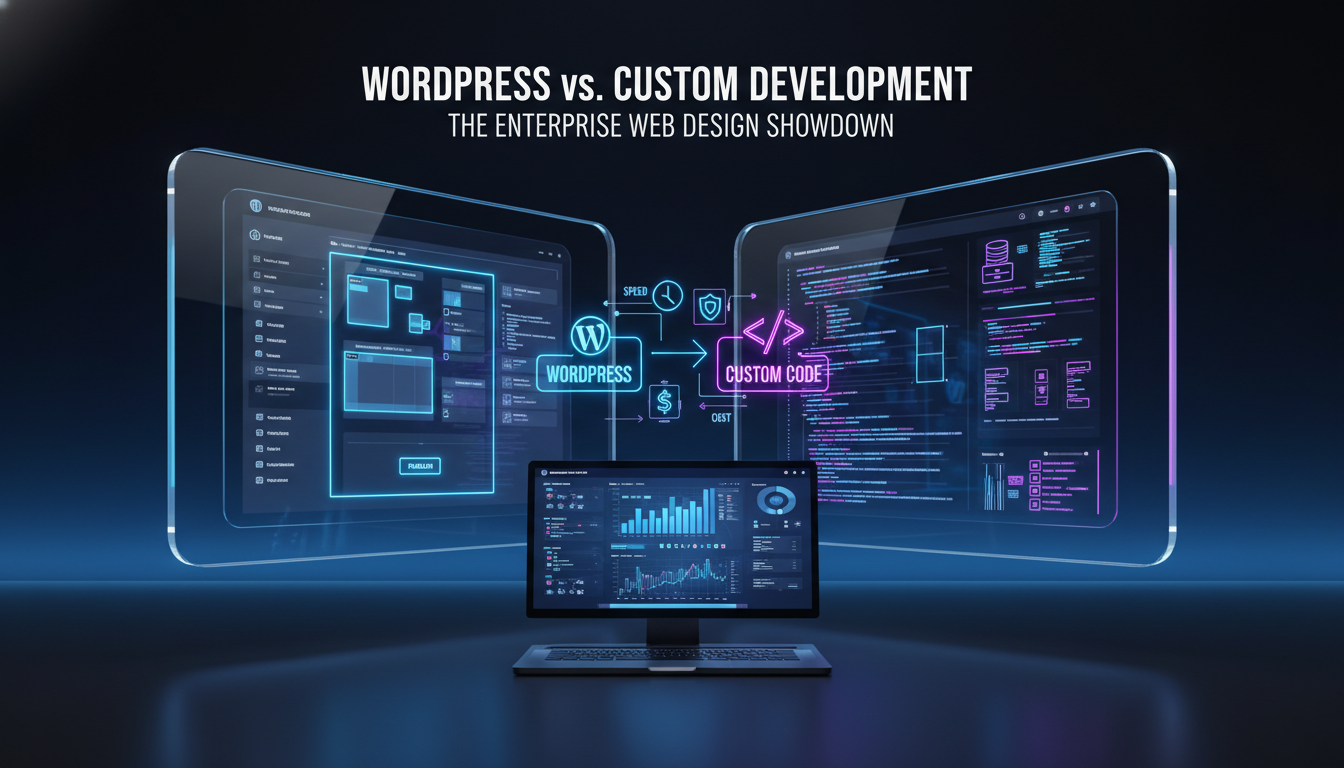
WordPress is a flexible, cost-effective platform suited for most small and mid-sized businesses. A custom website offers greater performance, scalability, and design freedom, but costs more upfront. The right choice depends on your budget, goals, required features, and how much long-term growth you expect from your online presence.
Key Takeaways
If you have ever tried to compare website options for your business, you have probably run into a wall of confusing terms. WordPress, custom development, CMS, frameworks, templates. What does any of it actually mean for a Lafayette business owner trying to get more customers online?
The distinction matters more than most people realize.
WordPress is an open-source content management system (CMS). A CMS is software that lets you build, manage, and update a website without writing code from scratch.
You install WordPress on a hosting server, choose a theme (a pre-designed visual template), and extend its functionality with plugins. Plugins are add-ons that do specific jobs, from contact forms to SEO tools to e-commerce checkouts.
WordPress currently powers over 43% of all websites on the internet, according to W3Techs. That massive adoption means a huge ecosystem of developers, themes, and tools built specifically for it.
A custom website starts with a blank canvas. Developers write the code from the ground up, typically using languages like HTML, CSS, JavaScript, PHP, or Python, depending on what the site needs to do.
Nothing is borrowed from a pre-built template. Every visual element, every function, and every database structure is designed specifically for your business.
This takes more time and expertise. But it also means no unnecessary code, no plugin dependencies, and no design compromises.
Many business owners confuse these two, and it creates real problems.
WordPress.org is the self-hosted version. You download the software, host it on your own server, and have full control over everything. This is what web design agencies use when they build WordPress sites for clients.
WordPress.com is a hosted service run by Automattic. It is easier to start, but it limits what you can do. You cannot install arbitrary plugins on lower-tier plans, and you share infrastructure with millions of other sites.
For any serious business website, WordPress.org is the correct choice.
WordPress is not the only CMS available. Shopify handles e-commerce. Webflow offers visual design flexibility. Drupal suits large enterprise content operations.
Custom frameworks, on the other hand, are built using programming tools like Laravel (PHP), Django (Python), or Next.js (JavaScript). They give developers complete control over how the application behaves, connects to external systems, and scales under load.
The key difference: a CMS shapes what you build around what it supports. A custom framework builds whatever you need, period.
A WordPress theme is a template. Even heavily customized themes still inherit structural decisions made by the original theme author: how pages load, how images are handled, how the navigation works on mobile.
Fully custom development makes none of those compromises. Every pixel, every interaction, and every database query is intentional.
That distinction becomes critical when your business has specific design requirements, complex workflows, or a brand that cannot afford to look like thousands of other websites using the same theme.
Before choosing a platform, you need to understand what your website actually has to do. A restaurant in Lafayette has very different requirements from an HVAC company or a law firm.
Most Lafayette service businesses need one thing above everything else: leads. Phone calls, form submissions, and appointment bookings.
A website that does not generate leads is an expense, not an investment. To generate leads, your site needs to rank on Google for searches your customers are already making, load quickly on mobile, and make it easy for visitors to contact you.
Local SEO, specifically optimizing for searches like “HVAC company Lafayette LA” or “personal injury attorney near me,” depends heavily on how your website is built and structured.
According to Google, more than 60% of local searches happen on mobile devices. If your website loads slowly or looks broken on a phone, you are losing customers before they ever call you.
Both WordPress and custom websites can be built to perform well on mobile. The difference is in how carefully that work gets done and who is doing it.
Most local service businesses need:
WordPress handles all of these reasonably well. So does a custom website. The platform matters less than the strategy and execution behind it.
Here is a scenario that plays out constantly. A local business gets a cheap WordPress website built for $500 by a freelancer. The site looks fine at first, but two years later, it is running 30 plugins, takes four seconds to load, and has been hacked twice. Fixing it costs more than building a better site from the start.
Choosing the wrong platform for your needs is not just a technical mistake. It is a business mistake that compounds over time.
| Factor | WordPress | Custom Website |
| Initial Build Cost | $1,500–$15,000 | $8,000–$75,000+ |
| Monthly Hosting | $20–$100 | $50–$300+ |
| Plugin/Tool Costs | $500–$2,000/year | Minimal |
| Maintenance | $100–$500/month | $200–$1,000/month |
| Long-Term Total (3 years) | $10,000–$35,000 | $20,000–$100,000+ |
WordPress sites can launch in two to eight weeks, depending on complexity. Custom websites typically take three to six months for a standard project, and longer for complex platforms.
WordPress wins here. Its dashboard is designed for non-technical users, and most business owners can update pages, publish blog posts, and manage media without developer help.
Custom websites require either a built-in admin panel (which adds development time) or ongoing developer support for content changes.
Both platforms can rank well on Google. WordPress with a well-configured SEO plugin like Rank Math or Yoast gives you solid control over on-page SEO elements.
Custom websites can be more precisely optimized, especially for Core Web Vitals (Google’s performance ranking signals), because there is no plugin overhead slowing things down.
Page speed is a confirmed Google ranking factor. WordPress sites can achieve good scores with proper optimization, but they require ongoing effort to prevent plugin bloat from degrading performance.
Custom websites typically load faster out of the box because they carry only the code they need.
WordPress scales reasonably well for content-heavy sites and small e-commerce. For complex applications, membership platforms, or high-traffic portals, it starts to show limitations.
Custom development scales as far as your infrastructure and budget allow.
WordPress sites are attacked more frequently because they are a known, widely deployed target. Keeping themes, plugins, and core files updated is a non-negotiable maintenance task.
Custom sites are less frequently targeted by automated attacks, but they still require regular security reviews.
| Business Type | Recommended Platform |
| Local service business (basic) | WordPress |
| Law firm or medical practice | WordPress or Custom |
| E-commerce (small/mid) | Shopify or WordPress (WooCommerce) |
| E-commerce (large/complex) | Custom or Headless |
| SaaS or web application | Custom |
| Restaurant | WordPress |
| Enterprise with complex needs | Custom |
WordPress exists at the center of the largest web publishing ecosystem in the world. Thousands of themes, tens of thousands of plugins, and a massive global developer community mean that almost any feature you can imagine already has a solution ready to install.
If you need a professional website live within a few weeks, WordPress is your fastest path. A skilled developer can build a polished, functional site in two to four weeks. That speed matters when your business needs an online presence now, not in six months.
Need a booking system? There is a plugin. Need live chat? There is a plugin. Need to accept payments, run a membership program, or display property listings? Plugins exist for all of it.
This flexibility means you can add features without custom development time, which keeps costs down significantly.
WordPress started as a blogging platform, and it still excels at content management. If your marketing strategy involves regular blog posts, resource guides, or case studies, WordPress gives you an intuitive workflow for publishing and organizing content.
Content marketing is one of the most effective long-term SEO strategies for local businesses, and WordPress makes it easy to execute.
WordPress is not the right tool for every job. Understanding its limitations helps you make a smarter decision before you commit to a platform.
Every plugin you add introduces more code that your server loads for every page request. A site running 20 or 30 plugins, which is more common than you might think, carries a significant performance penalty.
Slow websites lose visitors. Google penalizes slow pages in search rankings. And the damage is subtle. It compounds quietly over months until you notice your rankings slipping.
WordPress powers 43% of the web, which makes it the most attractive target for automated hacking tools. Outdated plugins and themes are the most common entry points.
According to Sucuri’s annual Website Threat Research Report, WordPress accounted for the majority of infected CMS platforms studied. That is not a reason to avoid WordPress, but it is a reason to take maintenance seriously.
WordPress struggles when you need:
When your business requirements move beyond what plugins can handle, you are either patching WordPress with workarounds (which creates technical debt) or you are building something custom anyway.
A custom website is built to match your brand exactly, not the other way around. No working around a theme’s assumptions about where the header goes or how the navigation collapses on mobile.
For businesses where first impressions are critical, a financial advisory firm, a luxury real estate agency, a premium medical practice, precision matters.
Custom development shines when you need features that do not exist in any plugin. A custom client portal, a proprietary quoting tool, a real-time inventory system tied to your warehouse, and integrations with specialized CRMs or ERP software. These require code written specifically for your business logic.
A custom-built site carries only what it needs. No unused plugin code is executing on every page load. No theme framework overhead. No shared database tables are slowing queries.
The result is faster page load times, better Core Web Vitals scores, and a stronger signal to Google’s ranking algorithm.
Custom code, built and maintained by your development team, does not share the mass-target vulnerability profile that WordPress carries. There are no public plugin changelogs that attackers can study to find exploits before site owners patch them.
That does not mean custom sites are immune to security risks. But the attack surface is smaller and more controlled.
When your business grows, a custom website grows with it. You add features, expand infrastructure, and adapt the architecture without being constrained by platform limitations.
For businesses with serious growth ambitions, that flexibility is worth the higher upfront investment.
Custom development is not cheap, and it is not fast. Expect to invest significantly more than a WordPress build, and to wait months rather than weeks before launch.
For a bootstrapped local business or a startup testing a new idea, the timeline and cost are often prohibitive.
With WordPress, many content updates and small changes are manageable without a developer. With a fully custom site, any structural change requires someone who understands the codebase.
If your developer becomes unavailable, you face a real problem. This makes choosing a reliable, long-term development partner especially important.
A five-page brochure website for a local plumber does not need custom development. A standard WordPress build handles it well, costs less, and launches faster.
Custom development is worth the investment when you have specific requirements that WordPress genuinely cannot meet cleanly, not simply because custom sounds more premium.
The honest answer: both platforms can rank well on Google. SEO success depends more on content quality, site architecture, link authority, and technical optimization than on whether you chose WordPress or a custom build.
That said, each platform has technical characteristics that affect how easily you can implement strong SEO.
WordPress with Rank Math or Yoast gives you solid control over meta titles, meta descriptions, canonical tags, robots directives, and XML sitemaps. For most small businesses, that is sufficient.
Custom websites allow finer control over every technical element, which matters for complex sites with thousands of pages or specific crawling requirements.
Google’s Core Web Vitals, which measure loading speed, interactivity, and visual stability, are confirmed ranking factors. A WordPress site with too many plugins often struggles to pass Core Web Vitals benchmarks without dedicated optimization work.
A well-built custom site typically passes these benchmarks more easily because there is no unnecessary code creating delays.
Schema markup is code that helps Google understand what your content means, not just what it says. Implementing the LocalBusiness schema, the Service schema, the FAQPage schema, and the ReviewSchema makes your site more eligible for rich results in Google Search.
WordPress plugins make schema implementation accessible, but sometimes generate messy or incomplete output. Custom development allows precise, validated schema implementation at the code level.
Google indexes the mobile version of your site first. A poor mobile experience hurts rankings directly.
Both platforms support responsive design. The difference is in execution. A custom site built mobile-first from the ground up will generally deliver a cleaner mobile experience than a WordPress theme retrofitted to behave responsively.
Local SEO requires specific technical elements that both platforms can support, but each handles them differently.
Your Google Business Profile (formerly Google My Business) works independently of your website platform. However, your website supports it by providing consistent NAP (name, address, phone number) information, location-specific landing pages, and strong local content signals.
Service area pages, city-specific landing pages, and neighborhood content help your business appear in searches from people in Lafayette and the surrounding areas. Both WordPress and custom sites support this structure.
Adding the LocalBusiness schema to your homepage and contact page tells Google exactly who you are, where you are located, what hours you operate, and how to reach you. This directly supports local search visibility.
“Near me” searches rely on your Google Business Profile, your website’s local relevance signals, and your overall domain authority. Platform choice matters less here than content quality and consistent local citations.
A WordPress site with 25 plugins is loading 25 separate codebases on every page request. Some of those plugins add JavaScript files, CSS files, and database queries that execute regardless of whether the current page actually uses that plugin’s features.
Lightweight custom code does exactly what it needs to do and nothing else. That efficiency translates directly to page speed.
WordPress stores all content in a MySQL database. For small to mid-sized sites, that works fine. For high-traffic sites or sites with complex queries, database performance can become a bottleneck.
Custom architectures can implement optimized database structures, query caching, and purpose-built data models that eliminate that bottleneck before it becomes a problem.
A content delivery network (CDN) distributes your website’s files across servers around the world, so visitors load content from a server close to them. Both WordPress and custom sites benefit from CDN implementation.
For WordPress, managed hosting providers like WP Engine or Kinsta include CDN and optimization tools that significantly improve performance. Custom sites require CDN configuration as part of the deployment architecture.
A well-optimized WordPress site on quality-managed hosting handles moderate traffic without issues. If your business is featured in a major publication or runs a campaign that drives thousands of concurrent visitors, WordPress sites sometimes struggle without advanced caching and server resources.
Custom sites built with scalability in mind, using load balancing, horizontal scaling, and optimized infrastructure, handle traffic spikes more predictably.
The most common scenario: a business builds a WordPress site, grows significantly, and starts adding features through plugins and workarounds. Eventually, the site becomes slow, fragile, and difficult to maintain. At that point, a full rebuild is less optional than it feels.
Recognizing the ceiling before you hit it allows you to plan a migration strategically rather than reactively.
Headless WordPress uses WordPress as a content management backend while serving the frontend through a modern JavaScript framework like Next.js or Gatsby. This approach delivers WordPress’s content management convenience combined with significantly better front-end performance.
It is a more complex setup and costs more to build, but it is an effective middle ground for businesses that want both CMS flexibility and high performance.
WordPress’s ubiquity makes it attractive to attackers who build automated tools targeting known vulnerabilities. When a plugin vulnerability is disclosed publicly, millions of sites running that plugin become targets simultaneously.
This is not a reason to avoid WordPress. It is a reason to take maintenance seriously.
According to Patchstack’s WordPress Vulnerability Report, the vast majority of WordPress security vulnerabilities originate in plugins and themes, not in WordPress core. In 2023, over 96% of reported vulnerabilities came from third-party plugins and themes.
This matters because many business owners install plugins without monitoring whether those plugins receive regular security updates.
Custom code does not appear in public vulnerability databases. Attackers cannot download your theme and study it for weaknesses before you patch them. The attack surface is limited to what your specific codebase exposes.
This is a meaningful security advantage for businesses handling sensitive client data, financial transactions, or regulated health information.
WordPress sites require regular updates to core software, themes, and plugins. Skipping updates creates compounding vulnerability risk.
Most reputable web design agencies offer WordPress maintenance plans that handle updates, backups, uptime monitoring, and security scanning. If your site does not have one, it should.
Regardless of platform:
A WordPress theme gives you a starting point. A skilled developer can customize it significantly, changing colors, fonts, layouts, and components. But the underlying design logic of the theme still influences the final result.
Fully custom design starts with your brand and builds outward. The layout, typography, spacing, and interactions all reflect decisions made specifically for your business and your audience.
User experience (UX) directly affects how many visitors take action on your website. A confusing navigation, a buried phone number, or a slow-loading form all reduce conversions.
Both platforms support strong conversion-focused design. The difference is that a custom website gives your designer complete freedom to remove every friction point without working around template constraints.
The Americans with Disabilities Act (ADA) applies to websites, and businesses in Louisiana have faced legal action over inaccessible sites. Accessibility requirements include things like screen reader compatibility, sufficient color contrast, and keyboard navigation support.
WordPress themes vary widely in their out-of-the-box accessibility compliance. Custom development allows you to build accessibility in from the beginning rather than retrofit it later.
Because most local searches happen on mobile, your site’s mobile experience is often your first impression. A custom mobile-first design treats the phone layout as primary, not as a shrunken version of the desktop layout.
This distinction shows in how menus work, how forms behave on touch screens, and how fast pages load on cellular connections.
Your website is often the first thing a potential customer looks at before deciding to call you. A professional, fast, well-organized site signals that your business is legitimate and established.
Generic template designs, especially ones visitors recognize from other sites, undermine that trust signal. A distinctive custom design, or a carefully differentiated WordPress build, makes a stronger impression.
Basic WordPress sites for small local businesses start around $1,500 to $5,000 for a professionally built site. Mid-range builds with custom design work, WooCommerce integration, or advanced features typically run $5,000 to $15,000.
Add annual plugin costs ($500 to $2,000), managed hosting ($300 to $1,200 per year), and ongoing maintenance ($100 to $500 per month), and the real cost of a WordPress site is higher than the initial quote suggests.
A custom business website from an experienced development team typically starts around $8,000 to $15,000 for a straightforward marketing site. Complex builds with custom features, API integrations, or large-scale content architectures can reach $30,000 to $75,000 or beyond.
The higher upfront investment reflects the scope of work involved and the long-term value built into the architecture.
WordPress managed hosting on a quality platform like WP Engine or Kinsta runs $30 to $300 per month, depending on your plan. Shared hosting is cheaper but delivers worse performance and less reliability for business sites.
Custom sites often run on VPS or cloud infrastructure (AWS, DigitalOcean, Google Cloud) with costs that scale based on traffic and complexity.
The costs businesses frequently underestimate:
These are not hypothetical. They are predictable costs that accumulate across the life of a WordPress site.
For most small local service businesses, a well-built WordPress site produces solid ROI because the lower initial investment leaves more budget for marketing, advertising, and lead generation.
For businesses with complex needs, high growth ambitions, or specific performance requirements, a custom website pays for itself through better conversion rates, stronger SEO performance, and reduced long-term maintenance friction.
The question is not which platform is objectively better. It is the platform that fits your specific business situation right now and over the next three to five years.
For most small local businesses in Lafayette, a well-built WordPress site is the practical choice. It handles lead generation, local SEO, mobile responsiveness, and content management at a price point that makes financial sense.
Home service businesses need fast-loading sites, clear call-to-action buttons, and strong local SEO. WordPress handles this well, especially with a clean theme and minimal plugins. Companies offering multiple service areas benefit from structured local landing pages, which both platforms support equally.
Law firms benefit from a professional, trustworthy design and strong local search visibility. For most law firms, WordPress works well. Firms with complex intake workflows, client portals, or document management needs may benefit from custom development for those specific components.
Healthcare websites often require HIPAA-compliant contact forms, appointment booking integrations, and strict accessibility standards. WordPress can accommodate all of these with the right implementation, but custom development offers greater control over data handling and compliance architecture.
Restaurants need menus, reservation systems, hours, and photos delivered fast on mobile. WordPress handles this effectively. Most restaurant-specific features are well-served by existing plugins and themes.
Small to mid-sized online stores work well on WooCommerce (WordPress) or Shopify. Large e-commerce operations with complex inventory management, custom pricing rules, or enterprise ERP integrations typically outgrow both platforms and benefit from custom or headless architecture.
Enterprise companies and SaaS products require custom development. The unique feature sets, security requirements, scalability demands, and integration complexity of enterprise platforms are beyond what any general-purpose CMS handles well.
If your business needs a professional online presence within weeks, WordPress is the fastest path. A skilled team can design, build, and launch a complete site in two to four weeks.
WordPress sites cost less to build and less to maintain in the early stages. If your marketing budget is limited, keeping website costs lower frees up money for paid advertising, content creation, and other lead-generation activities.
Contact forms, service pages, a blog, a gallery, and a booking widget. If your requirements are standard, WordPress handles them cleanly. There is no need to invest in custom development for features that already exist as stable, well-supported plugins.
If you want to update your own pages, publish blog posts, or manage media without calling a developer, WordPress is the right platform. Its dashboard is intuitive, and most business owners learn the basics within a few hours.
WordPress’s content management strengths are genuinely excellent. If your SEO strategy depends on publishing regular articles, guides, or resources, WordPress gives you the best workflow for managing that content at scale.
If your business processes require a custom quoting tool, a client-specific portal, automated workflows tied to your internal systems, or features that simply do not exist as plugins, custom development is not optional. It is the only viable path.
Some businesses compete on differentiation. Their website is part of what makes them feel different from every competitor. For those businesses, a generic theme undercuts the brand positioning they are trying to establish.
If your conversion rates are highly sensitive to load time, or if you are operating in a competitive market where slight performance advantages matter, custom development gives you an optimization ceiling that WordPress cannot match.
Building a website with three-year growth in mind is smarter than building the cheapest site today and rebuilding it in 18 months. If your business is on a growth trajectory, a custom architecture absorbs that growth more gracefully.
CRM systems, ERP platforms, industry-specific software, and payment processors with custom logic. When your website needs to talk to complex external systems, custom development handles those integrations more cleanly and reliably than plugin-based workarounds.
Price is important, but it is not the only cost. A $500 freelance WordPress site that generates zero leads has a higher real cost than a $10,000 professionally built site that generates $50,000 in business annually.
Evaluate cost in the context of expected return, not as a standalone number.
The platform that works for your business today may not work for your business in three years. Ask yourself where your business will be in three to five years, and choose a platform that can grow there with you.
Every plugin you add increases complexity, maintenance burden, and potential for performance or security issues. A disciplined approach, using only the plugins you genuinely need and keeping them updated, keeps WordPress performing well.
A cheap developer who builds a technically poor site costs you more in the long run than a skilled team that builds it right the first time. Ask to see prior work, request references, and verify that the team has experience with SEO, performance, and security, not just visual design.
Too many businesses treat SEO as something to add after the site is built. That is backwards. SEO requirements should inform the site architecture, URL structure, page hierarchy, and content strategy from day one.
If you are exploring your options for website platforms and agencies, reviewing a resource like this comparison of website building platforms can help you clarify what different tools actually offer before you commit.
Shopify is a purpose-built e-commerce platform that handles product management, payment processing, inventory, and shipping integrations better than WordPress does out of the box. For businesses selling physical or digital products, Shopify is worth serious consideration alongside WooCommerce.
Webflow gives designers visual control over responsive layouts without writing code, while generating clean HTML and CSS. It is a strong option for businesses that prioritize design quality and want a CMS without WordPress’s plugin complexity.
Headless CMS platforms like Contentful, Sanity, or Strapi manage content as structured data and deliver it via API to any frontend. This architecture supports multi-platform content distribution and delivers excellent performance, but it requires more technical sophistication to implement.
Some agencies build WordPress sites where the core CMS functions are handled by WordPress, but specific complex features (calculators, custom dashboards, interactive tools) are built as standalone applications that integrate with the WordPress environment.
This hybrid approach captures the best of both worlds for the right use case.
A common scenario: a business uses WordPress for their marketing site and blog, but builds a separate custom web application for their client portal or booking system. These two systems connect through APIs, giving the business CMS convenience for public content and full custom power for proprietary functionality.
Start here: what do you need your website to actually do? Generate leads? Sell products? Support existing customers? Publish content? Your goals determine your requirements, and your requirements determine the right platform.
List every feature your website needs: contact forms, scheduling tools, payment processing, live chat, CRM integration, member logins, and custom calculators. Then, determine which features exist as reliable WordPress plugins and which ones would require custom development.
If content marketing is central to your strategy, WordPress’s editorial workflow is a genuine asset. If technical SEO precision and Core Web Vitals performance are priorities, custom development gives you more control.
Both platforms support strong SEO when built correctly. The question is how much optimization effort each approach requires.
A startup testing an idea has different needs than an established business planning to triple its revenue in three years. Choose a platform based on where you expect to be, not just where you are today.
Be realistic about who will maintain your site after launch. If you have no technical team and no budget for ongoing developer support, a well-built WordPress site with a maintenance plan is more manageable than a custom build requiring specialized developer knowledge for every update.
Platform choice matters, but execution matters more. The best platform, built poorly, performs worse than a simpler platform built well.
Working with an experienced local web design team means you get strategic guidance, not just code. The team at SitesnApps understands what Lafayette businesses need from their websites, from local SEO and lead generation to long-term scalability planning.
Choosing between WordPress vs custom website is not a decision with a single right answer. It depends on your budget, your timeline, your required features, your growth expectations, and how much long-term investment you are prepared to make in your online presence.
For most small to mid-sized Lafayette businesses, a professionally built WordPress site is the smart starting point. It launches faster, costs less upfront, and handles the core requirements of local lead generation and SEO effectively.
For businesses with complex needs, unique branding requirements, or serious growth ambitions, a custom website is the better long-term investment. The higher upfront cost pays back through stronger performance, greater flexibility, and a site that grows with you instead of holding you back.
The decision you make today shapes how many customers find you, how many stay on your site, and how many call or book with you. It deserves more than a quick Google search and the cheapest quote you can find.
If you are ready to make the right decision for your business, the team at SitesnApps is here to help. Call us or book a consultation to talk through your goals and find out which solution actually fits your business in 2025.
Yes, WordPress is a legitimate platform for professional business websites. When built correctly with a clean theme, minimal plugins, proper hosting, and SEO optimization, a WordPress site performs well for most local service businesses. The keyword is “built correctly.” A poorly built WordPress site underperforms regardless of platform.
A custom website typically costs $8,000 to $75,000 or more, depending on complexity. A professional WordPress build ranges from $1,500 to $15,000. Both carry ongoing maintenance costs. The gap narrows over three to five years when you factor in WordPress’s plugin, hosting, and maintenance expenses.
Both platforms support strong local SEO when implemented correctly. What matters most is content quality, site speed, accurate NAP data, LocalBusiness schema, and your Google Business Profile. Platform choice is secondary to the quality of your SEO implementation and the authority of your domain.
Yes, but migrating from WordPress to a custom site requires rebuilding rather than simply moving files. Your content (pages, posts, images) can be exported and migrated, but the design and functionality need to be rebuilt entirely. It is faster and less expensive to plan your platform correctly up front than to migrate under pressure later.
Choosing based on the lowest upfront cost without considering the long-term cost of a site that does not perform. A website that fails to generate leads is not an asset. Budget for what you actually need, and evaluate agencies on the results they produce for businesses like yours, not just on their initial quote.
No. WordPress sites rank on Google’s first page across virtually every industry. SEO performance depends on content quality, technical optimization, site speed, link authority, and user experience, not on which CMS manages the content. A well-optimized WordPress site outranks a poorly built custom site every time.
Struggling to compete for high-search-volume keywords? We help businesses like yours increase visibility, drive more traffic, and dominate competitive search terms—all while keeping your costs low. Our proven strategies focus on long-term growth and measurable results.