
Home / Blog Details
Take your digital marketing to the next level with data-driven strategies and innovative solutions. Let’s create something amazing together!
From Google search results to AI chatbots, we optimize your website so customers can find you faster — and choose you over competitors.

A good business website is fast, mobile-friendly, and built around a clear purpose. It has the right pages, content that answers real customer questions, and a design that guides visitors toward action. It also ranks well in search because it is technically sound and locally optimized. Without these pieces, even an attractive site can fail to bring in customers.
Knowing what makes a good business website starts with admitting yours might not be one yet. Maybe it looks fine but never generates a call. Maybe it was built years ago and feels stuck in place. Either way, something is not working, and you deserve a straight answer about why.
At Sites N Apps, we have rebuilt websites for small businesses across Lafayette that had this exact problem. In nearly every case, the site was missing a clear structure, a mobile-friendly design, or a way to build trust fast. The fix is rarely a full teardown. It is usually a handful of specific gaps.
This guide breaks down exactly what makes a good business website, section by section. By the end, you will know what to check on your own site, what to fix first, and what “good” actually looks like in practice.
A website without a purpose is just a digital brochure nobody reads. Before choosing colors or fonts, decide what the site needs to do for your business.
Every page on your site should support a business goal. Are you trying to generate phone calls? Book appointments? Sell products directly? The homepage, the calls to action, and even the navigation menu should reflect that one primary goal.
For example, a home service company usually wants calls and quote requests. A retail brand wants online sales. These two goals lead to very different homepage layouts, even within the same industry.
You cannot write good copy for someone you have not defined. Think about who actually hires you: their age, their location, and their biggest frustration before finding you.
This matters because your ideal customer’s problem should show up in your headline. If a visitor does not see their situation reflected in the first few seconds, they leave and try a competitor instead.
Most small business sites are missing at least one page that visitors expect to see. This gap alone can quietly push people away.
These four pages form the minimum for any credible business site. The homepage should state clearly what you do and for whom. The About page builds trust by showing real people and real experience. The Services page should be specific, not vague, since visitors want to know exactly what you offer. Finally, the Contact page needs your phone number, address, and a simple form, all visible without scrolling.
A blog does more than fill space. It answers questions your customers are already searching for on Google, which builds both trust and search visibility over time.
According to Search Engine Journal, businesses that publish helpful, specific content consistently outperform competitors who only maintain static service pages. This is one reason a website built by Sites N Apps always includes a content plan, not just a design plan.
Your homepage gets more traffic than almost any other page, so it carries the most weight. A strong homepage should answer three questions instantly: what you do, who you help, and what to do next.
Avoid long paragraphs at the top. Instead, use a short headline, one supporting sentence, and a visible button. This structure keeps visitors moving instead of scrolling away confused.
Good design gets attention, but good content earns trust. Content that centers on the customer, not the business, consistently converts better.
Think about the questions customers ask before hiring you. What does this cost? How long does it take? Do you serve my area? These questions belong directly on your site, not buried in an email chain after they contact you.
Most visitors skim before they read. Short paragraphs, bullet points, and bold key phrases help visitors find what they need fast. Long blocks of text, however, push people to leave before they even find your offer.
A visitor deciding between you and a competitor often looks for proof first. Testimonials, review scores, and recognizable client logos all reduce hesitation. Research from BrightLocal’s Local Consumer Review Survey consistently shows reviews as one of the strongest local trust signals available.
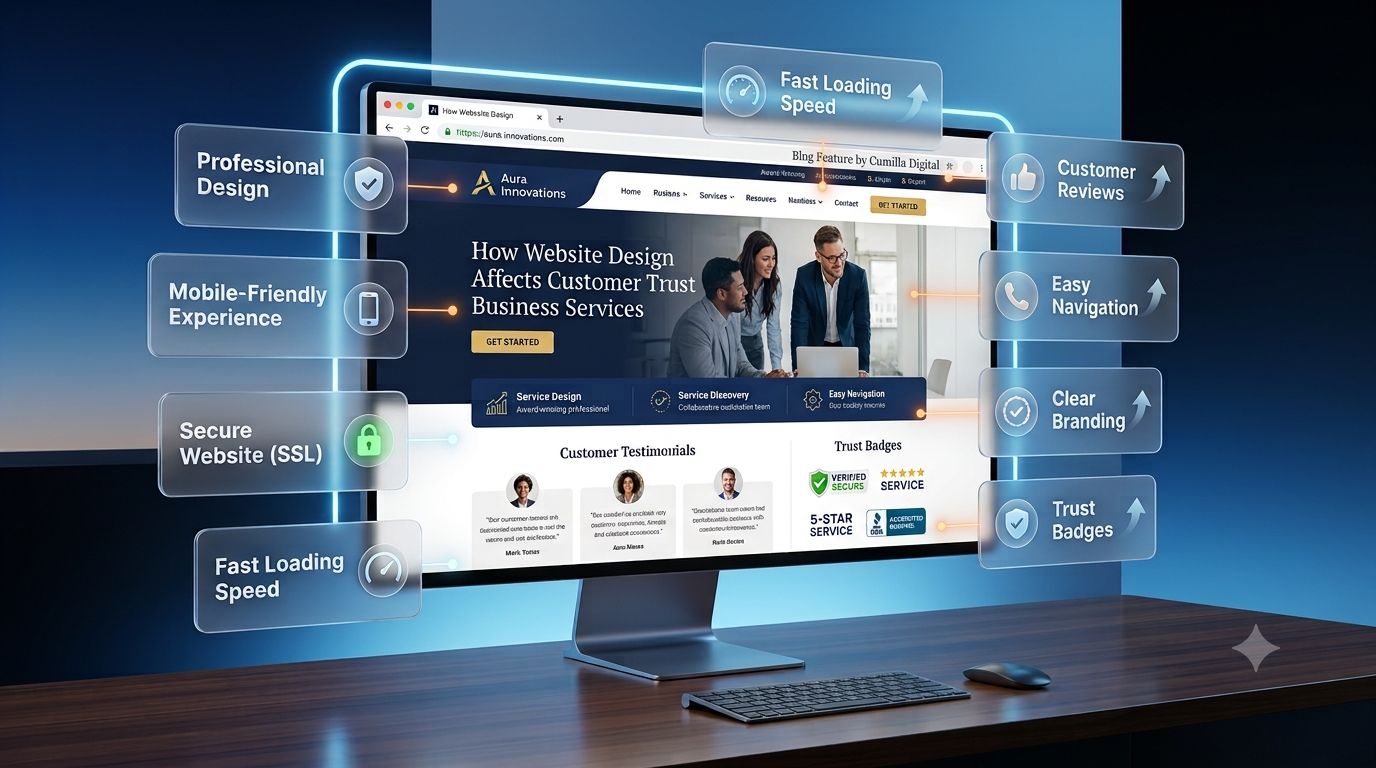
Speed and security are not backend details. They directly affect whether visitors stay or leave.
As mentioned in the Key Takeaways, 53% of mobile visitors abandon a page that takes longer than 3 seconds to load (Google). Given that most local searches now happen on mobile phones, this single factor can quietly cost a business real revenue every month.
Security matters too. A missing SSL certificate can trigger a browser warning that scares visitors away instantly. Google also uses HTTPS as a ranking signal, so weak security can hurt visibility as well as trust.
A good website does not just inform, it converts. Every page should include a clear next step: call now, request a quote, or book online.
Buttons should stand out visually and repeat throughout the page, not just once at the bottom. Forms should stay short, since every extra field reduces the number of people who finish it.
A beautiful website that nobody finds cannot generate business. This is where SEO, and specifically local SEO, becomes essential for any Lafayette-area company.
As referenced earlier, 76% of “near me” searches lead to a visit within 24 hours (Google/Think with Google). This statistic shows why local optimization, not just general SEO, drives real foot traffic and phone calls for small businesses.
A complete local SEO setup usually includes:
Some mistakes show up again and again across small business sites. A few of the most common include:
Each mistake on its own may seem small. Together, however, they quietly drain leads every single month.
You cannot improve what you do not measure. A good website is treated as an ongoing asset, not a one-time project.
Tools like Google Analytics show where visitors come from and which pages they leave from. Conversion tracking, meanwhile, shows exactly how many visitors turn into calls, forms, or bookings.
Heatmap tools reveal where visitors click, scroll, and get stuck. This behavioral data often reveals confusing layouts that traffic numbers alone cannot explain.
Small changes, a different headline, a repositioned button, a shorter form, can meaningfully shift conversion rates. Testing these changes over time turns a static website into a system that keeps improving.
A website is never truly finished. What ranks and converts well today can quietly fall behind within a year.
Search engines favor sites that stay active with fresh, relevant content. Meanwhile, outdated plugins and unpatched software create real security risks. A regular update schedule protects both your rankings and your visitors’ data.
A good business website is never about looks alone. It combines a clear purpose, the right pages, fast performance, and content that speaks directly to real customer needs. From there, local SEO and ongoing measurement turn that website into a consistent source of leads instead of a static brochure online.
Most small business owners do not need a full rebuild. They need a clear, honest look at what their current site is missing, and a plan to fix it in the right order. Sites N Apps has walked Lafayette-area businesses through exactly this process, rebuilding what matters and leaving alone what already works.
If you are unsure whether your site is helping or quietly costing you customers, we can show you exactly where it stands. We invite you to request a free website audit from our team, so you can see specific, actionable fixes instead of guesswork.
Outdated design, inconsistent fonts, low-quality images, and slow load times are the most common signs. Visitors form a trust judgment within seconds, so these details matter more than most business owners expect.
Most small business sites need at least four core pages: homepage, about, services, and contact. Many benefit from adding a blog or FAQ page to answer customer questions and support SEO.
Yes. According to Google, 53% of mobile visitors abandon pages that take longer than 3 seconds to load. Slow speed directly reduces both traffic retention and conversion rates.
Content should be reviewed every few months, while security patches and plugin updates should happen continuously. Neglecting either area gradually hurts both rankings and visitor trust.
Yes. Local SEO focuses on ranking for location-based searches through tools like Google Business Profile. Since 76% of “near me” searches lead to a visit within 24 hours, this type of optimization directly drives foot traffic.
Struggling to compete for high-search-volume keywords? We help businesses like yours increase visibility, drive more traffic, and dominate competitive search terms—all while keeping your costs low. Our proven strategies focus on long-term growth and measurable results.