Home / Blog Details
Take your digital marketing to the next level with data-driven strategies and innovative solutions. Let’s create something amazing together!
From Google search results to AI chatbots, we optimize your website so customers can find you faster — and choose you over competitors.
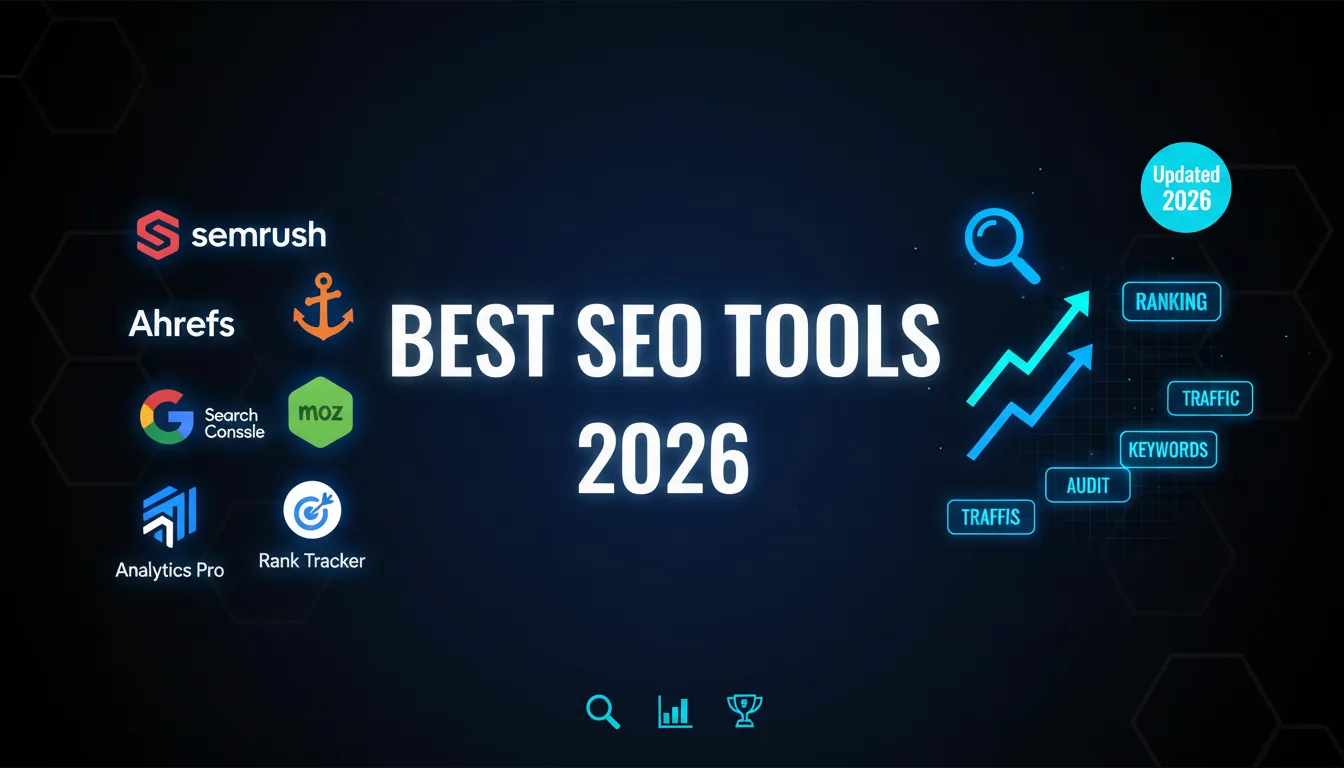
The best SEO tool overall is Semrush for most users who need an all-in-one platform covering keyword research, backlink analysis, rank tracking, and technical audits. Ahrefs is the stronger choice for backlink-focused work. For businesses on a tight budget, SE Ranking offers professional-grade features at a fraction of the cost.
You’ve probably stared at a comparison chart and felt more confused than when you started. Semrush, Ahrefs, Moz, SE Ranking, Screaming Frog, Surfer SEO… the list never seems to end. Every tool claims to be the best. Every review site seems to have a different winner. Meanwhile, your competitors are already ranking while you’re still trying to pick a platform.
The problem is that most SEO tool reviews are written by affiliates promoting whichever tool pays the highest commission. They’re not written by someone who has actually sat down, run the same keyword through five different tools, compared the results, and made real decisions based on that data. That’s a different kind of review.
This guide gives you a side-by-side breakdown of every major SEO tool across every major use case. You’ll see which tools win for keyword research, which win for backlinks, which are worth paying for, and which free tools can genuinely hold their own. By the end, you’ll know exactly which tool fits your budget, your business type, and your goals.
Every tool in this guide went through a structured evaluation process. The goal was to eliminate bias and focus on what actually matters to real users.
We scored each tool across five core categories:
No tool scored a perfect 10 across all five. That’s actually the point. Understanding where each tool is strong (and weak) is how you make the right choice.
We ran identical keyword sets through Semrush, Ahrefs, SE Ranking, and Moz Pro, then compared their reported search volumes, keyword difficulty scores, and backlink counts against verified data from Google Search Console.
The results were telling. Semrush and Ahrefs consistently came closest to actual GSC traffic data. SE Ranking performed well for rank tracking accuracy. Moz showed the widest variation in keyword volume estimates.
According to a 2024 study by AuthorityHacker comparing SEO tool data accuracy, Ahrefs had the most accurate backlink index among major platforms. Semrush showed the strongest keyword data alignment with Google’s own tools.
We evaluated each tool at its entry-level paid tier and its mid-tier plan, since most small businesses and agencies operate at one of those two levels. We also factored in what features disappear at lower price tiers, since some tools heavily restrict their most useful functionality unless you upgrade.
A tool that costs $99/month but delivers agency-level data is a better value than a $49/month tool that limits you to 10 keyword lookups per day.
Local SEO has specific requirements that general SEO tools often handle poorly. We tested each tool’s ability to track local pack rankings, support Google Business Profile audits, manage citation data, and provide competitor visibility at the city level. For businesses in markets like Lafayette, LA, these features aren’t optional. They’re how you compete.
These three platforms offer the most complete feature sets for serious SEO work. Each has a distinct strength.
Semrush is the most complete SEO platform available for most users. It covers keyword research, competitor analysis, backlink auditing, rank tracking, technical site audits, content optimization, and local SEO tools under a single subscription.
The keyword database contains over 25 billion keywords as of 2025. The Site Audit tool crawls your website and flags technical issues across more than 140 checks. The Position Tracking tool monitors your rankings daily at the city or zip code level, which matters for local businesses.
Semrush’s biggest strength is breadth. If you want one tool that handles nearly everything, this is it. The tradeoff is price. Plans start at $139.95/month (Pro tier), which is a serious investment for a solo operator or small business.
Best for: Agencies, in-house SEO teams, and small businesses ready to commit to a full SEO workflow.
Weakness: The learning curve is real. New users often feel overwhelmed by the volume of features in the first few weeks.
Ahrefs has the most accurate and comprehensive backlink index among all major SEO tools. Its database crawls over 420 million domains and updates every 15 to 30 minutes. If you need to understand where a competitor’s authority is coming from, or identify link-building opportunities in your niche, no tool does it better.
Beyond backlinks, Ahrefs offers strong keyword research through its Keywords Explorer, a solid content gap analysis feature, and a Site Explorer that gives you a full picture of any domain’s organic traffic and keyword rankings.
The tradeoff compared to Semrush is that Ahrefs is less comprehensive for technical SEO and local SEO. Its Site Audit tool is solid, but the local rank tracking and GBP support are weaker.
Best for: Content marketers, link builders, and SEOs who make backlinks a core part of their strategy.
Weakness: Less effective for local SEO workflows. Pricing starts at $129/month.
SE Ranking is the strongest mid-market option for small businesses and freelancers who need professional-grade data without the Semrush or Ahrefs price tag. Plans start at $65/month, and the feature set covers keyword research, rank tracking, backlink monitoring, competitor analysis, and technical audits.
SE Ranking’s rank tracking is a particular standout. It tracks rankings at the local level with high accuracy, making it a strong choice for local SEO work. The white-label reporting feature also makes it popular with small agencies that need to send branded reports to clients.
The data depth doesn’t quite match Semrush or Ahrefs at scale, but for most small businesses and freelancers, the difference won’t matter in daily use.
Best for: Freelancers, small agencies, and small businesses with limited budgets who still need reliable, professional-grade tools.
Free SEO tools are more powerful than most people realize. Google’s suite alone can carry a serious SEO workflow if you know how to use it.
Google Search Console (GSC) is the single most important free SEO tool available. It comes directly from Google and shows you exactly how Google sees your website, which queries are driving impressions and clicks, which pages have indexing issues, and what your average position is for specific keywords.
No third-party tool can replicate this data because it comes straight from the source. Every website owner should have GSC set up before spending a dollar on any paid platform.
Key features: Query performance data, coverage and indexing reports, Core Web Vitals monitoring, manual action alerts, and sitemaps management.
Google Analytics 4 (GA4) is essential for connecting SEO performance to actual business outcomes. GSC tells you how people find your site. GA4 tells you what they do when they get there.
For SEO, GA4 helps you identify which organic landing pages convert, which have high bounce rates, and where traffic is coming from by channel. Combined with GSC, it gives you a complete picture of organic performance at no cost.
Google Keyword Planner is the original source of Google’s search volume data, and every other keyword tool draws on some version of it. It’s designed for Google Ads users, but SEOs can use it for keyword discovery, seasonal trend analysis, and broad volume range estimates.
The limitation: Keyword Planner shows volume ranges (like “1K to 10K”) rather than exact numbers unless you’re running active ad campaigns. For precise volume data, a paid tool is more useful.
Google Trends shows relative search interest over time for any keyword or topic. It’s particularly useful for identifying seasonal patterns, comparing brand visibility against competitors, and spotting rising search trends before they peak.
For example, a local HVAC company in Lafayette, LA can use Google Trends to see exactly when searches for “AC repair” spike in their region, then time their content publishing accordingly.
Bing Webmaster Tools is a free platform that mirrors many of GSC’s features but for Bing’s search engine. While Google dominates with roughly 90% of global search share, Bing still accounts for a meaningful portion of desktop searches, especially in certain industries.
The tool offers keyword research, backlink data, site scanning, and rank tracking, all for free. For most small businesses, it’s worth a 30-minute setup to capture any traffic Google isn’t showing you.
The right tool depends entirely on what you’re trying to accomplish. Here’s how the top platforms stack up for each core SEO task.
Semrush wins for keyword research breadth, with over 25 billion keywords across its database and detailed metrics including keyword difficulty, search intent classification, and SERP feature analysis. Ahrefs Keywords Explorer is the closest competitor and many SEOs prefer its interface.
For free keyword research, Google Keyword Planner combined with Google Search Console covers the essentials well.
Winner: Semrush (paid), Google Keyword Planner + GSC (free)
Semrush’s Competitive Research toolkit is the most comprehensive for analyzing competitor traffic, keywords, ads, and content strategy. Its Traffic Analytics feature estimates competitor site visits and sources. The Keyword Gap tool shows exactly which keywords your competitors rank for that you don’t.
Ahrefs’ Site Explorer is equally strong for organic competitor research, particularly for content gap analysis.
Winner: Semrush (slight edge for breadth), Ahrefs (slight edge for content gap analysis)
Ahrefs is the clear winner for backlink analysis. Its index is the largest and most frequently updated among all major platforms. When you need to audit a competitor’s link profile, identify toxic backlinks, or find high-authority link opportunities in your niche, Ahrefs gives you the most complete and reliable data.
Semrush’s backlink database is solid but consistently smaller than Ahrefs in independent comparisons.
Winner: Ahrefs
SE Ranking and Semrush both offer excellent rank tracking, with daily updates and local tracking at the city or zip code level. SE Ranking earns a slight edge here for accuracy at the local level and for the value it delivers at a lower price point.
Ahrefs’ rank tracker is solid but updates less frequently at lower plan tiers.
Winner: SE Ranking (best value), Semrush (best overall)
Screaming Frog SEO Spider is the gold standard for technical SEO audits. It crawls your website the way Googlebot does and surfaces issues with broken links, redirect chains, missing metadata, duplicate content, and page speed signals. The free version crawls up to 500 URLs. The paid version (£259/year, approximately $329 USD) removes the limit entirely.
For ongoing technical monitoring without manual crawls, Semrush’s Site Audit tool is the most accessible option.
Winner: Screaming Frog (depth), Semrush (convenience and ongoing monitoring)
Surfer SEO is purpose-built for content optimization. It analyzes the top-ranking pages for your target keyword and tells you exactly how to structure your content, which terms to include, how long your article should be, and what questions to answer. Writers and content teams find it significantly speeds up the process of creating content that has a real chance of ranking.
Winner: Surfer SEO
Semrush with its Local SEO toolkit covers the widest range of local SEO tasks, including Google Business Profile auditing, local rank tracking, and citation management. For local businesses competing for map pack rankings, this is the most complete single solution.
BrightLocal is also worth mentioning as a specialized local SEO platform that many agencies prefer for citation management and local reporting.
Winner: Semrush (for all-in-one), BrightLocal (for citation-focused work)
Some tools focus on doing one or two things exceptionally well rather than trying to cover everything.
Screaming Frog SEO Spider is the most trusted technical crawl tool in the SEO industry. It’s used by agencies and enterprise teams worldwide and has been the default choice for technical audits for over a decade.
What makes it irreplaceable is its level of detail. It surfaces issues that automated cloud-based tools frequently miss, including JavaScript rendering problems, hreflang errors, and complex redirect mapping. For any serious technical SEO audit, Screaming Frog should be in the workflow.
Surfer SEO is best used for on-page content optimization and editorial content planning. Its Content Editor scores your article in real time based on keyword usage, structure, and topic coverage compared to top-ranking competitors. The SERP Analyzer shows you the exact correlation between specific on-page factors and top rankings for your target keyword.
Content teams that use Surfer consistently report faster time-to-ranking for new content compared to writing without a data-driven framework.
Moz Pro remains a strong platform, particularly for teams that value its Domain Authority (DA) metric. DA has become an industry shorthand for evaluating site strength, even though Google does not use it directly. Moz’s Keyword Explorer is user-friendly, making it a good option for beginners.
However, Moz has fallen behind Semrush and Ahrefs in terms of data depth and feature development over the past few years. It’s still a legitimate tool, but rarely the first recommendation for professionals choosing a platform in 2025.
Similarweb specializes in traffic estimation and competitive intelligence at a level other tools don’t match. It shows estimated visits, traffic sources, audience demographics, and engagement metrics for virtually any website. For market research and understanding competitive traffic patterns, it goes deeper than Semrush’s Traffic Analytics.
The free version provides limited data. The paid plans are priced for agencies and enterprise users.
AnswerThePublic visualizes the questions people ask around any keyword, pulling from Google’s autocomplete data. It organizes questions by type: who, what, where, when, why, how, and versus. For content strategists planning topic clusters or FAQ sections, it surfaces real user questions that keyword tools often miss.
The free version allows a limited number of daily searches. The paid version removes limits and adds historical comparison features.
Artificial intelligence has changed how SEO tools work. Here’s where AI actually adds value versus where it’s just a marketing label.
Surfer SEO and Clearscope are the most established AI-driven content optimization platforms. Both analyze top-ranking content and use natural language processing to identify the topics, terms, and structures that correlate with high rankings. Clearscope focuses primarily on content grading and is widely used in enterprise content teams. Surfer covers both the optimization and brief-creation workflow.
MarketMuse is another strong option for enterprise content teams, offering topic modeling and content inventory analysis at scale.
Semrush’s AI-powered keyword clustering and Ahrefs’ keyword intent classification are the most useful AI applications in keyword research right now. Both tools use machine learning to group related keywords and classify search intent automatically, which saves significant time for large-scale keyword projects.
Google’s own AI is increasingly influencing search results through AI Overviews. Structuring your content to directly answer specific questions gives you the best chance of appearing in both traditional results and AI-generated answers.
AI SEO automation tools in 2025 primarily handle repetitive tasks like generating meta descriptions at scale, identifying content gaps across large sites, and flagging technical issues automatically. Tools like Semrush’s AI writing assistant and Ahrefs’ AI-powered content suggestions help speed up workflows without replacing the strategic thinking that SEO requires.
Use AI automation for efficiency. Use human judgment for strategy. The combination outperforms either approach alone.
| Feature | Semrush | Ahrefs | SE Ranking | Moz Pro |
| Keyword Research | ★★★★★ | ★★★★★ | ★★★★☆ | ★★★★☆ |
| Backlink Analysis | ★★★★☆ | ★★★★★ | ★★★☆☆ | ★★★☆☆ |
| Rank Tracking | ★★★★★ | ★★★★☆ | ★★★★★ | ★★★★☆ |
| Technical SEO | ★★★★★ | ★★★★☆ | ★★★★☆ | ★★★☆☆ |
| Content Optimization | ★★★★☆ | ★★★☆☆ | ★★★☆☆ | ★★★☆☆ |
| Local SEO | ★★★★★ | ★★★☆☆ | ★★★★☆ | ★★★☆☆ |
Semrush and Ahrefs both offer databases exceeding 20 billion keywords. SE Ranking uses a combination of its own data and third-party sources, which is adequate for most small business use cases. Moz provides solid keyword data but with lower volume estimates that occasionally diverge significantly from GSC data.
For the most accurate volume estimates, cross-referencing any paid tool’s data with Google Search Console’s actual performance data is always the best practice.
Ahrefs indexes more backlinks than any other tool in this comparison. In a 2024 independent test by Detailed.com comparing backlink databases, Ahrefs returned the highest number of unique referring domains for the same set of test URLs across all tested platforms.
Semrush’s backlink database is the second-largest and updates frequently. SE Ranking and Moz trail behind both for raw backlink data volume.
For raw technical depth, Screaming Frog has no competitor in this list. For cloud-based automated auditing, Semrush’s Site Audit runs on a schedule and alerts you to new issues without requiring manual crawls. SE Ranking’s audit tool is solid for identifying common issues but less detailed for complex technical problems.
Semrush offers the most complete local SEO feature set among general-purpose platforms: local rank tracking, GBP management, and listing management. SE Ranking’s local rank tracking is accurate and affordable. Ahrefs has limited local SEO tooling by comparison.
For pure local SEO work, a combination of Semrush (or SE Ranking) with a dedicated local tool like BrightLocal is what most local SEO specialists use in practice.
Most SEO agencies run a two- or three-tool stack. The most common combination in 2025 is Semrush for keyword research and reporting, Ahrefs for backlink analysis, and Screaming Frog for technical audits. Agencies that work with local clients often add SE Ranking or BrightLocal for local rank tracking and citation management.
According to a 2024 survey by Search Engine Journal, Semrush was the most widely used paid SEO tool among agency professionals, followed closely by Ahrefs.
White-label reporting features matter to agencies. SE Ranking and Semrush both offer branded reporting. Ahrefs does not have white-label reporting.
In-house SEO teams at mid-size companies often use Semrush or Ahrefs as the primary platform, supplemented by Google Search Console and Google Analytics 4 for performance data. Teams that produce a high volume of content frequently add Surfer SEO or Clearscope to their stack.
Enterprise SEO teams may also use specialized crawling tools like DeepCrawl (now Lumar) or Botify for large-scale technical monitoring.
Freelance SEO consultants tend to prioritize value and portability. SE Ranking is the most popular choice among freelancers who need professional-grade data without a $250/month commitment. Ahrefs is also widely used among freelancers who specialize in content strategy and link building.
For freelancers working with local clients, the free tier of Google’s tools combined with SE Ranking covers the majority of work at a manageable cost.
SE Ranking or Semrush’s entry-level plan is the most beginner-friendly paid options. SE Ranking’s interface is clean and intuitive. Semrush offers an extensive learning library and academy courses that help new users get up to speed quickly.
For anyone just starting out, spend your first 60 to 90 days using Google Search Console and Google Analytics before spending money on a paid tool. You’ll learn more about your site’s actual performance from free tools than from any dashboard you haven’t yet learned how to read.
Ahrefs is the preferred tool for bloggers who rely on organic traffic as their primary revenue source. The Keywords Explorer helps identify low-competition topics with real traffic potential. The Content Gap feature shows which keywords your competitors rank for that your site doesn’t yet cover.
For bloggers on a tight budget, a combination of Google Search Console, Ubersuggest’s free tier, and AnswerThePublic covers keyword discovery without a recurring subscription.
For most small businesses, SE Ranking provides the best combination of features, accuracy, and price. It covers all the core SEO tasks a small business needs: rank tracking, keyword research, site auditing, and competitor monitoring. The local rank tracking feature is particularly strong for businesses competing in a specific city or region.
If your business is in a competitive local market and SEO is a real growth lever for you, stepping up to Semrush for its local SEO toolkit makes sense.
Semrush is the strongest choice for e-commerce SEO because of its ability to analyze competitor product pages, track keywords at scale, and monitor product listing visibility. Its eCommerce-specific features include tracking for shopping ads and product snippet visibility.
Ahrefs is equally strong for e-commerce content strategy and product page link building.
Enterprise teams need platforms that scale. Semrush’s Business plan, Ahrefs’ Advanced plan, and specialized crawlers like Botify or Lumar are the typical combination at the enterprise level. Enterprise needs include large crawl limits, API access, custom reporting, team collaboration features, and dedicated support.
Semrush and Ahrefs both offer enterprise plans with custom pricing. For organizations managing hundreds of thousands of pages, a specialized crawl platform should sit alongside a general-purpose tool rather than replacing it.
Local SEO in Lafayette, LA requires tools that can track rankings at the city level, manage Google Business Profile visibility, and monitor competition in a specific geographic market. Here’s what works best for each part of that workflow.
Semrush’s GBP Management tool audits your listing for completeness, consistency, and optimization opportunities. It flags missing information, photo gaps, category issues, and review response rates. BrightLocal is an alternative that focuses almost entirely on local listing management and is preferred by agencies handling multiple GBP accounts.
For Lafayette businesses competing for map pack visibility, GBP optimization is often the highest-return SEO activity available.
Semrush and SE Ranking both support location-specific keyword research, allowing you to pull search volume and difficulty data filtered to the Lafayette, LA market. This matters because search behavior in a small regional market often looks different from national averages.
For example, searches like “accountant in Lafayette LA” or “Lafayette web design company” have local volumes that national keyword averages won’t accurately reflect. City-level filtering gives you the real numbers.
SE Ranking offers the most accurate and affordable local rank tracking for city-level positions. You can set your tracking location to Lafayette, LA specifically and monitor your rankings in Google’s local pack, organic results, and mobile results separately.
Semrush’s Position Tracking offers the same capability and adds more contextual data, but at a higher price point.
BrightLocal is the leading tool for managing local citations, which are mentions of your business name, address, and phone number (NAP) across directories, maps, and local data aggregators. BrightLocal’s Citation Builder automates the process of building and correcting NAP consistency across the most important local directories.
SE Ranking and Semrush both offer some citation monitoring, but BrightLocal’s specialized focus gives it a clear advantage for this specific task.
Semrush’s Competitive Research toolkit allows you to monitor which keywords local competitors rank for, how their rankings change over time, and where their backlinks come from. For a Lafayette business wanting to understand why a competitor consistently outranks them in the local pack, this is where you start.
SE Ranking offers a similar competitor tracking feature at a lower price point. The depth of data is slightly less, but it’s adequate for most local competitive research.
Free SEO tools are genuinely sufficient for many businesses. Specifically, free tools are enough when:
Google Search Console, Google Analytics 4, Google Keyword Planner, Bing Webmaster Tools, and Screaming Frog’s free crawler together form a capable free stack. Pair those with AnswerThePublic for content ideas, and you have a real workflow.
Paid tools make sense when free tools create friction that slows down your ability to compete. Specifically, consider a paid tool when:
For a local business where SEO is a meaningful revenue driver, $65 to $139/month on a professional SEO tool is a justifiable expense when weighed against the customer lifetime value of a single new client.
SE Ranking offers the strongest value of any paid SEO tool at its price point. It gives small businesses and freelancers access to professional-grade rank tracking, keyword research, backlink monitoring, and site auditing for a fraction of Semrush or Ahrefs pricing.
For businesses that need only one specific feature, Screaming Frog’s paid version (£259/year) is exceptional value for technical auditing. Surfer SEO’s entry plan is strong value for content-focused teams.
Before comparing tools, write down the three most important things you want SEO to accomplish for your business in the next 12 months. Common answers include:
Your answer should determine which tool category you prioritize. Ranking and competitor goals point toward Semrush. Backlink goals point toward Ahrefs. Local ranking goals point toward SE Ranking or Semrush’s local toolkit.
Match features to your workflow, not to a feature checklist. A tool with 200 features you’ll never use is less valuable than a focused tool with 10 features you’ll use every day.
Ask yourself: What will I actually do in this tool every week? If the honest answer is “track rankings and find new keywords,” you don’t need the most expensive platform on the market.
Think 18 to 24 months ahead. Will this tool still meet your needs if your site doubles in size? If you add two more client accounts? If you need to track rankings in three cities instead of one?
Check the limits on each plan tier before committing: keyword tracking limits, crawl credits per month, user seat limits, and API access. Tools that scale smoothly are more valuable over time than those that force an expensive upgrade every six months.
Annual plans typically save 17 to 20% compared to monthly billing. Factor that into your comparison.
Also factor in the cost of time. A tool that is confusing to use wastes hours every month. A clean, intuitive tool that gives you the right data quickly is worth paying a premium for, even if a cheaper option technically has the same features buried somewhere in the interface.
Choosing the cheapest tool often costs more in the long run. Free or low-cost tools frequently have data accuracy limitations or feature restrictions that lead to bad decisions. One poor SEO decision based on inaccurate keyword data can cost far more in wasted content and missed rankings than a $100/month subscription ever would.
Price matters. It should not be the only thing that matters.
Data accuracy is the foundation every SEO decision is built on. If a tool tells you a keyword has 5,000 monthly searches when it actually has 500, you might invest months in content that can never deliver the return you expected. Always test a tool’s data against GSC before trusting it at scale.
Ask any free trial tool: how does this compare to what my GSC actually shows for my own site? The answer tells you a lot.
Many businesses sign up for an enterprise-level tool because the features list looked impressive, then use 10% of the platform every month. That’s not the tool’s fault. It’s a mismatch between the tool’s capability and the user’s actual workflow.
Before upgrading plans, calculate your actual usage. Most tools show your credit consumption and feature usage in account settings. If you’re consistently using less than 30% of what you’re paying for, downgrade or switch.
General SEO tools are built for national and global campaigns. Local businesses have fundamentally different needs: city-level rank tracking, GBP monitoring, NAP citation management, and local competitor analysis.
A tool that scores a 9 out of 10 for enterprise keyword research might score a 4 out of 10 for local SEO functionality. For a Lafayette business, that 4 is what matters.
Total approximate annual cost: under $1,100 USD.
This stack covers every core local SEO need at an accessible price point.
The best SEO tool is the one that matches your actual workflow, your budget, and the specific goals you’re working toward. Semrush is the best all-in-one platform for teams and agencies. Ahrefs is the best for backlink-driven strategies. SE Ranking is the best for small businesses and freelancers who want professional data without a premium price. And Google’s free tools are more powerful than most people give them credit for.
There is no universal winner. There is only the right match for your situation.
Start by defining your primary SEO goal. Then match your tool to that goal at a price you can commit to for at least 12 months. The compounding benefits of consistent SEO work only show up when you stick with a strategy long enough to see results. Switching tools every three months resets your learning curve and disrupts your data continuity.
If you’re spending more time evaluating tools than using them, that’s a sign. Pick one, learn it well, and execute.
At Sites N Apps, we’ve helped businesses in Lafayette, LA and beyond cut through the tool confusion and build SEO strategies that actually move the needle. Choosing the right platform is step one. Knowing how to use it to grow your business is where the real work begins. If you’re ready to build a search strategy that compounds over time, we’d love to help.
Schedule a consultation with our SEO team to talk through your goals, audit your current setup, and build a plan that fits your business, not someone else’s.
Start with Google Search Console and Google Analytics 4. Both are free, both come directly from Google, and together they give you more accurate data about your actual site performance than most paid tools. Add AnswerThePublic for content ideas and Screaming Frog’s free crawler for technical checks. This stack costs nothing and covers the essentials.
It depends on your primary use case. Semrush is stronger for all-around SEO work, especially local SEO, technical auditing, and competitor research. Ahrefs is stronger specifically for backlink analysis and content gap research. Many agencies use both. If you can only choose one, Semrush covers more ground for most business types.
For basic SEO work on a single site, yes. Google’s free tools cover keyword discovery, performance tracking, and indexing monitoring effectively. The gap between free and paid tools shows up in data depth, automation, competitor intelligence, and the ability to manage SEO at scale across multiple sites or clients.
Most small businesses can run a capable SEO workflow for $65 to $140/month using SE Ranking or Semrush’s entry plan alongside Google’s free tools. For local-focused businesses, adding BrightLocal at approximately $29 to $49/month covers citation and GBP management. An annual total of $900 to $2,000 is a realistic range for a well-equipped small business SEO stack
No third-party tool perfectly matches Google’s own search volume data. Among paid tools, Semrush and Ahrefs consistently come closest to actual GSC data in independent comparisons. Always cross-reference keyword tool estimates with your GSC performance data for your own site before building content strategy around volume estimates alone.
No. SEO tools provide data and identify opportunities. Rankings come from executing on that data: publishing quality content, earning authoritative backlinks, fixing technical issues, and maintaining consistency over time. A tool is only as valuable as the strategy and effort applied to the insights it surfaces.
Struggling to compete for high-search-volume keywords? We help businesses like yours increase visibility, drive more traffic, and dominate competitive search terms—all while keeping your costs low. Our proven strategies focus on long-term growth and measurable results.