

A landing page is a standalone web page designed for a single goal: converting visitors into leads or customers. Unlike a homepage, it removes navigation and distractions, focusing the visitor on one specific action, filling out a form, booking a call, or making a purchase. It is the foundation of any high-converting digital marketing campaign.
Key Takeaways
A landing page is a dedicated, standalone web page that a visitor “lands on” after clicking a link, usually from a paid ad, email, or social media post. It has one clear purpose: to get the visitor to take a specific action. That action might be submitting their contact information, scheduling a consultation, downloading a resource, or buying a product.
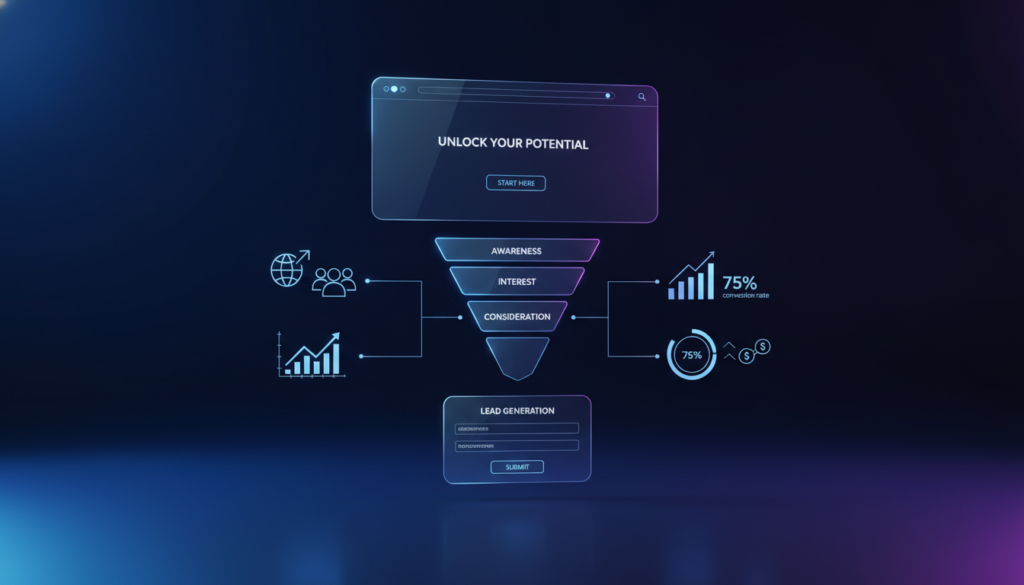
The keyword here is “standalone.” A landing page is not connected to your website’s main navigation. It exists independently, built entirely around one offer and one audience.
Here is the basic flow. A potential customer sees your Google Ad, Facebook post, or email. They click. Instead of landing on your homepage, they arrive on a page that directly matches what they just saw. The messaging is consistent. The offer is clear. There is one button to click or one form to fill out.
That focused experience is why landing pages work. When there is only one path forward, more visitors take it.
In digital marketing, every campaign has a goal. Landing pages exist to make sure that the goal actually gets achieved. Without a dedicated landing page, you are sending paid or earned traffic to a general page that was never designed to convert.
According to HubSpot’s 2024 marketing report, companies with 10 to 15 landing pages generate 55% more leads than those with fewer than 10. The more targeted your pages, the better your results.
Most businesses use landing pages because they work better than any other page on their site for capturing leads. A homepage has to do too many things: introduce the brand, explain services, build trust, and guide different types of visitors. A landing page only has to do one thing.
That focus is the competitive advantage. If you run ads without a landing page, you are paying for traffic and then letting it escape.
Your homepage is the front door to your entire business. It serves multiple audiences with multiple needs. A landing page, by contrast, is built for one audience, one offer, and one outcome.
Here is a direct comparison:
| Feature | Homepage | Landing Page |
| Purpose | Introduce the brand | Drive one specific action |
| Navigation | Full menu | None or minimal |
| Audience | Everyone | One specific segment |
| Content | Broad overview | Focused on one offer |
| Goal | Explore and browse | Convert immediately |
| Links | Many | One CTA only |
Use a landing page any time you are running a paid campaign, promoting a specific offer, or trying to capture leads from a defined audience segment. If your goal is measurable (sign-ups, calls, purchases), a landing page will almost always outperform a general website page.
If you are running Google Ads for HVAC services in Lafayette, sending that traffic to your homepage means visitors have to work to find the offer they clicked for. That extra friction costs you conversions.
Landing pages convert better because they are built around one specific visitor with one specific problem. There is no competing content, no menu pulling them elsewhere, and no reason to hesitate. The offer is right there. The message matches exactly what they were looking for.
According to WordStream, the average landing page conversion rate across industries is 9.7%. High-performing landing pages in competitive niches regularly reach 20% to 30%.
Every link on a web page is an exit opportunity. When you include a navigation menu on a landing page, you are essentially giving the visitor ten reasons to leave before converting. Removing navigation keeps the visitor focused on the one action you want them to take.
This is not just a best practice; it is one of the most consistent findings in conversion rate optimization research.
A lead generation landing page collects visitor information, usually a name, email address, and phone number, in exchange for something valuable. This is the most common type for service businesses, B2B companies, and local businesses.
The form is the centerpiece of a lead generation page. Shorter forms convert more visitors. Longer forms qualify leads better. The right balance depends on your sales process. For most local service businesses, asking for a name, email, and phone number is enough to start a conversation.
A lead magnet is the incentive you offer in exchange for contact information. It could be a free consultation, a downloadable guide, a coupon, or a cost estimate. The stronger and more specific the offer, the higher your conversion rate will be. “Free 15-minute HVAC inspection” converts far better than “Contact us today.”
A click-through landing page does not ask for information. Instead, it warms up the visitor and prepares them to click through to a checkout page or sign-up flow. E-commerce businesses use these frequently to pre-sell a product before the purchase page.
A sales landing page is a long-form page designed to sell a product or service directly. It typically includes detailed descriptions, pricing, testimonials, FAQs, and multiple CTAs throughout the page. These pages do the heavy lifting that a salesperson would normally do in person.
PPC (pay-per-click) landing pages are built specifically to receive paid traffic from platforms like Google Ads or Meta Ads. They are tightly matched to the ad’s messaging and keywords. Message match between ad copy and landing page copy is one of the most important factors in PPC campaign performance.
Local businesses use geo-targeted landing pages to capture leads from specific service areas. For example, a plumber in Lafayette, LA might have separate landing pages for emergency plumbing, drain cleaning, and water heater installation, each targeting a different keyword and customer need.
Event landing pages promote a specific date, session, or live event. They include registration forms and build urgency through countdown timers and limited availability messaging. These pages tend to have a short lifecycle but high conversion intent.
Your headline is the most important copy on the page. It has roughly three seconds to convince a visitor they are in the right place. A strong headline addresses the visitor’s goal or problem directly. It does not try to be clever. It is clear, specific, and benefit-driven.
The hero section, which is the area visible before scrolling, must communicate your value proposition immediately. If visitors have to scroll to understand what you offer, most of them will not.
Every word on a landing page has to earn its place. Conversion-focused copy speaks directly to the visitor’s pain points, shows them the outcome they want, and explains why your offer is the best path to get there. It uses the visitor’s language, not industry jargon.
One practical approach: write your copy as if you are answering the visitor’s unspoken question, “What’s in this for me?” Answer that question in every paragraph.
Your call-to-action button is where the conversion actually happens. Button text matters more than most people expect. “Get My Free Quote” converts better than “Submit.” “Book My Consultation” converts better than “Click Here.” Specific, first-person language performs consistently better because it feels personal and low-risk.
Place your primary CTA above the fold, repeat it after major sections, and make it visually distinct from everything else on the page.
Forms should ask for only what you genuinely need. Every additional field reduces conversions. If your sales team can follow up with just a name and email, do not ask for a phone number on the first interaction. You can gather more information later in the sales process.
Social proof answers the visitor’s biggest hesitation: “Can I trust this?” Reviews, testimonials, star ratings, client logos, and case study snippets all serve this purpose. Specific testimonials with names, locations, and concrete results outperform generic ones dramatically.
“SitesNapps built our new website, and our inquiry rate doubled in 60 days” is far more convincing than “Great service, highly recommend.”
Trust signals reassure visitors that their information is safe and that your business is legitimate. These include SSL certificates, Better Business Bureau badges, Google Partner logos, industry certifications, and clear privacy policy links. For e-commerce, payment security badges near the form are especially effective.
More than 60% of web traffic now comes from mobile devices (Statista, 2024). A landing page that looks great on desktop but breaks on mobile is losing the majority of its potential conversions. Buttons need to be large enough to tap, forms need to be easy to fill out on a touchscreen, and load times need to be fast on cellular connections.
Page speed is a conversion factor and a ranking factor. Google’s Core Web Vitals measure loading performance, interactivity, and visual stability. A page that takes more than three seconds to load loses roughly 50% of its visitors before they see a single word of your copy. Compress images, minimize scripts, and use a fast hosting provider.
When a visitor clicks an ad for “emergency AC repair Lafayette” and lands on a page specifically about emergency AC repair in Lafayette, they stay. When they click that ad and land on a homepage about a general HVAC company, most of them leave. Intent match is the single most powerful conversion driver a landing page provides.
Friction is anything that makes it harder for a visitor to take action. Long forms, confusing layouts, slow load times, and unclear CTAs all create friction. Landing pages are built to remove every possible obstacle between the visitor and the conversion.
A well-designed landing page collapses the customer journey into a single decision: take action or do not. There is no exploration phase, no browsing, no distraction. That simplicity is what makes landing pages so effective compared to regular website pages.
Google Ads uses a Quality Score to determine how much you pay per click. One major factor in Quality Score is landing page experience, specifically how well your landing page matches the ad and how useful it is for the visitor. Better landing pages lower your cost per click and improve your ad rankings simultaneously.
Every design choice on a landing page should point toward the conversion. Color contrast draws the eye to the CTA. White space reduces visual noise. A single-column layout keeps the visitor moving down the page. These are not aesthetic choices; they are conversion decisions.
Before you write a word or choose a color, decide exactly what you want the visitor to do. One page, one goal. Are they booking a call? Downloading a guide? Requesting a quote? Your entire page is built around that single answer.
Who is this page for? What problem are they trying to solve? What language do they use to describe that problem? The more specifically you can answer these questions, the more effective your copy will be.
Match the page type to the campaign goal. Lead generation campaigns need lead capture pages. Awareness campaigns that lead to a purchase need click-through pages. Direct sales campaigns need long-form sales pages.
Start with the headline. Make it problem-focused or outcome-focused. Then write the body copy in a logical sequence: here is what you are getting, here is why it works, here is why we are the right choice, here is what others say, here is what to do next.
Use images that show the outcome your visitor wants, not just your product. Show happy customers, finished projects, or the result of working with you. Add testimonials with specific details. Include any credentials, awards, or certifications that build credibility.
Test every element on a real mobile device, not just in a desktop browser’s mobile simulator. Check that buttons are easy to tap, that forms do not require zooming, and that text is readable without pinching.
Your first version of a landing page is a hypothesis. Publish it, collect data, run A/B tests on headlines and CTAs, and improve based on what the numbers tell you. The best landing pages are built over time through iteration, not created perfectly on the first try.
A/B testing means showing two versions of a page to different visitors and measuring which one converts better. Test one element at a time: the headline, the CTA button text, the hero image, or the form length. Running multiple simultaneous tests muddies the data.
Small changes to CTA copy produce significant conversion lifts. Test action-oriented, first-person button text against generic alternatives. Test button color against your page’s color scheme. Test button placement, above the fold, mid-page, and after testimonials.
Dynamic landing pages change their content based on who is visiting. If someone clicked a Google Ad for “HVAC repair,” the headline automatically shows “Fast HVAC Repair in Lafayette.” If they came from a Facebook ad for “AC installation,” the headline shifts accordingly. This level of personalization consistently improves conversion rates.
Tools like Hotjar and Microsoft Clarity show you exactly where visitors click, how far they scroll, and where they drop off. This data tells you what is working and what is confusing or missing. If 70% of visitors never scroll past the hero section, the problem is at the top of your page.
A high bounce rate means visitors arrive and immediately leave without taking action. The most common causes are slow load times, a headline that does not match the ad, or a page that feels irrelevant to the visitor’s search. Fix these in order of priority.
User experience on a landing page is about clarity and ease. Can the visitor immediately understand what you offer? Is the CTA obvious? Is the form simple? Is the page fast? These fundamentals, when done well, solve most conversion problems before optimization testing is even necessary.
Paid search is the most direct and controllable traffic source for landing pages. You choose the keyword, write the ad, and send traffic to a page built specifically for that search. Google Ads campaigns connected to dedicated landing pages consistently outperform campaigns sending traffic to homepages.
Landing pages optimized for search engines can rank organically and generate free, ongoing traffic. This requires targeting specific long-tail keywords, creating genuinely useful content, and building backlinks to those pages. SEO traffic takes longer to build but has a lower long-term cost per lead.
Paid social campaigns on Facebook, Instagram, and LinkedIn can drive highly targeted traffic to landing pages. The key is matching the creative and messaging in the ad to the landing page. A disconnect between your social ad and the page it leads to will kill conversions.
Email lists convert at some of the highest rates of any traffic source because the audience already trusts you. Sending subscribers to a targeted landing page tied to a specific offer is far more effective than sending them to a general newsletter or homepage.
Retargeting shows ads to people who have already visited your site but did not convert. These visitors already know who you are, which makes them significantly easier to convert the second time. Dedicated retargeting landing pages, often with a stronger offer or urgency trigger, can recover a meaningful portion of lost leads.
Yes, landing pages can rank in search engines and deliver organic traffic. They are especially effective for targeting specific commercial and transactional keywords where the visitor’s intent closely matches what the page offers. A well-optimized landing page can capture both paid and organic traffic simultaneously.
For a landing page to rank, it needs the basics: a keyword-optimized title tag and meta description, proper heading structure, fast load speed, mobile responsiveness, and enough body content to signal relevance. Thin pages with only a form and a headline rarely rank.
Each landing page should target one primary keyword and a small cluster of related terms. Targeting too many keywords dilutes relevance. Targeting one specific, high-intent keyword makes the page more competitive for that exact search.
Creating dozens of nearly identical landing pages with only location names swapped out is a tactic that used to work and now creates duplicate content issues. Google’s Helpful Content guidelines (updated in 2024) penalize pages that exist primarily for search engines rather than humans. Write each page with genuine, location-specific value.
For local businesses, landing pages targeting city-specific or neighborhood-specific keywords are highly effective. Include local landmarks, neighborhoods, service area details, and locally relevant testimonials. This builds geographic relevance that broad pages cannot match.
If you run a local service business in Lafayette, a well-built landing page is one of the highest-return investments you can make in your marketing. Instead of sending all traffic to one generic page, you can create separate pages for each service and each neighborhood, each one designed to convert a specific type of customer.
This approach is the foundation of the website design services that high-performing local businesses use to generate consistent leads from both paid and organic traffic.
Running Google Ads in Lafayette without a dedicated landing page is one of the most common and costly mistakes local businesses make. You are paying for every click. If the page those clicks land on is not built to convert, you are paying for visitors who leave without taking action.
A properly built PPC landing page in Lafayette should load in under two seconds, reflect the exact keyword the visitor searched, and make it effortless to call or submit a form.
Geo-targeted landing pages rank for searches like “HVAC repair Lafayette LA” or “personal injury lawyer Acadiana.” These pages include neighborhood references, local landmarks, service maps, and customer reviews from local clients. They are not just location-swapped templates; they are genuinely useful pages for local searchers.
The SitesNapps team specializes in building these types of high-converting, locally optimized landing pages for businesses across Lafayette and the surrounding areas.
Different industries have different conversion goals. An HVAC company needs phone calls for emergency service. A medical practice needs appointment bookings. A law firm needs consultation requests. A restaurant needs reservations or online orders. Each of these goals requires a landing page designed around that specific action, not a generic business page.
Industry-specific landing pages also build credibility. A visitor who searches “emergency plumber Lafayette” and lands on a page that speaks directly to plumbing emergencies in Lafayette will trust that business far more than one that lands on a generic service company page.
Local searches are overwhelmingly mobile. Someone searching “nearest AC repair” at 2 pm on a summer afternoon in Lafayette is on their phone. Your landing page must load instantly, display a tap-to-call button prominently, and require as few steps as possible to convert.
If your landing page passes the mobile test, it will outperform almost every competitor in your local market who built their pages only for desktop.
Vague CTAs like “Learn More” or “Submit” do not tell visitors what happens next. Specific CTAs like “Get My Free Estimate” or “Book My 15-Minute Call” remove ambiguity and reduce hesitation. Always tell visitors exactly what they are getting when they click.
A one-second delay in page load time reduces conversions by up to 7% (Google/Deloitte, 2024). If your page takes more than three seconds to load, fix that before testing anything else. Optimize images, eliminate render-blocking scripts, and upgrade your hosting if necessary.
Every navigation link is an invitation to leave. Remove your site’s main menu from landing pages. If a visitor clicks away to browse your blog or read your About page, they are no longer on the path to conversion.
A landing page that is hard to use on mobile is invisible to most of your potential audience. Tap targets need to be large enough to use accurately. Forms need to be usable with one thumb. Text needs to be readable without zooming.
Every field you add to a form reduces the percentage of visitors who will complete it. Ask for only what you need to start the conversation. You can gather more information after you have the lead.
If your ad promises “50% off your first service” and your landing page says nothing about that offer, visitors will leave immediately. Message match between your ad and your landing page is not optional. It is the baseline requirement for any conversion to happen.
Popular standalone landing page tools include Unbounce, Leadpages, and Instapage. These platforms offer drag-and-drop editors, A/B testing, and integrations with major CRM tools. They are good choices for marketers who want to build and test landing pages quickly without developer involvement.
For businesses running WordPress sites, plugins like Elementor, Divi, and Beaver Builder provide landing page functionality inside the existing site environment. These integrate with Rank Math for SEO, WooCommerce for e-commerce, and most major email marketing platforms.
HubSpot, ActiveCampaign, and Klaviyo all include landing page builders connected directly to their CRM and automation features. When a visitor submits a form, they automatically enter a follow-up sequence. This reduces manual follow-up and speeds up lead response time.
When evaluating platforms, prioritize these capabilities:
Conversion rate is the percentage of visitors who complete your desired action. It is the primary metric for measuring landing page success. Industry average conversion rates vary widely, from 2% for e-commerce to over 10% for lead generation in service industries.
Bounce rate measures how many visitors leave without interacting with the page. A high bounce rate usually signals a mismatch between the ad and the landing page, a slow load time, or a headline that does not immediately communicate relevance.
Cost per conversion tells you how much you are spending to acquire each lead or sale through paid campaigns. Lower is better, but the real target is a cost per conversion that is profitable relative to your customer lifetime value.
For pages with multiple steps, click-through rate measures how many visitors click your CTA but do not yet convert. This helps identify drop-off points in multi-step funnels.
Form completion rate measures how many visitors who start filling out your form actually submit it. If this number is low, your form is likely too long or asking for information that visitors are not ready to share.
Time on page, scroll depth, and session recordings reveal how visitors interact with your content. If most visitors leave after reading the headline, the problem is at the top of the page. If they scroll to the bottom but do not convert, the problem is at the CTA.
Landing pages are not optional for businesses that want consistent, measurable results from digital marketing. They are the mechanism that turns traffic into leads and leads into revenue. Every campaign that drives traffic to a general page is a campaign that leaves money on the table.
The right strategy depends on your goals, your audience, and your traffic sources. For most local service businesses, the starting point is a lead generation landing page connected to a Google Ads campaign, followed by organic SEO landing pages targeting high-intent local keywords.
A well-built landing page is the single most efficient tool for improving what a landing page is supposed to do: convert visitors. Whether you are running paid ads, building organic traffic, or sending email campaigns, a dedicated landing page gives every campaign the best possible chance of success.
Ready to build landing pages that actually convert? The SitesNapps website design team builds high-converting, locally optimized landing pages for businesses in Lafayette and across the region. Contact SitesNapps today to book your strategy session and find out exactly what your business needs to generate more leads from your existing traffic.
A website contains multiple pages serving different purposes, such as informing, educating, and building brand awareness. A landing page is a single, standalone page with one goal: conversion. It removes navigation, eliminates distractions, and focuses the visitor entirely on one action, which makes it far more effective for campaigns.
Length depends on the offer. Simple offers with low perceived risk, like a free consultation, can convert with a short page under 500 words. High-ticket offers or complex services often need longer pages with more proof, detail, and objection handling. The rule is: long enough to answer every question a hesitant visitor would have, no longer.
Not all landing pages are designed for SEO, but they can be. PPC landing pages are optimized for paid traffic, not organic rankings. SEO landing pages are built to rank and often include more content. You can build pages that serve both purposes, but the two goals sometimes require different design tradeoffs.
The average landing page conversion rate across all industries is approximately 9.7%, according to WordStream’s industry benchmark data. High-performing pages regularly reach 20% or more. If your landing page converts below 2%, it needs immediate attention on messaging, speed, or offer clarity.
One primary CTA is repeated strategically throughout the page. All CTA buttons should lead to the same action. Some longer pages include a secondary CTA, like a phone number alongside a form, but both options should support the same conversion goal.
Absolutely. Local service businesses often see the highest ROI from landing pages because local search intent is highly specific and high-converting. A plumber, dentist, or law firm that sends targeted local traffic to a focused landing page will outperform competitors sending that same traffic to a generic homepage every time.