
Think about this for a second.
A couple wants to buy their first home. They sit down, open their laptop, and start searching online. Before they call a single agent, they have already visited 5–6 websites. They already have a favorite, and it is NOT the one with the outdated design.
This happens every single day.
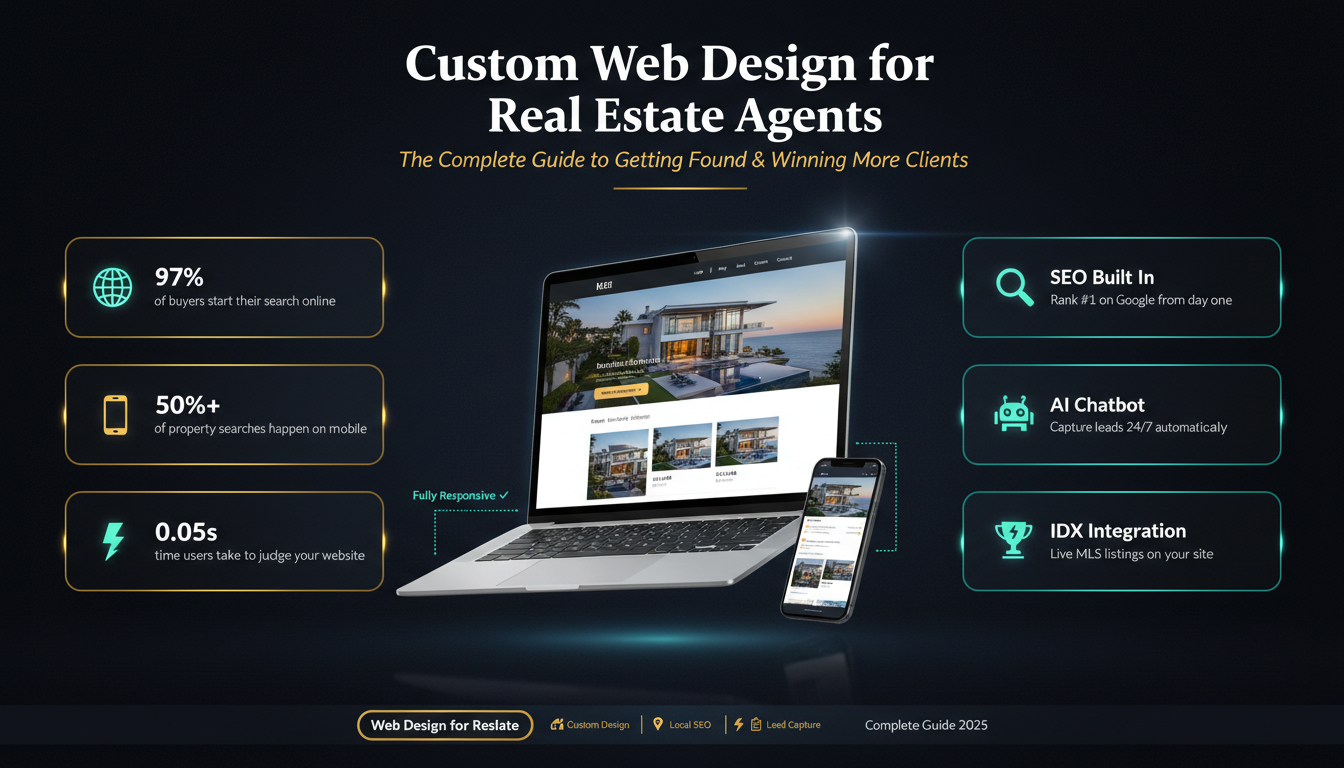
Right now, according to the National Association of Realtors, 97% of homebuyers use the internet to search for properties. Your website is the very first thing many of them see. It is your shop window. It is your business card. It is your 24/7 sales team.
The good news? Most real estate websites are just… average. That means smart web design for real estate agents is one of the biggest opportunities you have right now to get more clients, more calls, and more closings.
This guide will show you exactly how to build a real estate website that gets found on Google, earns trust with buyers and sellers, and turns visitors into actual clients.
Here is something most agents don’t want to hear:
If your website looks like everyone else’s, buyers will not remember you.
Most real estate websites are built on the same 5–6 templates. Same layout. Same stock photos. Same “Buy. Sell. Invest.” headline. A buyer visits your site, then your competitor’s site, and they can barely tell the difference.
That is a huge problem.
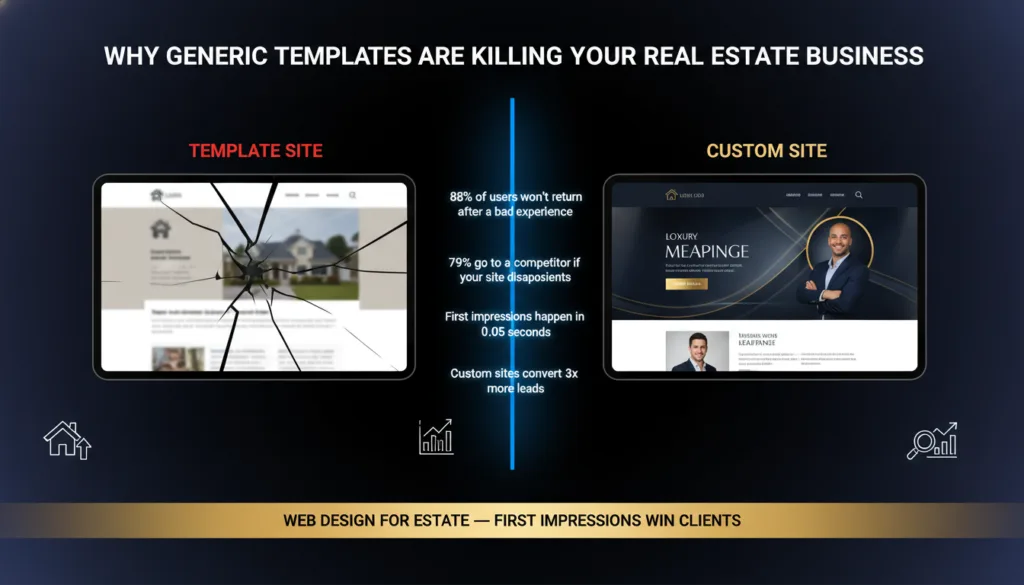
Research shows that 88% of users will not return to a website after a bad experience. And 79% of buyers will simply go to a competitor’s site if your site doesn’t impress them in the first few seconds.
First impressions happen fast. Studies show people judge a website in just 0.05 seconds, which is less than the blink of an eye.
Custom Design vs. Template: What’s the Real Difference?
| Feature | Template Website | Custom Website |
| Design | Looks like 1000 other sites | Unique to your brand |
| Flexibility | Limited | Fully flexible |
| Load Speed | Often slow | Optimized for speed |
| SEO Setup | Basic, generic | Built for your market |
| First Impression | Forgettable | Memorable |
| Conversion Rate | Lower | Higher |
| Cost | $50–$200/month | $5,000–$25,000 one-time |
A custom website is not just about looking pretty. It is about building trust, showing professionalism, and giving buyers and sellers a reason to choose YOU over the next agent on the list. If you are not sure where to start, SitesnApps helps businesses build custom websites that are designed to stand out and convert.
Most agents make a big mistake. They jump straight into colors, fonts, and layouts without ever stopping to ask: “What do I actually want my brand to say?”
Your website is just the face of your brand. If you don’t know what your brand stands for, your website will look confused, and confused visitors don’t become clients.
Ask yourself these questions before you design anything:
Once you know your “why,” you can build a look and feel around it. Your brand identity includes:
Here is the key thing to remember: A custom website without a brand is just an expensive template.
Get your brand right first. Then build your website around it.
Okay, now let’s talk about the actual features your website needs. Good web design for real estate is not just about looking nice. It needs to DO things. It needs to help buyers search, help sellers get valuations, and help YOU capture leads.
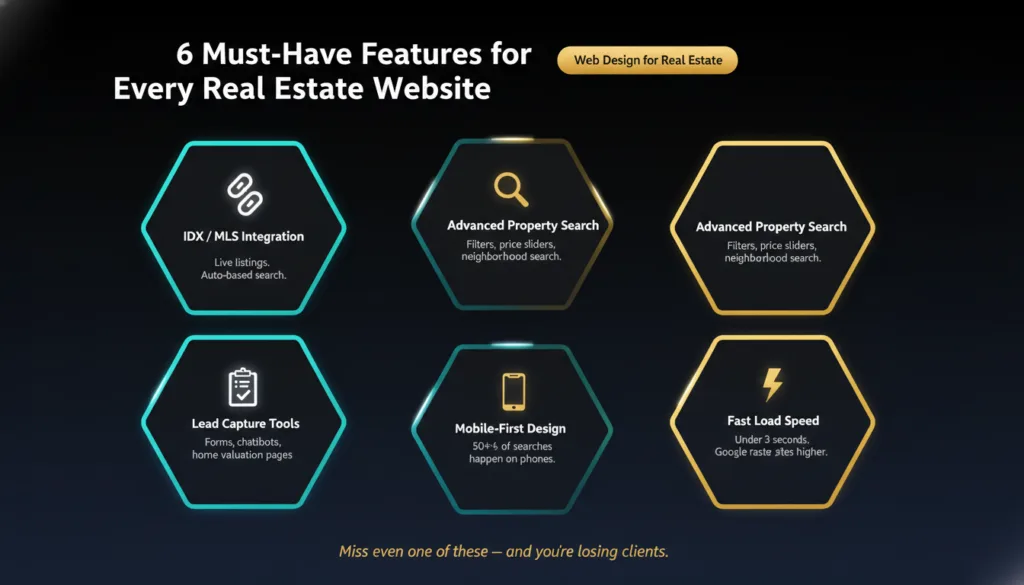
Here are the non-negotiable features every real estate website should have:
IDX stands for Internet Data Exchange. In simple terms, it lets you show live property listings directly on YOUR website, pulling data from the Multiple Listing Service (MLS) automatically.
Without IDX, your website is just a brochure. With IDX, it becomes a full property search engine.
What good IDX includes:
The best part? When buyers save searches and come back to YOUR website to check listings, you build a habit. They stop going to Zillow and start coming to you.
A basic search box is not enough anymore. Today’s buyers expect a smooth, intuitive search experience similar to what they get on Zillow or Realtor.com.
Your property search should include:
When searching for a home feels easy on your site, buyers stay longer, and they trust you more.
Getting traffic to your website is only half the battle. You also need to capture that traffic and turn it into leads.
Here is where most real estate websites fall short. They have a “Contact Me” page buried in the menu, and that’s it.
Smart real estate websites use multiple lead capture tools:
The goal is simple: make it as easy as possible for a visitor to raise their hand and say,y “Yes, I want help.”
More than 50% of all real estate searches now happen on a phone.
That means if your website looks great on a desktop but falls apart on a mobile screen, you are already losing half your potential clients.
Mobile-first design means:
Google also ranks mobile-friendly sites higher in search results. So mobile design is not just about user experience; it is a direct SEO advantage.
People do not buy homes based on words. They buy homes based on how a property makes them FEEL. And feelings come from visuals.
Your website needs:
Great visuals keep people on your site longer, build an emotional connection to properties, and make your brand look premium.
Here is something most real estate websites completely ignore:
Buyers are not just buying a house. They are buying a neighborhood. A lifestyle. A community.
They want to know: What are the schools like? Where do people eat breakfast on Sundays? Is it walkable? Is it quiet? What’s the vibe?
Zillow and Realtor.com show listings. But they can’t tell the story of what it FEELS like to live in your city. That is your opportunity.
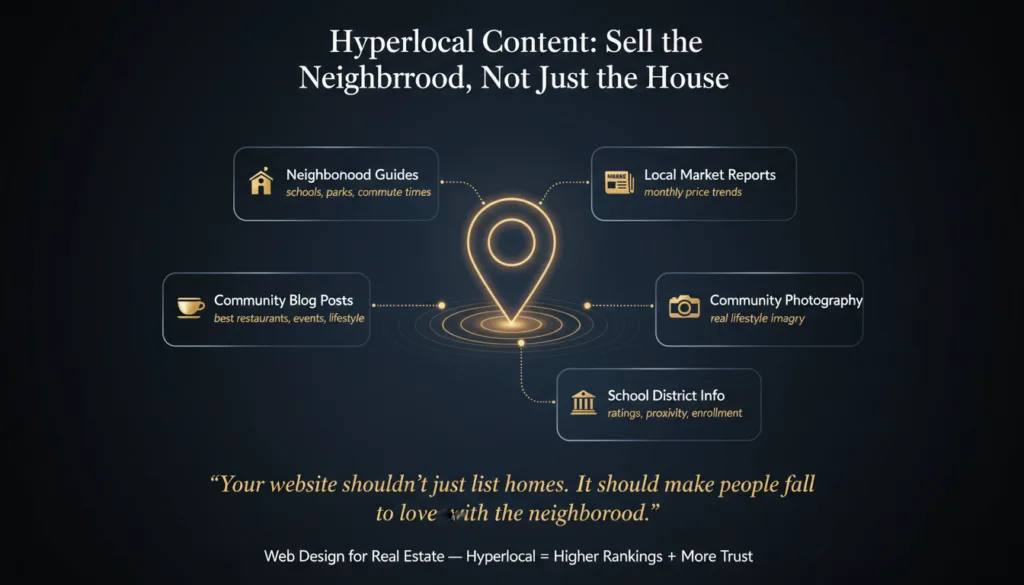
When buyers land on your site and find this kind of local content, they think: “This agent really knows this area.” That trust is priceless, and no template site can replicate it.
“Your website shouldn’t just list homes. It should make people fall in love with the neighborhood.”
A beautiful website that nobody can find is useless.
SEO (Search Engine Optimization) is what helps your website show up when someone types “homes for sale in [your city]” into Google. And here’s the critical thing most people get wrong: SEO needs to be built into your website from the very beginning, not added on afterward.
Good web design for real estate always has SEO baked in.
Every page on your website needs:
Local SEO is about showing up when people search for real estate in YOUR area. It is the most valuable type of SEO for real estate agents.
How to win at local SEO:
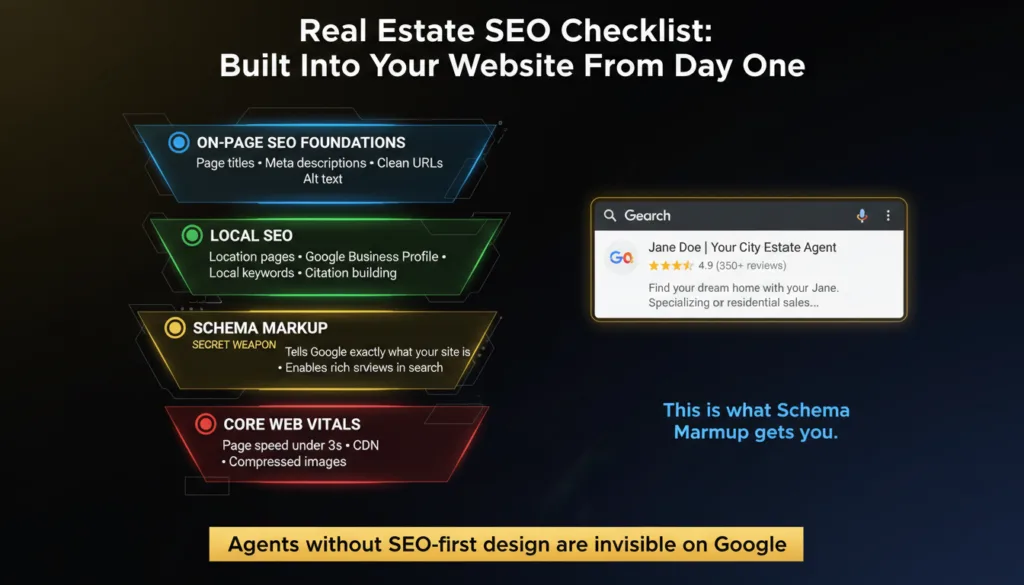
This one is almost never talked about in the real estate world, but it is incredibly powerful.
Schema markup is a bit of code you add to your website that helps Google understand exactly what your content is about. For real estate agents, it tells Google: “This is a real estate agent located in [City], and these are their listings.”
What schema markup does for you:
If your web designer doesn’t know what schema markup is, that is a red flag.
Google cares deeply about how fast your website loads. Slow sites get pushed down in search rankings. And slow sites lose visitors 53% of mobile users abandon a site that takes longer than 3 seconds to load.
How to keep your site fast:
Aim for a page load time under 3 seconds. Use Google’s free PageSpeed Insights tool to check yours.
Here is a truth that many agents overlook:
People don’t hire agencies. They hire people.
Buyers and sellers want to know WHO they are working with. They want to feel like they know you before they pick up the phone. Your agent bio page is where that connection happens.
Most agent bio pages are terrible. They say something like: “Hi, I’m John. I’ve been in real estate for 12 years. I love helping families find their dream home. Call me.” That tells nobody anything interesting.
Think of your bio page as a landing page with one goal: to make someone feel comfortable enough to contact you.
The world of real estate websites is changing fast. The best agents are already using new technology to stay ahead.
Here’s what is changing RIGHT NOW in web design for real estate:
Imagine a buyer visits your website at 11 pm on a Saturday. They have questions. With a regular contact form, they submit and wait until Monday. With an AI chatbot, they get answers immediately.
AI chatbots can:
You wake up on Monday with warm leads already waiting without doing anything.
Smart real estate websites can track what a visitor looks at and show them more of what they like, similar to how Netflix recommends your next show.
If a buyer keeps looking at 3-bedroom homes in a certain price range, the site automatically surfaces more of those listings. This keeps buyers on your site longer and makes their experience feel personal.
Empty homes are hard to sell. Virtual staging tools use AI to digitally furnish an empty room, turning a bare concrete floor into a beautifully decorated living room. It costs a fraction of physical staging and can be done in hours.
Some real estate websites now let buyers “walk through” a home using their phone camera or a VR headset. They can see how their furniture would fit in the living room, or take a virtual tour while sitting on their couch in another city.
This is not sci-fi anymore; it is available right now, and the agents using it are getting serious attention.
Let’s talk money. Here is what different website options actually cost:
| Website Type | Cost | What You Get |
| Template (DIY) | $50–$200/month | Basic design, limited features, looks like everyone else |
| Semi-Custom | $1,000–$5,000 | Some branding customization, better features, moderate flexibility |
| Fully Custom | $5,000–$25,000+ | Unique design, full control, built for your brand and market |
Now here is the ROI math that most people forget:
The average real estate commission is between $5,000 and $20,000 per deal.
If a custom website costs $10,000 and it helps you close just ONE extra deal per year, it has already paid for itself. Most well-built real estate websites generate far more than one additional lead per month.
Before you sign a contract with any web designer, ask these questions:
A good web design agency will want to understand YOUR business before they touch a single design element. If you are looking for a team that specializes in custom websites built for results, check out the website design services at SitesnApps, designed to help your business get found and grow online.
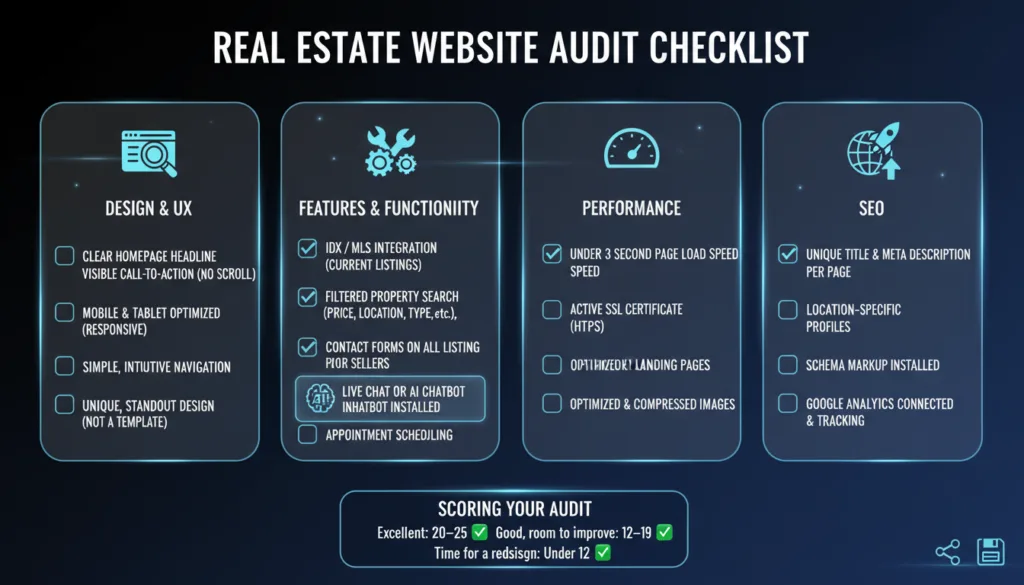
Even well-meaning agents make these mistakes. Check your site right now and see if any of these apply to you.
Mistake 1: No clear “Call to Action” above the fold- The first thing visitors see on your homepage should tell them exactly what to do next. “Search Homes,” “Get a Free Valuation,” or “Book a Call” something clear and compelling. If people have to scroll down just to figure out how to contact you, you are losing leads.
Mistake 2: Slow-loading property pages- Listings with large, uncompressed images can take 8–10 seconds to load. Most visitors leave after 3 seconds. Compress every image before uploading.
Mistake 3: Outdated listings- Nothing destroys trust faster than a listing that says “Active” when the home sold six months ago. Make sure your IDX sync is working properly so listings stay current automatically.
Mistake 4: No SSL certificate- If your website URL starts with “http://” instead of “https://”, your site is not secure. Browsers like Chrome will warn visitors that your site is “Not Secure.” This kills trust instantly and hurts your Google rankings.
Mistake 5: A weak or missing agent bio. As we talked about in Section 6, buyers hire people. If your bio is thin or missing, you are losing clients to agents who have a better story on their site.
Mistake 6: No local content- If your website has zero blog posts, no neighborhood guides, and no local market info, you are invisible to anyone searching for local real estate information. Add local content consistently.
Mistake 7: Ignoring your website analytics. Google Analytics is free. It tells you exactly how many people visit your site, where they come from, and what pages they read. If you don’t look at this data at least once a month, you are flying blind.
Mistake 8: Not updating the site. An outdated website says, “I don’t care about the details.” Keep your content fresh. Update your listings. Add new testimonials. Post new blog content. Google rewards fresh, updated sites with better rankings.
Here is the bottom line.
The real estate market is competitive. Buyers and sellers have more choices than ever. When someone is deciding which agent to call, their first stop is almost always Google, and your website is what they find first.
Good web design for real estate is not about being flashy. It is about being clear, trustworthy, fast, and easy to use. It is about telling your story, showing your listings, and making it effortless for someone to reach out.
The agents winning right now have websites that:
This is what separates a website that just exists from a website that actually grows your business.
You don’t need to do everything at once. Pick two or three things from this guide and start there. Fix your bio page. Add a neighborhood guide. Set up your Google Business Profile. Small improvements add up fast.
And if you are ready to build a custom website that is designed specifically for your market, your brand, and your clients, contact us today for a free consultation.