

SEO and social media solve two different problems. SEO puts your business in front of people who are already searching for what you sell. Social media puts your business in front of people who have not started looking yet.
Most business owners treat this as a choice: SEO or social media, pick one. It almost never is. The more useful questions are which channel deserves your first dollar, and how the two feed each other once both are running.
This guide covers the difference between SEO and social media marketing, how social media impacts SEO (including what social signals actually do and do not do for rankings), and how to run both as one system instead of two disconnected tasks.
The fastest way to understand the difference between SEO and social media is to look at what each one is built to do.
SEO focuses on:
Social media focuses on:
Both are legitimate. Both grow businesses. Treating them as interchangeable is one of the most common marketing mistakes small and mid-sized companies make, because the two channels reach people at completely different moments.
SEO, or search engine optimization, is the practice of improving your website so it appears higher in unpaid search results. When someone types a question into Google, the pages that appear are there because Google judged them to be the most relevant and trustworthy answers for that query.
Search engines use automated crawlers to scan websites, read content, evaluate site structure, and assess how many credible sites link back to yours. Optimizing for SEO means making it easy for Google to understand what your page covers and why it deserves to outrank a competitor.
SEO breaks down into four connected disciplines:
That is the short version. If you want the full picture of how site structure and search visibility interact, see our guide on how web design and SEO work together.
Social media marketing uses platforms like Facebook, Instagram, LinkedIn, X, TikTok, and YouTube to build an audience, distribute content, and talk directly to current and potential customers.
Social platforms use algorithms to decide who sees what. When you post, the platform reads engagement signals such as likes, comments, shares, and watch time, then decides whether to show your content to a wider audience. Paid social works differently: you pay to place content in front of a defined audience segment based on demographics, interests, behaviour, or location, whether or not those people were looking for you.
Each platform serves a different purpose:
One distinction matters more than most businesses realise. Organic social costs no money but a lot of time, and organic reach on most major platforms has declined sharply over the past several years. Paid social delivers faster, then stops the moment your budget stops.
This is the single most important difference. Someone searching “best HVAC company in Lafayette, LA” is ready to hire. Someone scrolling Instagram is not looking for anything in particular. They might notice your post and remember your brand, but the interaction starts from a completely different place.
SEO is a demand-capture channel. It positions you to reach people who already want what you sell. Social media is a demand-generation channel. It builds interest among people who did not know they needed you.
Neither is superior. They serve different stages of the funnel. Social media gets you noticed. SEO gets you chosen.
Organic search traffic tends to convert at higher rates than social traffic. Research from BrightEdge puts organic search at roughly 53% of all website traffic on average, and that traffic usually carries stronger purchase intent than social referrals. Social traffic is not worthless. It just behaves differently, and your expectations should match.
An SEO-optimized blog post can rank and drive traffic for three, five, or even ten years with light updates. A social post peaks within 24 to 48 hours and then effectively disappears from feeds. Over a year, that gap compounds into a large difference in marketing efficiency.
Social media produces visibility almost immediately. Publish a post or run an ad and people see it within minutes. SEO takes time. Most new pages need three to six months to rank meaningfully for competitive keywords, and some take longer.
If you need leads this week, paid social will outperform SEO. If you want steady leads twelve months from now without ongoing ad spend, SEO wins.
SEO costs are front-loaded into content, technical work, and outreach, then the returns compound. Paid social requires continuous spend to maintain results. Over a twelve-month horizon, SEO usually produces a lower customer acquisition cost, because one well-ranked page can generate hundreds of leads with no additional spend. In the short term, paid social delivers faster leads at a higher cost per lead.
Social media wins on speed of awareness and on genuine two-way conversation. Comments, direct messages, and interactive content build community in a way SEO cannot replicate. SEO builds awareness more slowly, through consistent presence in search results over time.
Your website and its rankings are owned media. Your social profiles are rented. The platform owns the audience and can change its algorithm, throttle your reach, or close your account. This is one of the strongest arguments for building an SEO foundation: rankings do not vanish overnight the way social reach can.
| Factor | SEO | Social Media |
| Speed of results | Slow (3–6+ months) | Fast (immediate) |
| Traffic intent | High (active searchers) | Lower (passive browsers) |
| Content lifespan | Long (years) | Short (24–48 hours) |
| Cost over time | Decreases | Continuous spend required |
| Brand awareness | Builds gradually | Builds quickly |
| Engagement | Limited | High |
| Audience control | You own the traffic | Platform controls reach |
| Best for | Long-term lead generation | Awareness and community |
| Algorithm dependence | Google’s algorithm | Platform algorithms |
| ROI timeline | 6–18 months | Shorter with paid ads |
Benefits of SEO
Limitations of SEO
Benefits of social media marketing
Limitations of social media marketing
Here is the honest answer: social signals are not direct ranking factors. Google has said so consistently for years, from Matt Cutts’ public comments in 2014 through more recent statements from the search team. Your like count, share count, and follower total are not inputs Google’s core algorithm reads to decide where you rank.
That is not the same as saying social media does nothing for SEO. Social activity creates downstream effects that do influence rankings.
| Signal type | Examples | Used directly by Google? |
| Direct ranking factors | Backlinks, page speed, content quality, relevance | Yes |
| Social engagement metrics | Likes, shares, followers, comments | No |
| Bridge signals | Referral traffic, branded search, brand mentions, earned links | Indirectly, through the direct factors they create |
Social media sits in that middle row. It feeds the factors Google measures without being one itself. Understanding this stops you from chasing metrics that will never move a ranking, and points your effort at the four paths that genuinely do.
Crawlers do not sit and wait for a sitemap ping. When a new page is shared and clicked shortly after publishing, that circulation is an early signal the page exists, and search engines often find and index it faster. This matters most for time-sensitive content such as a local announcement or a limited promotion.
Every post is a chance for someone new to click through to your site. That referral visit does not move your ranking by itself. It does create the conditions that matter: more people reading your content, more chances one of them cites it, and more chances one of them becomes a customer. A local HVAC company posting seasonal maintenance tips typically sees a visible bump in site visits that week, and a share of those readers come back.
The more people encounter your brand socially, the more of them type your business name straight into Google later. Branded search is a strong indicator that real people recognise and trust a business, and it tends to move in step with the rest of your marketing. It is also one of the cleaner ways to tell whether your social presence is doing anything at all.
Search engines take weeks to fully surface new content. Social platforms surface it in minutes. That makes social media the fastest distribution layer available for the content you built for search, which is a different job from being a ranking factor and arguably a more useful one.
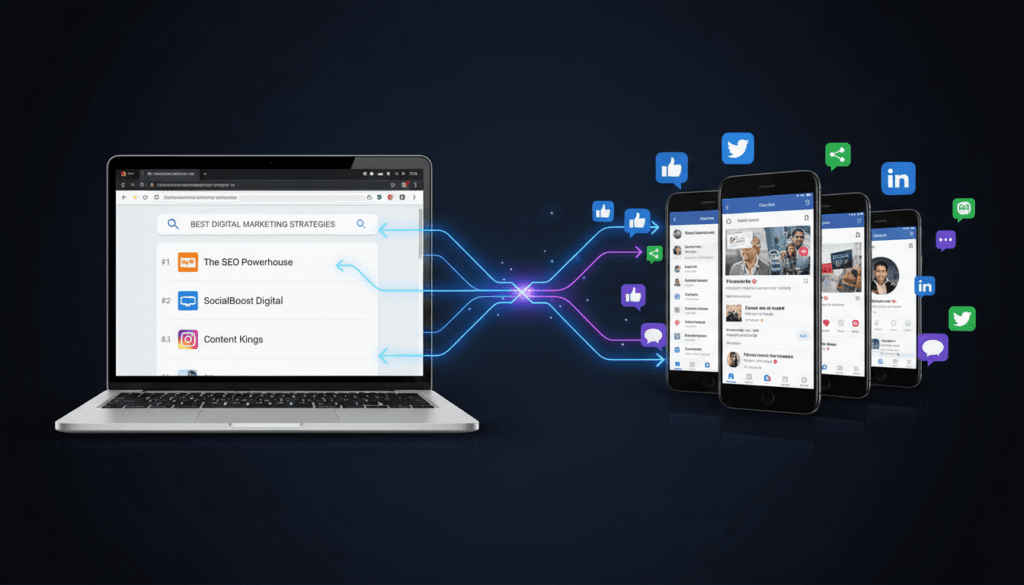
A long-form article can be cut into carousel posts, short videos, quote cards, and a LinkedIn summary. You do the research once and put it in front of several audiences, each of which can send traffic and attention back to the original page. Content that nobody sees earns nothing, and publishing without promotion is the most common reason good SEO content underperforms.
Google’s quality guidelines emphasise Experience, Expertise, Authoritativeness, and Trustworthiness (E-E-A-T). Search engines increasingly treat businesses as entities rather than as collections of pages, and consistent social profiles help confirm you are a real, established company. Matching business names, addresses, and phone numbers across your website and every social platform feeds directly into local knowledge panels and search results. Inconsistent details do the opposite.
A share from a recognised industry voice also carries more weight than a hundred shares from unrelated accounts, because quality of source now matters more than raw volume.
Your comments, DMs, and community threads are free keyword research. The questions people ask you repeatedly are the questions they are also typing into Google. Turning those recurring questions into search-optimized pages is one of the highest-return uses of a social presence, and it closes the loop between the two channels.
This is the strongest connection between social media and SEO. Journalists, bloggers, and industry writers frequently find sources through social feeds. A well-researched post that circulates on LinkedIn can attract citations from industry publications, and backlinks remain among Google’s most heavily weighted ranking factors, as Moz documents in detail. Those earned links validate your expertise far more than the original post ever could.
Reviews, video testimonials, before-and-after photos, and customer stories build a kind of trust that website copy cannot manufacture on its own. Google Business Profile reviews influence local rankings directly, and social engagement reinforces them. The two create a loop: more visible trust, more clicks from search results, more visibility.
Tools like ChatGPT, Perplexity, and Google’s AI Overviews pull from content across the web, and they favour sources that already show signs of authority and consistency. Content that earned engagement and links through social distribution is more likely to be the source an AI tool cites. Publishing consistent facts across your site and social channels improves those odds.
| SEO | Social Media |
| Long-term organic growth | Faster audience engagement |
| Search intent based | Interest and community-based |
| Builds sustainable traffic | Builds relationships |
There is no universal answer. The right choice depends on your goals, your stage, and where your customers already look for businesses like yours.
| Budget range | Recommendation |
| Under $500/month | Local SEO plus organic social |
| $500–$1,500/month | SEO-first with light social support |
| $1,500–$3,000/month | Balanced SEO and social strategy |
| $3,000+/month | Full integrated strategy with paid social |
If your goal is awareness, social gets you there faster. If your goal is consistent lead generation, SEO delivers more reliably. If your goal is revenue growth without a matching rise in marketing spend, SEO is the better path.
Search behaviour is shifting, and it changes how you should think about both channels.
Social SEO means optimizing your social content and profiles for discovery inside the platforms themselves. According to Adobe’s 2023 Future of Creativity study, roughly 40% of Gen Z users prefer searching on TikTok or Instagram over Google for certain queries, particularly restaurant recommendations, product reviews, and how-to content. LinkedIn has become a real discovery surface for B2B. Google is not irrelevant. Your audience is simply searching in more places than one.
Practically, that means treating your bio and profile descriptions the way you treat on-page SEO: relevant keywords, a clear description of what you do and who you serve, and location identifiers if you are local. Captions and video transcripts function as searchable content, so use real terms in your captions rather than relying on hashtags alone. On YouTube, titles and descriptions work almost identically to on-page SEO.
For businesses serving the Lafayette market, the channel decision has a clear answer in most cases: lead with SEO, support it with social.
Lafayette is competitive across HVAC, legal services, healthcare, and food service, and most residents searching for a local business use Google. Your Google Business Profile is the single most important local SEO asset you have. A complete profile with accurate hours, photos, service descriptions, and consistent name, address, and phone details improves your visibility in local results directly. The local pack, the three map results at the top of local searches, drives a large share of calls and site visits, and it is earned through local SEO rather than social activity.
Reviews influence both local pack rankings and click-through rate from search results, so actively requesting them from satisfied customers is one of the highest-return actions available to a local business. Consistent citations across directories like Yelp, Angi, and industry-specific sites reinforce the same signals, while inconsistent listings weaken them.
Social media does real work here too. Facebook remains strong for community engagement in Lafayette, where local groups and neighbourhood pages are where residents recommend businesses to each other. Tagging your location, joining local conversations, and cross-posting reviews between Facebook and your Google Business Profile all reinforce local relevance and help you appear in more “near me” searches across Acadiana.
The strongest strategies do not treat these channels as competitors. They run them as one system.
SEO captures people actively searching. Social media creates awareness among people who are not searching yet. That covers both ends of the funnel instead of one.
Social channels distribute SEO content. Your best-performing article can reach an audience in hours instead of waiting weeks for search engines to surface it.
SEO content supplies material for social campaigns. Keyword research tells you which topics have real demand, which makes for better social content than guessing.
Presence in both places compounds trust. When a prospect sees your business in Google results and again in their feed, you become familiar. Familiarity converts. A customer might find you through a social ad, leave without buying, then search your name weeks later and land on your content. Both channels earned that sale.
Track SEO performance in Google Analytics and Google Search Console: organic traffic, keyword rankings, branded search growth, and conversions from search. Track social performance in native platform analytics: engagement rate, click-through rate, and conversion rate from social traffic, which all tell you more than follower count does. Then look at where the two overlap. Watch social referral traffic trends, and when new backlinks appear, check whether they trace back to a social share.
Most businesses see branded search and referral traffic respond within 60 to 90 days of consistent social activity paired with strong website content. Ranking improvements take longer.
SEO vs social media is the wrong framing for most businesses. The real question is how to run both in a way that fits your budget, your goals, and where your customers already are.
If you run a local service business or any company that needs steady, qualified leads, SEO should be the foundation. Build it properly, then use social media to distribute what you create and to build the brand recognition that makes people search for you by name.
Social media will not move your rankings on its own. It will feed the traffic, links, branded search, and trust that do, and it will do it faster than search engines can. Used together, each channel makes the other one work harder.
If you want an experienced team to assess your current visibility and build a strategy for both channels, Sites N Apps works with businesses across Lafayette and beyond. We offer a free 30-minute strategy call and a free website audit. See our SEO optimization services or get in touch to get started.
Not directly. Google does not use likes, shares, or follower counts as ranking factors. Social media improves SEO indirectly by driving referral traffic, earning backlinks when your content gets discovered, increasing branded search volume, and building the trust signals search engines do measure.
Neither is better in the abstract. SEO produces higher-intent traffic and compounding long-term returns, which suits businesses that need consistent leads. Social media produces faster awareness and direct engagement, which suits new brands, visual products, and time-sensitive campaigns. Most established businesses get the best results from both.
No. Social media reaches people who are not looking for you, and platform reach is rented rather than owned. It cannot capture the person actively searching for your service, and an algorithm change can erase your visibility overnight. Social media is a distribution channel for SEO content, not a substitute for it.
Every post with a link is a route back to your site, and social platforms surface new content within minutes rather than weeks. That referral traffic also improves the odds of secondary benefits: repeat readers, natural backlinks, and people searching your brand name later.
Start by asking how your current customers find you. If they come mostly from referrals and you have little search visibility, SEO should be the priority, especially for local service businesses. If you already rank for your key terms but few people know your brand, social investment makes more sense. As a general rule, a business older than 12 months with a functioning website sees better long-term ROI from SEO.
Most businesses see meaningful organic traffic improvements within three to six months of consistent work. Competitive markets take longer. The timeline depends on your starting authority, content quality, and how aggressively competitors are optimizing.
Branded search growth and referral traffic usually become visible within 60 to 90 days of consistent, quality social activity paired with strong website content. Backlink and ranking effects build more gradually.
It depends on your audience. LinkedIn tends to drive the strongest backlinks for B2B content. YouTube has the most direct crossover with Google search. Instagram and TikTok increasingly function as search engines themselves for product research and recommendations.
Reviews are not a social platform, but they work like social proof and they do influence local search rankings and click-through rate directly. Cross-promoting reviews between your social channels and your Google Business Profile reinforces both.