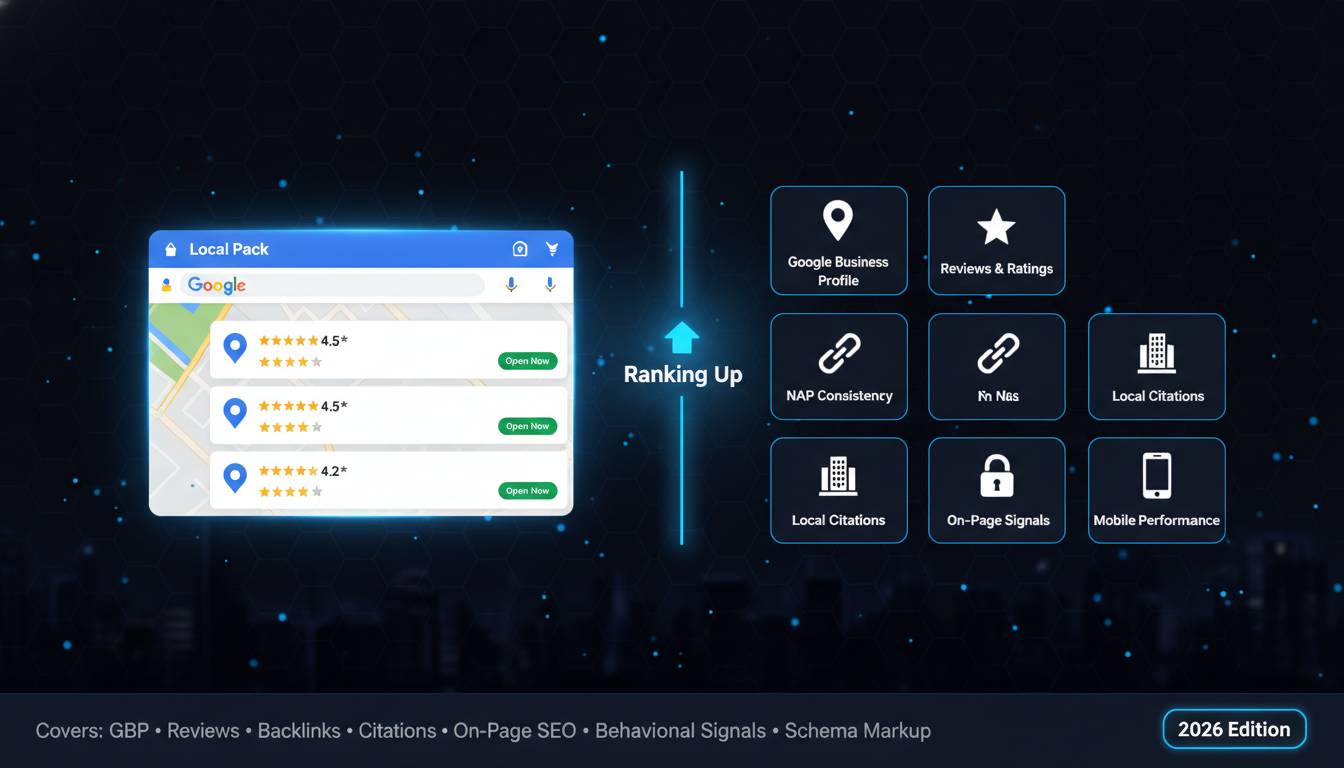
You have a great business. Your customers love you. But when someone nearby Googles the exact thing you offer, a competitor down the street shows up, and you don’t. That is a local SEO problem. And the good news is, it is completely fixable.
This guide covers every major local SEO ranking factor in plain, simple English, no jargon, no fluff. By the end, you will know exactly what Google looks at, what you need to fix, and where to start.
Local SEO ranking factors are the specific signals Google uses to decide which businesses to show when someone does a location-based search, like “dentist near me” or “best pizza in Chicago.”
Think of it like a scorecard. Google is constantly evaluating businesses across dozens of criteria. The businesses that score highest on the most relevant factors are the ones that show up in the local pack, that prominent map section with three business listings that appears at the top of Google search results.
These factors are different from regular SEO signals. General SEO is about ranking content for broad topics. Local SEO ranking factors are specifically tied to location, trust, and proximity. And for small businesses, this distinction matters a lot, because local SEO is where you can genuinely compete with bigger brands.
Before diving into each factor, it helps to understand the framework Google uses. Every local SEO ranking factor falls under one of three pillars:
• Relevance: Does your business match what the user searched for?
• Distance, How close is your business to the person searching?
• Prominence: How well-known and trusted is your business online?
Relevance and distance are largely determined by how well you have set up your business information. Prominence is built over time through reviews, backlinks, citations, and content. The rest of this guide is organised around these three pillars.
Local SEO does not exist in isolation; it sits on top of general SEO foundations. The factors that matter for all websites also matter for local search:
• Website loading speed, slow sites lose both visitors and rankings
• Mobile-friendliness, most local searches happen on phones
• Quality and relevance of your website content
• Backlinks, other websites linking to yours
• HTTPS security, your site should start with https, not http
If these basics are broken, local SEO efforts will only get you so far. Think of them as the floor, and the local-specific factors below as everything that builds on top.
Google Business Profile (GBP), hands down.
GBP is your free business listing on Google Maps and in local search results. It is the first thing Google checks when deciding whether to show your business. A fully completed, actively managed GBP is the fastest route to appearing in the local pack.
Here is what a strong GBP looks like:
• Every field is filled in: name, address, phone, website, hours, and description
• You have chosen the most accurate primary business category
• You have uploaded real, high-quality photos of your business
• You are posting updates and offers regularly using the Posts feature
• You have answered common questions in the Q&A section before customers even ask
Action Tip: Log into your Google Business Profile today and check every single field. Anything blank or outdated? Fix it before moving on to anything else.
Now that GBP is covered, let’s go through every other major local SEO ranking factor , and what you can do about each one.
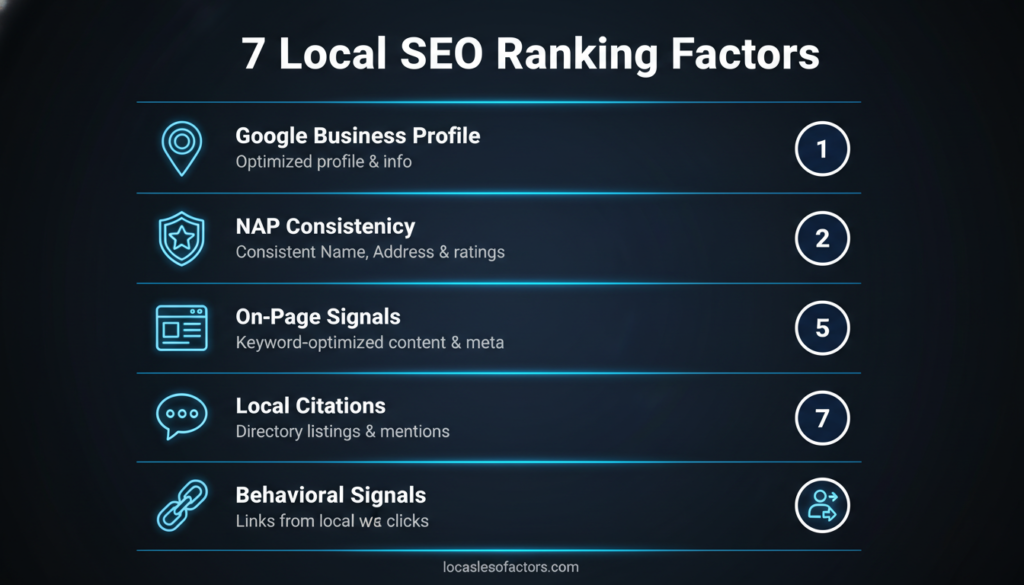
Your GBP is where everything starts. Fill out every field completely: business name, address, phone number, website, hours, and description. Choose the most accurate primary category, add secondary categories where relevant, and upload real photos of your business. Use the Posts feature to share updates or offers, and answer common questions in the Q&A section before customers even need to ask.
Action Tip: Log into your Google Business Profile and check every single field. Anything blank or outdated? Fix it before moving on to anything else.
NAP stands for Name, Address, and Phone Number. Google cross-references your business information across many different websites. If it finds inconsistencies, a different phone number here, a slightly different address format there, it loses confidence in your listing, and your rankings drop.
Your NAP must be 100% identical everywhere:
• Your website footer and contact page
• Every online directory (Yelp, Bing Places, Facebook, Apple Maps, etc.)
• Social media profiles
• Any press mentions or partner websites
Action Tip: Google your business name right now. Click every listing that appears and compare the name, address, and phone number carefully. Fix any that do not match exactly.
Reviews influence both your Google ranking and whether real customers choose you over a competitor. Google looks at three things: how many reviews you have, your overall star rating, and how recently reviews were left.
A business with 80 reviews from the past year will almost always outrank one with 10 reviews from three years ago, even if that older business has a slightly higher rating.
How to build a steady stream of reviews:
• Ask customers right after a positive experience, timing is everything
• Send a follow-up text or email with a direct link to your Google review page
• Respond to every review, positive or negative, as it shows Google and customers that you are active and care
• Never buy fake reviews; Google detects them, and the penalty can remove your listing entirely
Action Tip: Create a simple follow-up message you send after every sale or job. Something like: ‘Happy we could help! Would you mind leaving us a quick Google review? Here’s the link.’ That is all it takes.

Your website needs to clearly communicate where you are and what you do, not just to visitors, but to Google’s crawlers. Many small business websites completely miss this.
Key on-page signals to get right:
• Include your city or region in your homepage title tag and H1 heading
• Write your business address and phone number in the footer of every page
• Embed a Google Map on your contact page
• Create separate location pages if you serve multiple areas, one page per city
• Write blog posts about local topics, events, or community news to build local relevance over time
Action Tip: Open your website homepage right now. Does the page title include your city? Is your address in the footer? If not, those are two quick wins you can fix today.
A citation is any online mention of your business name, address, and phone number, even without a link back to your website. Citations help Google verify that your business is legitimate and that your information is accurate across the web.
The most valuable directories to appear on:
• Yelp
• Bing Places for Business
• Apple Maps
• Your local Chamber of Commerce website
• Industry-specific directories (TripAdvisor for hospitality, Houzz for home services, Healthgrades for medical, etc.)
Do not chase hundreds of random directories. Ten accurate, relevant listings on authoritative sites are worth more than fifty inconsistent ones on low-quality directories.
Action Tip: Pick the five most important directories for your industry and make sure your NAP is listed there correctly. Then expand from there.
A backlink is a link from another website to yours. In local SEO, links from locally relevant websites carry extra ranking power; a mention from your city’s newspaper or a local business association link is worth far more than a generic directory link.
Practical ways to earn local backlinks:
• Get featured in a local news article or community blog
• Sponsor a local event, charity, or sports team, many include a website credit
• Join your local Chamber of Commerce (they typically link to all members)
• Partner with nearby non-competing businesses for cross-promotions or guest posts
Action Tip: Make a list of five local websites, blogs, or organisations that might mention your business. Reach out to just one this week. One local link can make a meaningful difference.
Google quietly tracks how people interact with your listing in search results. These behavioural signals include:
• How often do people click on your listing versus a competitor’s
• How many people request directions to your location
• How many people call you directly from the search results
• How long visitors stay on your website after clicking through
You improve these signals by making your listing and website genuinely more appealing. A strong cover photo, an honest and specific business description, and a clear call to action; these small details drive more clicks and interactions, which in turn tell Google your business is worth ranking higher.
Action Tip: Look at your listing from a customer’s perspective. Does the cover photo make a good impression? Is your business description clear about what you do and who you serve? Would you click on it?
Schema markup is a small piece of code added to your website that helps Google instantly understand your business details, your type of business, location, opening hours, and more. It does not directly guarantee a ranking boost, but it helps Google read your site with more confidence. Free tools like Google’s Structured Data Markup Helper let you generate it without touching a line of code yourself.
Social media is not a direct Google ranking signal, but it supports your local SEO indirectly. An active Facebook or Instagram presence builds brand familiarity. When people recognise your business name before they search, they are far more likely to click your listing. Just make sure your business name, address, and phone number match your other listings.
Every time a customer tags your location on social media, uploads a photo to your Google listing, or checks in on Facebook, they are adding a small local relevance signal around your business. Encourage this naturally; a simple ‘tag us if you share a photo’ is all it takes.
Even businesses that care about their online presence often fall into these traps:
• Duplicate Google Business Profile listings, having two profiles for the same location, splits your ranking signals and confuse Google
• Ignoring negative reviews, leaving them unanswered, signals to both Google and potential customers that you are not engaged
• Targeting keywords that are too broad, ‘lawyer’ is not a local keyword; ‘family lawyer in Denver’ is
• Never updating your website, stale content with no new posts or pages signals an inactive business
• Skipping location pages, if you serve five cities but only mention one on your website, you are invisible in the other four
None of these is hard to fix once you know about them.
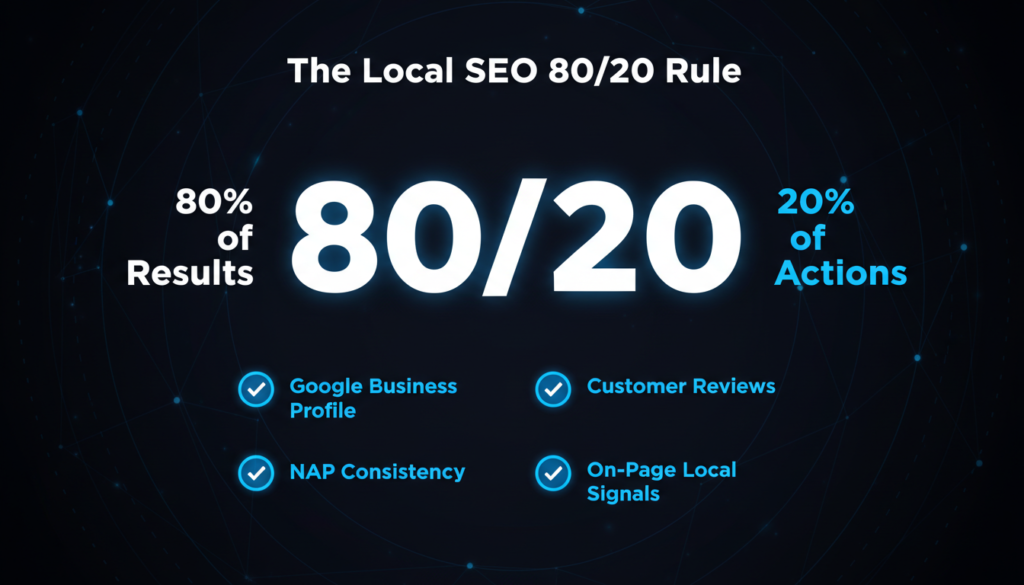
The Pareto Principle says 80% of your results come from 20% of your actions. In local SEO, this is especially true. You do not need to do everything at once, and trying to do so usually leads to doing nothing well.
The 20% that drives the most results for most small businesses:
• Google Business Profile, fully completed and actively maintained
• Customer reviews, a steady, ongoing stream of genuine ones
• NAP consistency, identical across every platform
• On-page local signals, city in title tags, address in footer, location pages
Get these four things right before anything else. The backlinks, schema markup, and social media signals can come later. Focus beats breadth every time.
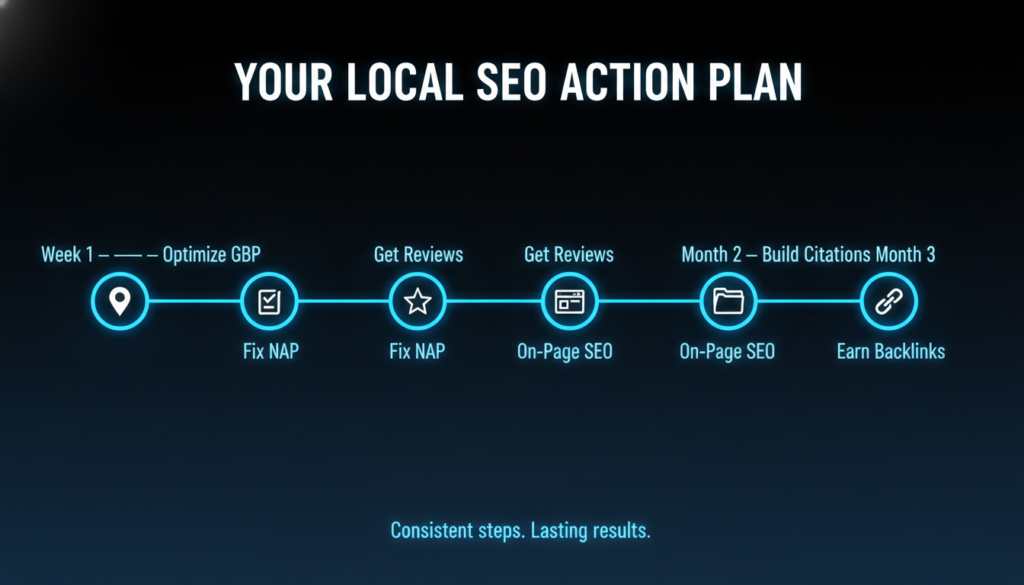
Here is a realistic, week-by-week roadmap you can actually follow:
| Timeline | Action |
| Week 1 | Claim and fully optimise your Google Business Profile |
| Week 2 | Audit NAP consistency across your website, GBP, and directories |
| Week 3 | Set up a simple review request system for customers |
| Week 4 | Add on-page local signals to your website (title tags, footer NAP, map embed) |
| Month 2 | Get listed on the top 10 local directories with identical NAP |
| Month 3 | Start building local backlinks through partnerships and press |
Bookmark this checklist. Come back to it each week. Consistency over a few months beats a burst of effort followed by nothing.
Yes, and it is one of the best returns on time you can get. Unlike paid ads that stop working the moment your budget runs out, local SEO builds momentum over time. Once you rank well, you keep getting clicks, calls, and visits without ongoing spend. For a small business trying to compete locally, it is hard to find a better long-term investment.
Small improvements, like showing up more often in searches you previously missed, can appear within 4 to 8 weeks of fixing your GBP and NAP. Breaking into the local pack or jumping significantly in rankings usually takes 3 to 6 months of consistent effort. Local SEO is not a quick fix, but the results last.
Not strictly. Some businesses rank in the local pack on GBP alone. But a well-optimised website dramatically improves your chances and gives customers a place to learn more, book services, or contact you. Think of your GBP as the front door and your website as the inside of the shop; both matter.
The fundamentals, GBP optimisation, NAP consistency, review management, and basic on-page signals, are absolutely something a small business owner can handle without hiring an agency. The more advanced tactics, like link building and schema markup, are where professional SEO help can speed things up. Start with what you can do yourself, and bring in help once you’ve hit the ceiling of the basics.
Local SEO is not about gaming Google. It is about making sure your business information is accurate, your reputation is strong, and your website speaks clearly to both customers and search engines about who you are and where you are.
The businesses that win in local search are not always the biggest or the oldest. They are the ones that show up consistently, with a complete profile, fresh reviews, accurate listings, and a website that loads fast on a phone.
Start with the checklist above. Pick one item this week and get it done. Then come back next week and do the next one. And if you ever need expert guidance along the way, Sites N Apps is here to help you build a stronger digital presence from the ground up.
Your ideal customers are already searching. Make sure they find you.
Have a question about local SEO for your specific type of business? Drop it in the comments, we read every one.