
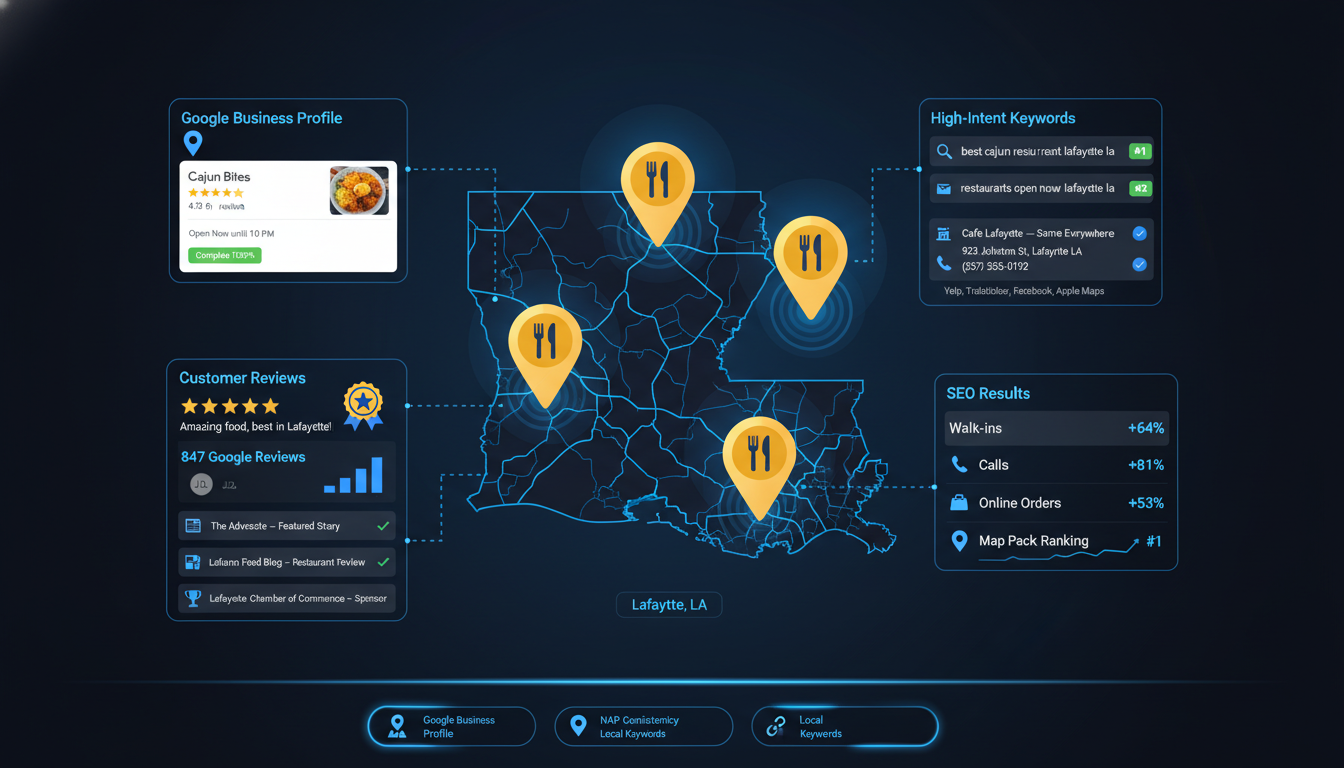
You have a great restaurant in Lafayette, LA. The food is good. The service is good. But people are not finding you on Google. That is a problem. Most people search online before they go to eat anywhere. If your restaurant is not showing up, you are losing customers every single day.
That is where local SEO for restaurants comes in. It helps your restaurant show up when people nearby search for a place to eat. This guide will show you exactly how to do it, step by step.
Want expert help getting started? Check out our local SEO guide or visit our homepage to learn how we help restaurants grow online.
Local SEO stands for local search engine optimization. It is the process of helping your restaurant show up on Google when people nearby search for food. Think of it as making your restaurant easy to find on the internet.
When someone is hungry, they grab their phone and type something like “pizza near me” or “best burger in Lafayette.” Google then shows them a list of nearby restaurants. The ones at the top get the most clicks. Those clicks turn into visits, calls, and orders.
Local SEO puts your restaurant at the top of that list. More clicks mean more customers walking through your door or ordering from you online.
“Near me” searches have grown a lot in recent years. People want food close to them, and they want it fast. Google Maps is one of the first things they check. If your restaurant is not on Google Maps or your listing is incomplete, you are invisible to these hungry customers.
Getting your restaurant to show up on Google Maps is one of the most important things you can do for your business.
Lafayette has a strong food culture. People here love to eat out. But the restaurant scene is also competitive. Local SEO helps you stand out. When your restaurant ranks higher than the one across the street, you get their customers too.
Better rankings lead to more calls, more visits, and more orders. That means real money coming into your restaurant.
Lafayette locals search for food often on their phones. They look for specific cuisines like Cajun, seafood, and soul food. They also search by neighborhood, occasion, and time of day. Understanding what your customers are searching for helps you create the right content for them.
Lafayette has hundreds of restaurants, from small family spots to large chains. The competition is real. But most local restaurants do not do much local SEO. That is your opportunity. By doing even the basics well, you can outrank restaurants that have been around longer than you.
High-intent searches mean people are ready to eat right now. Searches like “restaurants open now in Lafayette” or “best seafood Lafayette LA” are from people who want to make a decision fast. Showing up for these searches brings in customers who are ready to spend money.
Look at the Google Business Profiles of your top competitors in Lafayette. Check how many reviews they have, what photos they use, and what categories they picked. Find areas where they are weak. Maybe they have a few photos or no menu listed. Fill those gaps in your own profile, and you will have an advantage.
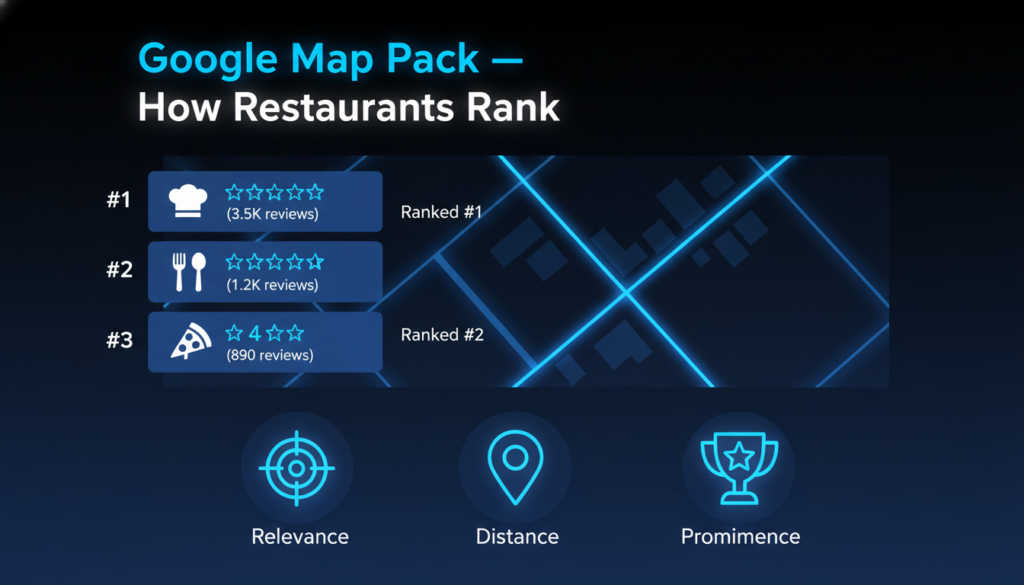
When you search for a restaurant on Google, you often see a map at the top with three restaurant listings below it. That is called the Local Map Pack, or sometimes the Google 3-Pack. These three spots get the most clicks by far. Getting into the Map Pack is one of the biggest goals of local SEO for restaurants.
Google uses three main things to decide who shows up in the Map Pack:
• Relevance: Does your restaurant match what the person is searching for?
• Distance: How close is your restaurant to the person searching?
• Prominence: How well known and trusted is your restaurant online?
Prominence comes from things like reviews, backlinks, and how complete your Google Business Profile is.
Studies show that most people click on one of the top three listings and rarely look further. If you are not in the top three, most customers will never see you. That is why ranking in the Map Pack is so important for restaurants in Lafayette.
Not everything in local SEO has the same impact. Here is what to focus on first:
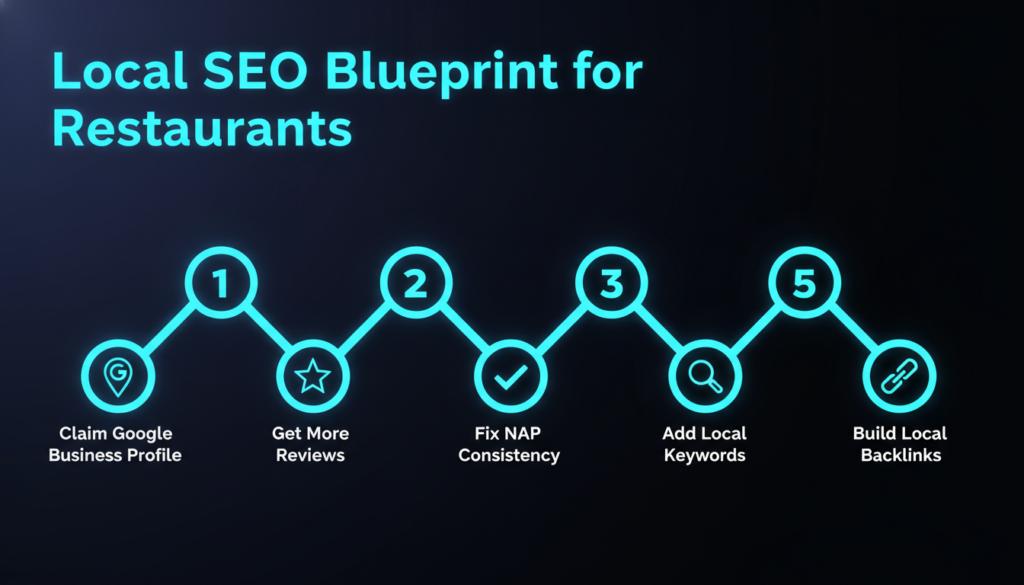
• Claim and fully complete your Google Business Profile
• Get more customer reviews on Google
• Make sure your name, address, and phone number are correct everywhere online
• Add local keywords to your website
• Build local backlinks from other Lafayette websites
Local SEO is not a one-time thing. You need to keep working on it every month. Here is a simple monthly system:
• Post new photos on Google Business Profile
• Respond to all new reviews
• Publish a Google Post about a special event
• Check your rankings and see what is improving
• Fix any wrong information you find in online directories
Your Google Business Profile (GBP) is the most important tool for local SEO for restaurants. It is the listing that shows up on Google Maps and in search results. Getting it right is the foundation of everything else.
First, go to Google Business and search for your restaurant. If it exists, claim it. If not, create it. Google will ask you to verify that you own the business, usually by sending a postcard to your address or by calling your phone number. Once verified, you can manage everything.
Fill out every single field in your profile. Do not leave anything empty. Here is what matters most:
• Business name: Use your real name, nothing extra
• Address: Must be exact and match your website
• Phone number: Use a local Lafayette number
• Hours: Keep these updated, including holidays
• Website: Link to your main website
• Categories: Choose the most accurate one as primary
Add your full menu to your GBP. Restaurants with menus listed get more clicks. Add at least 10 high-quality photos of your food, inside and outside. Google Posts are like mini social media updates right on your listing. Use them to share specials, events, and news.
Your primary category should be very specific. Instead of just “Restaurant,” choose “Cajun Restaurant” or “Seafood Restaurant” if that fits. You can add secondary categories, too. Look at what categories your top competitors in Lafayette are using and make sure you are not missing anything important.
Post at least once a week on your GBP. Share things like weekend specials, new menu items, or local events you are part of. Posts show Google that you are active and engaged. Active profiles tend to rank better than inactive ones.
Reviews are one of the top-ranking factors for local SEO. The more good reviews you have, the higher Google tends to rank you. Reviews also build trust. When someone sees 200 five-star reviews, they feel good about coming to your restaurant. Reviews are basically free advertising.
Do not wait for reviews to come in on their own. Build a system to get them regularly. Here are some easy ways to do that:
• Ask customers in person right after a great meal
• Put a QR code on your receipt that goes straight to your Google review page
• Send a follow-up text or email to customers who ordered online
• Train your staff to mention reviews to happy customers
Always respond to reviews, both good and bad. For good reviews, thank the customer and mention something specific they said. For example, if they loved the gumbo, say something like “So glad you loved the gumbo! We use a family recipe, and it means a lot to hear that.” This shows other people that you care.
Never ignore a bad review. Never argue or get defensive. Instead, apologize for the experience, take responsibility, and offer to make it right. Keep your response short and professional. Other potential customers are reading how you handle problems. A good response to a bad review can actually build trust.
High-intent keywords are search terms that show someone is ready to act. Examples include:
• “Best Cajun restaurant in Lafayette,e LA.”
• “Restaurants open late in Lafayette.”
• “Family-friendly restaurants Lafayette, LA.”
• “Seafood near me Lafayette.”
These are the kinds of searches that bring in real customers. Your job is to show up for them.
Put local keywords in your page titles, headings, and throughout your text. If you have a seafood restaurant, your page might say “Fresh Seafood Restaurant in Lafayette, LA” in the title. Your menu page should describe dishes naturally and include the city name where it makes sense. Do not stuff keywords everywhere. Write for people first.
Every page on your website has a meta title and a meta description. These are what show up in Google search results. Make them clear and include your main keyword and location. For example, a good meta title might be: “Best Cajun Food in Lafayette, LA | Your Restaurant Name.”
The meta description should explain what makes your restaurant special and include a call to action like “Reserve a table today.”
Search intent means understanding why someone is searching. Someone searching “how to make gumbo” wants a recipe. Someone searching “gumbo restaurant Lafayette” wants to go eat. Make sure your pages match the intent of the keywords you are targeting. If someone lands on your page expecting to find a restaurant and instead gets a recipe, they will leave right away.
If you have one location in Lafayette, make a dedicated page about it. If you have multiple locations, each one needs its own page. Here is what each location page should have:
• Full address
• Phone number
• Hours of operation
• Embedded Google Map
• Photos of the location
• Parking or accessibility information
• Link to the menu
• Online ordering or reservation button
Mention your neighborhood and nearby landmarks. Say something like “Located on Johnston Street near the Mall of Acadiana.” This helps Google understand exactly where you are. It also helps customers recognize your location. Trust signals include things like your hours, your team photos, and customer reviews shown on the page.
Always embed a Google Map on your location page. Make your phone number clickable so mobile users can call you with one tap. Include simple directions from major parts of Lafayette. The easier you make it for people to find you, the more likely they are to come.
If you have more than one restaurant location, each one needs its own Google Business Profile. Log in to Google Business, and you can manage all of them from one account. Keep each profile fully updated with the correct address, hours, and photos for that specific location.
Duplicate listings happen when the same restaurant appears more than once on Google Maps. This confuses both Google and customers. It can also hurt your rankings. Search for your restaurant name on Google Maps regularly and report any duplicates you find. Google has a process to remove them.
You can manage SEO from one central team or let each location handle its own. For small groups, central management is easier. For larger brands, giving each location some control helps keep content fresh and locally relevant. The important thing is that all locations follow the same core rules for NAP consistency and profile completeness.
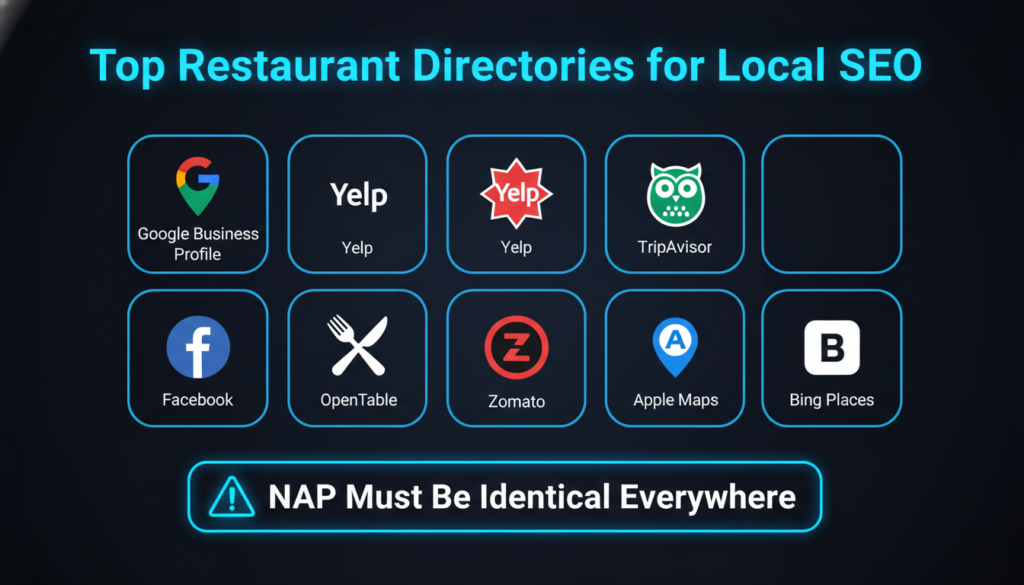
NAP stands for Name, Address, and Phone number. Every time your restaurant appears online, whether on Yelp, TripAdvisor, or a local directory, the NAP must be exactly the same. Even small differences like “St.” vs “Street” can confuse Google and hurt your rankings.
Make sure your restaurant is listed and accurate on these platforms:
• Yelp
• OpenTable
• Zomato
• Foursquare
• Apple Maps
• Bing Places
Check your listings at least every three months. If your hours change, your menu changes, or you move, update everything right away. Old or wrong information sends customers to the wrong place. That leads to frustration and bad reviews.
Reach out to Lafayette food bloggers and Instagram influencers. Invite them to try your food and write about it. When they link back to your website, that tells Google your restaurant is trustworthy and popular. These local links are very powerful for local SEO for restaurants.
The Advocate, Lafayette Daily Advertiser, and local food magazines are always looking for stories. Host an event, launch a new menu, or do something interesting in the community. Then reach out to these publications. A feature article with a link to your site can boost your rankings significantly.
Sponsor a local school event, youth sports team, or community festival. Many of these organizations will list you as a sponsor on their website with a link back to yours. This builds both your reputation and your local SEO at the same time.
Write blog posts or pages about topics your Lafayette customers care about. Examples include “Best places to eat Cajun food in Lafayette,” “Family dinner ideas in Lafayette,” or “A guide to Lafayette food festivals.” You do not have to only write about your own restaurant. Content that helps people in Lafayette builds your authority and brings in organic traffic.
Write about things happening in Lafayette. If you have a special for Mardi Gras or a new crawfish boil special for crawfish season, publish it on your site and share it as a Google Post. Fresh content tells Google you are active and relevant.
Short videos of your kitchen, your dishes, or your team are very engaging. Post them on your Google Business Profile, YouTube, and social media. User-generated content means photos and videos your customers share about your restaurant. Repost these with permission. When real customers share your food, it builds trust that no ad can buy.
Google Posts show up directly on your Google Business Profile in search results. Use them every week. Share a photo of your daily special, announce an upcoming event, or highlight a great review. These posts give customers a reason to click on your listing instead of a competitor’s.
Most people searching for restaurants are on their phones. If your website looks bad on a phone or loads slowly, they will leave and go to a competitor. Google also ranks mobile-friendly websites higher. Make sure your website was built to work on phones first.
A slow website loses customers. People will not wait more than a few seconds for a page to load. Use tools like Google PageSpeed Insights to check your site speed. Compress your images, reduce unnecessary code, and use a good hosting provider. Fast websites keep people on your site longer and rank better.
Your menu should be easy to read on a small screen. Do not use a PDF that requires zooming in. Use a simple web page with clear text. Your online ordering button should be at the top of your homepage, easy to tap. The fewer steps between a customer seeing your site and placing an order, the better.
People use voice search on their phones and smart speakers to find restaurants. They say things like “Hey Google, find a Cajun restaurant near me” or “What are the best restaurants open now in Lafayette?” Voice search results often come from Google Business Profiles and local SEO-optimized websites.
Voice searches are more conversational than typed searches. Instead of “Lafayette seafood,” someone might say, “Where can I get fresh seafood in Lafayette tonight?” Create content that answers these kinds of questions naturally. An FAQ page on your website is a great place to do this.
People who search by voice on their phone are often very close to making a decision. They want to eat soon. Make sure your GBP is fully updated so Google can give them your phone number, hours, and address instantly. The faster Google can answer its question using your information, the better your chances of getting that customer.
Schema markup is a type of code you add to your website to help Google understand your content better. For restaurants, the most useful types are:
• Restaurant schema: Tells Google your name, address, hours, and cuisine type
• Menu schema: Lists your menu items so Google can show them in search results
• Review schema: Displays your star rating directly in search results
• Reservation schema: Makes it easy for Google to show a booking button
When you use schema markup correctly, Google can show richer information in search results. This might include your star rating, your price range, or your hours right below your listing title. These rich results stand out more and get more clicks. It gives your restaurant an edge over competitors who have not set up schema.
A call-to-action (CTA) tells visitors what to do next. Your website should have clear CTAs at the top of every page. Good examples for restaurants are “Order Online Now,” “Reserve Your Table,” and “View Our Menu.” Make these buttons big and easy to see.
Your phone number should be at the top of your website and clickable on mobile. When someone taps it, their phone should dial you automatically. Same for directions. A “Get Directions” button that links to Google Maps makes it easy for customers to find you without having to type your address.
If your online ordering system is hard to use, people will give up. Test it on your own phone. Can you complete an order in under two minutes? If not, it is too complicated. Use a simple, reliable ordering platform. The same goes for reservations. The easier the experience, the more orders and bookings you will get.
Use tools like Google Search Console and Google Business Profile Insights to track how you are doing. GBP Insights shows you how many people viewed your profile, clicked for directions, or called you. Track these numbers every month so you can see if things are improving.
Google Business Profile tells you exactly how many people called your restaurant from your GBP, how many clicked for directions, and how many visited your website. These are the most direct measures of whether your local SEO is working. If these numbers go up over time, your strategy is working.
Look at your data every month. Find out which search terms are bringing people to your site using Google Search Console. See which pages get the most traffic. Find out where you are losing people. Then make changes based on what the data tells you. Local SEO gets better over time when you keep learning and adjusting.
If your address on Yelp says “Main St” and your address on Google says “Main Street,” that inconsistency confuses Google. Always use the exact same format everywhere. Even small differences matter. Do a regular audit of all your listings to make sure everything matches.
Not responding to reviews is one of the biggest mistakes restaurant owners make. Every unanswered review is a missed chance to show customers you care. Set aside 10 minutes each week to read and respond to new reviews. It does not take long, and the impact on your reputation is huge.
Nothing frustrates a customer more than showing up for a dish that is no longer on the menu, or arriving at a restaurant that is closed because you forgot to update your hours. Keep everything current. Update your GBP, website, and directories whenever anything changes.
A website that does not work well on mobile will lose most of your potential customers before they even see your menu. Test your site on a real phone regularly. If pages load slowly or buttons are hard to tap, fix those issues right away.
When your restaurant ranks higher on Google, more people find you. More people finding you means more calls, more reservations, and more walk-ins. Online orders also increase because your website gets more traffic from people searching for food in Lafayette. Local SEO for restaurants is a direct path to more revenue.
To understand your return on investment, track how many new customers come from Google. Ask new customers how they found you. Use Google Analytics to see how much traffic comes from local search. Compare that to what you spend on local SEO each month. Most restaurants find that local SEO brings a much better return than paid ads in the long run.
Getting a customer to come in once is great. Getting them to come back is even better. When someone finds your restaurant through Google and has a good experience, they often leave a review. That review helps bring in more new customers. It is a cycle that keeps growing when you do local SEO right.
Most restaurants start seeing results within three to six months. Some basic actions like claiming your GBP and fixing your NAP can show results faster, sometimes within a few weeks. Long-term results from content and backlinks take longer but last much longer too.
Google ranks restaurants on Maps based on relevance, distance, and prominence. To rank higher, make sure your GBP is complete, get more reviews, and make sure your information is consistent across all online directories.
The most important factors are your Google Business Profile, customer reviews, NAP consistency, and your website quality. Focus on these four things first before anything else.
Yes, small restaurants need local SEO even more than big chains. Big chains have big marketing budgets. Small restaurants have to be smarter. Local SEO levels the playing field. A well-optimized small restaurant can outrank a big chain for local searches.
Lafayette has great food everywhere. To stand out, you need to be visible online. Most of your competitors are not doing local SEO well. That is your advantage. By following this guide, you can rank above restaurants that have been around for decades just by being more visible on Google.
Every search for “restaurants in Lafayette” or “best Cajun food near me” is a potential customer looking for you. Local SEO makes sure they find you instead of your competitor. The goal is simple: be the first restaurant people see when they are hungry and searching in Lafayette.
Ready to take action? Visit our local SEO guide or go to sitesnapps.com to see how we can help your Lafayette restaurant get found, get clicks, and get customers.
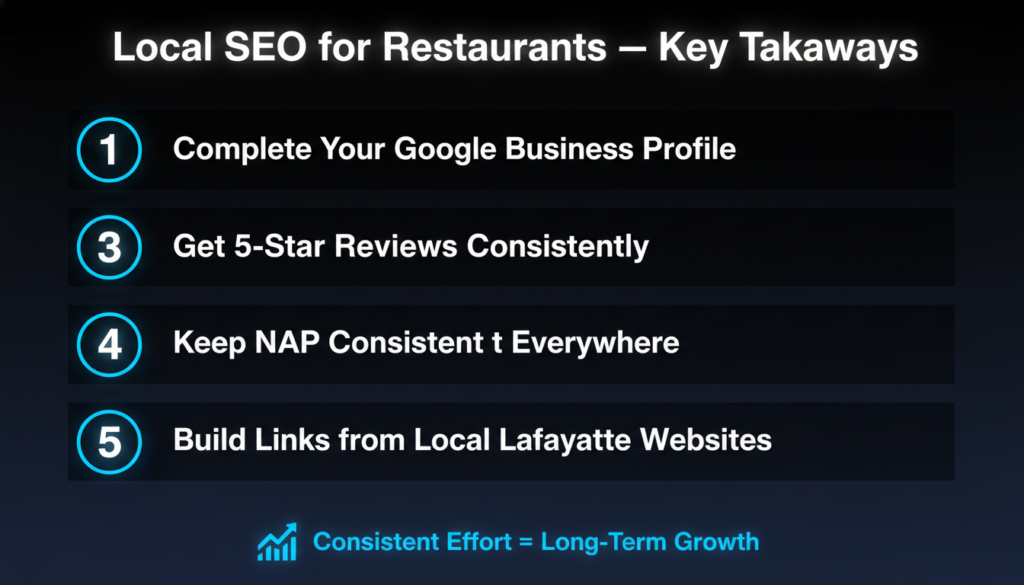
If you only do a few things, do these:
• Complete and optimize your Google Business Profile
• Get more five-star reviews consistently
• Keep your NAP consistent on every platform
• Add local keywords to your website pages
• Build links from other trusted Lafayette websites
Local SEO is not something you do once and forget. The restaurants that rank highest are the ones that keep working on it every month. Post new content, respond to reviews, update your information, and track your results. Over time, this consistent effort turns into a steady stream of new customers who found you on Google.
Local SEO for restaurants in Lafayette, LA, is one of the best investments you can make in your business. It builds visibility, trust, and revenue at the same time. Start today, be consistent, and the results will follow.