
Imagine you own a small bakery in Lafayette, LA. You make the best bread in town. But when someone nearby searches “best bakery near me” on Google, your shop does not show up. Someone else gets the customer. That hurts, right?
This is a problem many local businesses face every single day. They have great services. They have happy customers. But online, nobody can find them.
The good news? There is a fix. It is called local landing page optimization.
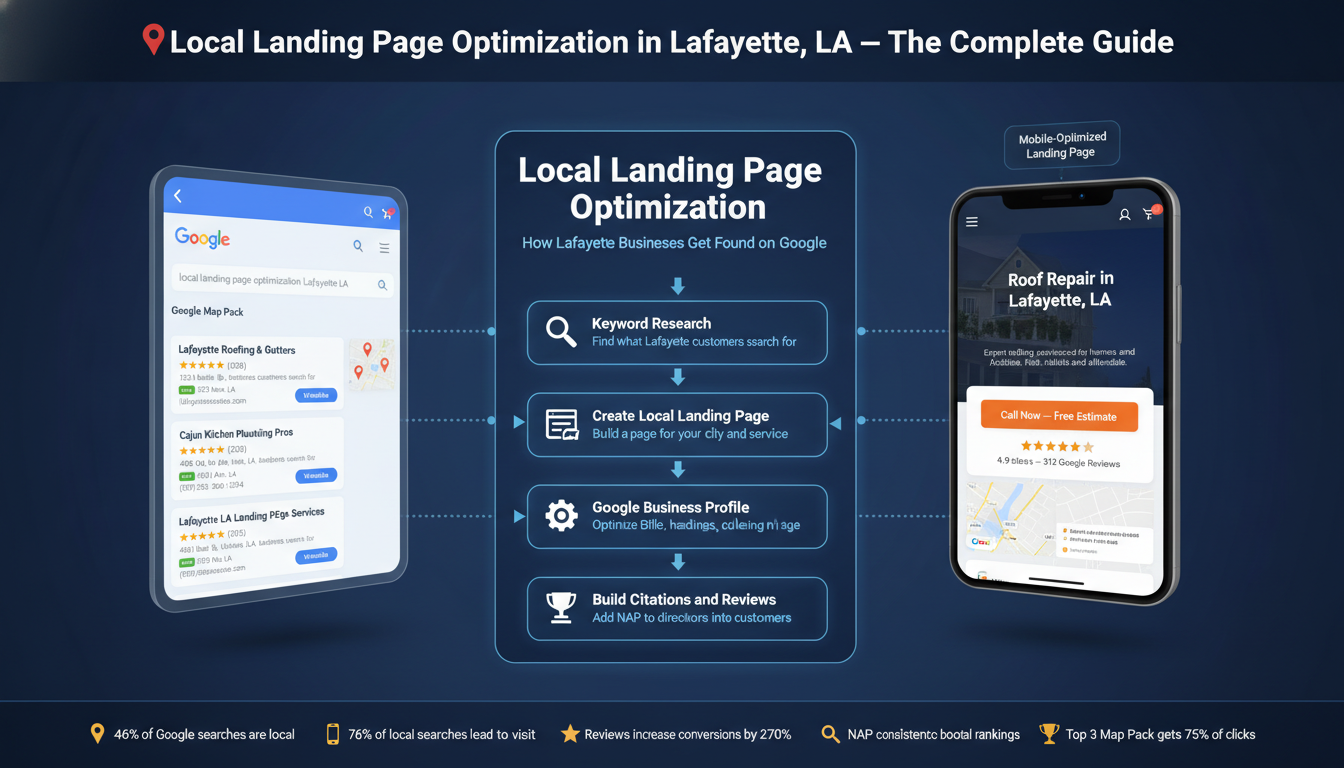
Local landing page optimization is the process of building and improving special pages on your website so that people in Lafayette can find your business on Google. These pages are built for your city, your neighborhood, and your customers.
In this guide, we are going to explain everything in very simple words. You will learn what local landing pages are, why they matter, how to create them, and how to make them work hard for your business.
Whether you run a restaurant, a law firm, a hair salon, or a plumbing company in Lafayette, this guide is for you.
Have you ever searched for “pizza near me” or “best dentist in Lafayette”? Then you already know what local search is.
Local landing page optimization means making a special page on your website that helps people find your business when they search online. This page talks about your city, your services, and why you are the best choice nearby.
When you do local landing page optimization the right way, more people in Lafayette can find your business on Google. And when they find you, they are more likely to call you or visit your store.
It is that simple.
Think about this. There are thousands of businesses in Lafayette, LA. If you own a plumbing company, you are not the only one. You have many competitors.
So how do you stand out?
You create a local landing page. This page tells Google: “Hey! This business is in Lafayette. They help people here.” Google then shows your page to people who are looking for a plumber in Lafayette.
Without a local landing page, your business may never show up in local search. And that means losing customers to your competitors.
Here is what a good local landing page can do for your Lafayette business:
Creating a good local landing page is not always easy. Here are some common problems businesses face:
But don’t worry. This guide will help you do all of these things step by step.
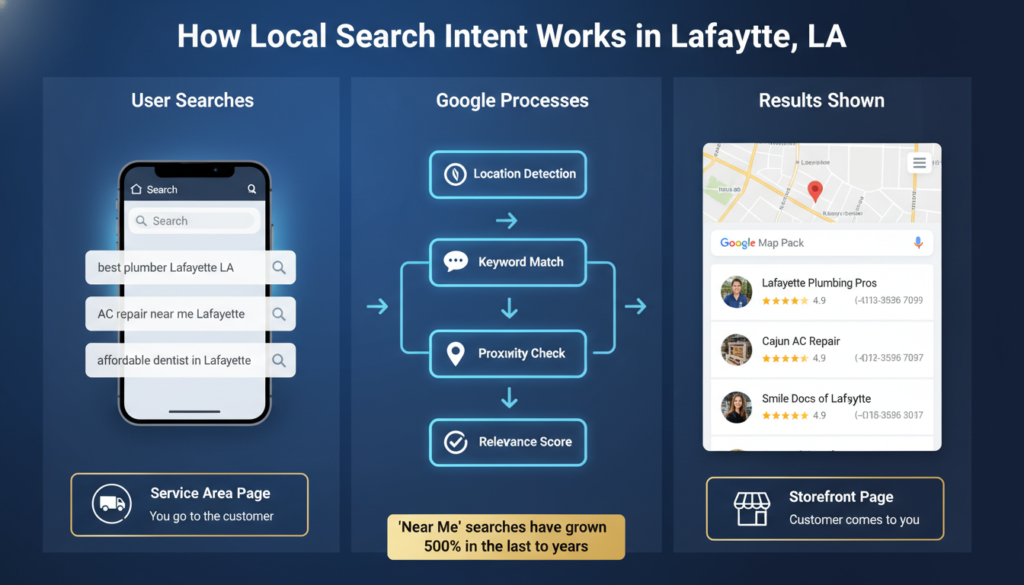
When someone types “best pizza near me,” Google looks at where that person is. Then it shows businesses that are close to them.
This is called local search intent. The person wants something nearby, fast.
If your landing page is well-optimized, your business can show up for these “near me” searches. That means more traffic and more customers without spending money on ads.
People in Lafayette, LA, have their own way of searching. They may search for things like:
Your landing page should use these kinds of phrases. Think like your customer. What would they type into Google?
There are two types of local pages:
Storefront pages: These are for businesses with a real address, like a restaurant or a clinic. People can come visit you.
Service area pages: These are for businesses that go to the customer, like a plumber or electrician. You don’t need a storefront, but you still serve Lafayette and nearby areas.
Both types need local landing page optimization. The difference is just how you talk about your location.
These pages are made for one city only — like Lafayette, LA. They mention the city name, talk about local customers, and use local keywords.
Example: “Roof Repair in Lafayette, LA — Trusted by Thousands of Homeowners”
If you serve multiple areas around Lafayette (like Broussard, Scott, or Youngsville), you can make separate pages for each area.
Each page talks about that specific area. This helps you rank in more places.
Big businesses with many locations use store locator pages. These help customers find the nearest branch.
If you have more than one office or store, you need a separate landing page for each. This way, each location can rank on Google for its own city.
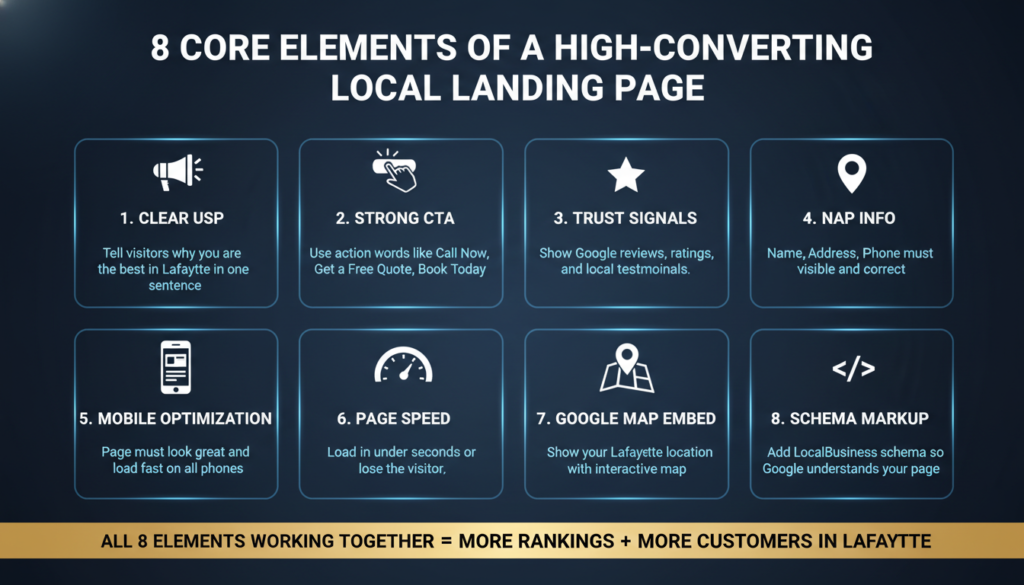
Your USP is the one thing that makes you different from everyone else. Tell visitors right away why they should choose you.
Examples:
A CTA is a button or line that tells visitors what to do next. Keep it simple and clear.
Good CTAs:
Put the CTA at the top of the page so visitors see it right away.
People trust businesses that other people have used. Show them:
Make sure visitors can find your basic information fast:
Put this information at the top and bottom of your page.
Most people search on their phones. If your page loads slowly or looks bad on a phone, people will leave.
Make sure your page:
Before you publish your page, check these things:
Don’t just write the same thing as everyone else. Talk about your local community. Be specific about Lafayette.
Instead of: “We are a great plumbing company.”
Write: “We have been helping Lafayette homeowners with plumbing since 2005. From the Cajundome area to River Ranch, our team is always nearby.”
Mention local places, neighborhoods, or events in your content. This shows Google and visitors that you are truly local.
Examples:
If you have pages for multiple cities, don’t copy-paste the same content. Each page needs its own unique words.
Google can tell when content is duplicated. It will lower your rankings if you copy content from page to page.
Use real photos of your team, your location, or your work in Lafayette. Don’t just use stock photos.
Real images build trust. They also help with SEO when you add the right alt text.
Before you write anything, you need to know what words people are searching for.
Use tools like Google Keyword Planner, Ubersuggest, or Semrush to find keywords like:
Pick keywords that have good search volume and are not too competitive.
Each landing page should focus on one main keyword. Don’t put all your keywords on one page.
Example:
This way, each page has a clear purpose.
Keyword cannibalization means having two pages that compete for the same keyword. This confuses Google and hurts your rankings.
Make sure each page targets a different keyword or location.
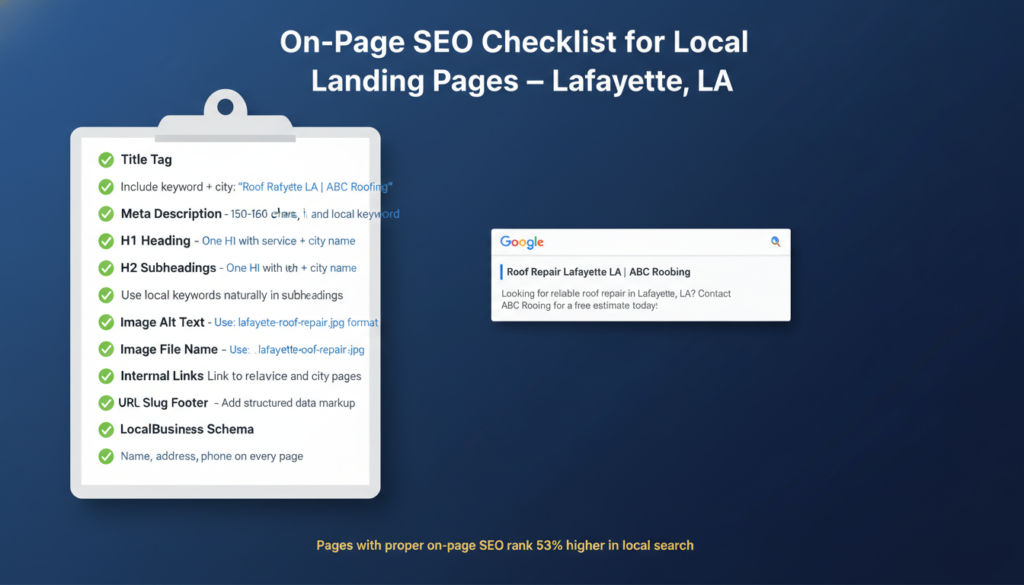
Your title tag should include your main keyword and your city.
Example title: “Affordable Roof Repair in Lafayette, LA | ABC Roofing”
Your meta description should be 150-160 characters and give people a reason to click.
Example: “Need roof repair in Lafayette, LA? ABC Roofing offers fast, affordable service. Call today for a free estimate!
Use your city name in your H1 and H2 headings where it makes sense.
H1: “Roof Repair Services in Lafayette, LA” H2: “Why Lafayette Homeowners Trust ABC Roofing”
Don’t force it. It should read naturally.
Every image on your page needs:
Link your local landing pages to each other and to your main service pages. This helps Google understand your site structure and gives visitors more pages to explore.
Keep your URLs clean and simple.
Good: yourwebsite.com/lafayette-la/roof-repair Bad: yourwebsite.com/page?id=123&loc=laf
Google uses the mobile version of your site to rank you. So design for mobile first.
Page speed matters a lot for local SEO. Slow pages rank lower and lose visitors.
To improve speed:
Schema markup is a small piece of code you add to your page. It tells Google exactly who you are.
It includes things like your business name, address, phone number, hours, and reviews. Google can then show this info in search results as rich snippets.
Keep your page easy to navigate. Use clear headings and short paragraphs. Put the most important info first.
Visitors should be able to find what they need in 10 seconds or less.
A high bounce rate means people are leaving your page fast. This tells Google your page is not helpful.
To keep people on your page:
Make your page usable for everyone, including people with disabilities.
Your Google Business Profile (GBP) and your landing page should match. The name, address, and phone number must be exactly the same on both.
If Google sees different information, it gets confused and may lower your rankings.
Embed a Google Map on your landing page. This makes it easy for customers to find you. It also tells Google that your business is real and has a physical location.
Pull your Google reviews onto your landing page. Showing real customer feedback builds trust and can help more people convert.
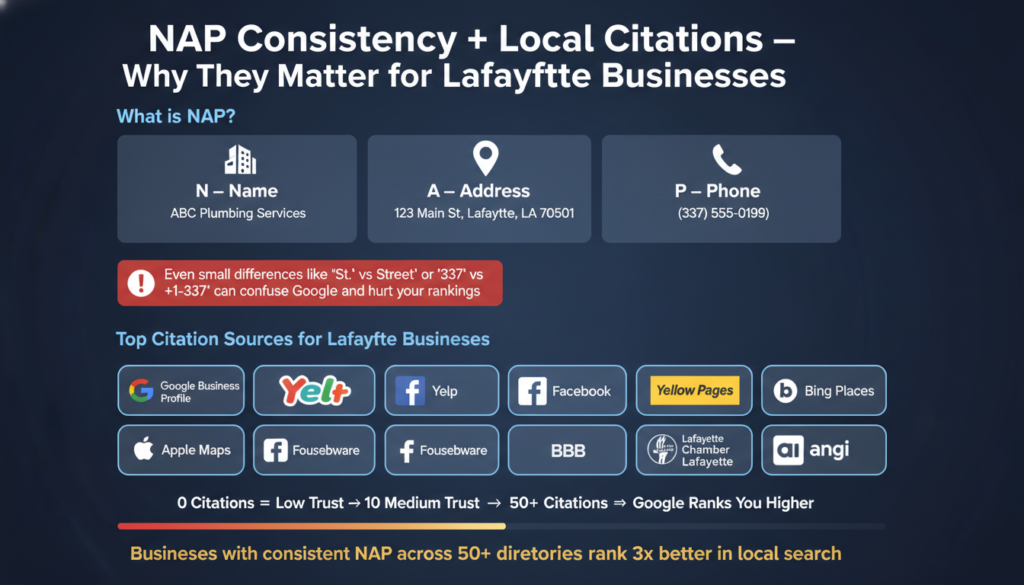
A citation is any place online that mentions your business name, address, and phone number. This includes Yelp, Yellow Pages, Facebook, and many more.
The more citations you have, the more Google trusts your business.
NAP stands for Name, Address, Phone number. This information must be exactly the same everywhere online.
Even small differences (like “St.” vs “Street”) can confuse Google and hurt your rankings.
Good citation building can help you rank in the Google Map Pack — the top 3 local results that appear on Google with a map. This is extremely valuable for getting more customers.
Backlinks are links from other websites to yours. Local backlinks come from other Lafayette businesses, news sites, or community organizations.
Ways to build local backlinks:
Share your landing pages on Facebook, Instagram, and other platforms. Engage with the local Lafayette community. Join local groups and be helpful.
Social signals can help build brand awareness and drive traffic to your pages.
Ask happy customers to leave reviews on Google. Respond to all reviews — good and bad. This shows Google and future customers that you care.
Find out what your competitors are ranking for. Look at their pages. Then do your own keyword research for Lafayette-specific terms.
Write your content using your target keywords. Make sure to include all the elements we talked about. Publish and submit the page to Google Search Console.
Check your rankings every month. Look at your Google Analytics data. See which pages are working and which ones need improvement. Keep updating and improving.
Here is what a great local landing page for a Lafayette AC company might look like:
Headline: “Fast AC Repair in Lafayette, LA — Same-Day Service Available”
Content: Talks about the hot Louisiana summers. Mentions serving neighborhoods like River Ranch, Couret Farms, and Youngsville. Shows photos of real technicians. Lists prices. Includes Google reviews. Has a “Call Now” button at the top.
This page is specific, trustworthy, and easy to use. That is the goal.
Different industries need different approaches. A lawyer’s page needs to focus on trust and credentials. A restaurant page needs photos and menu info. A gym page needs class schedules and before/after stories.
Always think about what your specific customer in Lafayette needs to feel confident enough to contact you.
If your business serves Lafayette, Baton Rouge, and Lake Charles, you need a separate landing page for each city. Each page should be unique and tailored to that specific area.
Never just copy one city page and change the city name. This is called duplicate content. Google does not like it and will lower your rankings.
Write fresh content for every single location.
Use a clear URL structure like:
This is clean, logical, and easy for Google to understand.
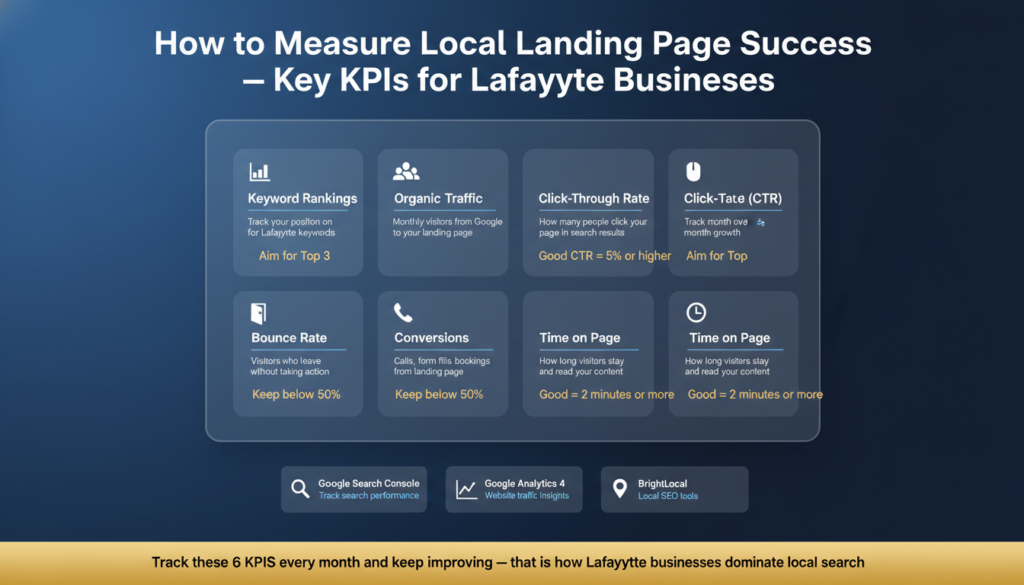
You need to track these numbers to know if your local landing page optimization is working:
Set up Google Analytics and Google Search Console. Use call tracking tools to know how many calls come from your landing page. Review your data every month.
If a page is not getting traffic, it may need better keywords. If it is getting traffic but no calls, it may need a better CTA or more trust signals.
Data tells you what to fix. Always be testing and improving.
If you add a new service or change your hours, update your landing page right away. Old information confuses customers and hurts trust.
You can also add seasonal content — like “AC Tune-Up Specials in Lafayette This Summer.”
Check your NAP information regularly. If you move or change your number, update it everywhere — your website, Google Business Profile, and all citations.
Google likes fresh content. Every 3–6 months, review your local landing pages. Add new reviews, update your photos, or rewrite sections to keep them current.
Don’t use your keyword 50 times on one page. It looks spammy, and Google will penalize you.
Use your keyword naturally — just like how you would say it in a normal conversation.
A page with only 200 words is not very helpful. Write at least 500–800 words of useful, detailed content. And never copy content from other pages or websites.
If your page is slow or hard to use on a phone, visitors will leave fast. Always test your page on a real mobile device.
If your address on Yelp says one thing and your website says another, Google gets confused. Keep everything consistent.
Create a group of pages around one topic. For example, if you are an HVAC company, create pages for:
All these pages link to each other. Google sees you as an expert in HVAC for Lafayette.
Once you rank in Lafayette, expand to nearby cities like Broussard, Scott, Youngsville, and Breaux Bridge. Create local landing pages for each one.
Write blog posts about local topics. For example: “5 Signs Your AC Needs Repair Before Louisiana Summer” or “How to Choose a Plumber in Lafayette, LA.”
These blog posts link to your landing pages and help them rank higher.
Look at your Google Search Console data. What search terms are people using to find your page? What position are you in? Use this data to fine-tune your content and climb higher in rankings.
Start with keyword research. Pick one location and one service. Write helpful, original content. Add your NAP info, a Google Map, customer reviews, and a clear CTA. Optimize your title, meta description, and headings with local keywords. Publish and track your results.
Every local landing page should have: your business name and contact info, a clear headline with your city and service, a unique selling proposition, customer reviews, a call-to-action, a Google Map, schema markup, and original content.
As many as you need — one for each city or neighborhood you serve. Just make sure each page has unique content. Quality matters more than quantity.
They tell Google exactly where you are and what you do. When someone in Lafayette searches for your service, Google can match them with your page. This means more visibility, more traffic, and more customers.
Local landing page optimization is one of the most powerful things you can do for your Lafayette business. It helps you show up when the right people are searching. It builds trust. And it turns website visitors into real customers.