Home / Blog Details
Take your digital marketing to the next level with data-driven strategies and innovative solutions. Let’s create something amazing together!
From Google search results to AI chatbots, we optimize your website so customers can find you faster — and choose you over competitors.
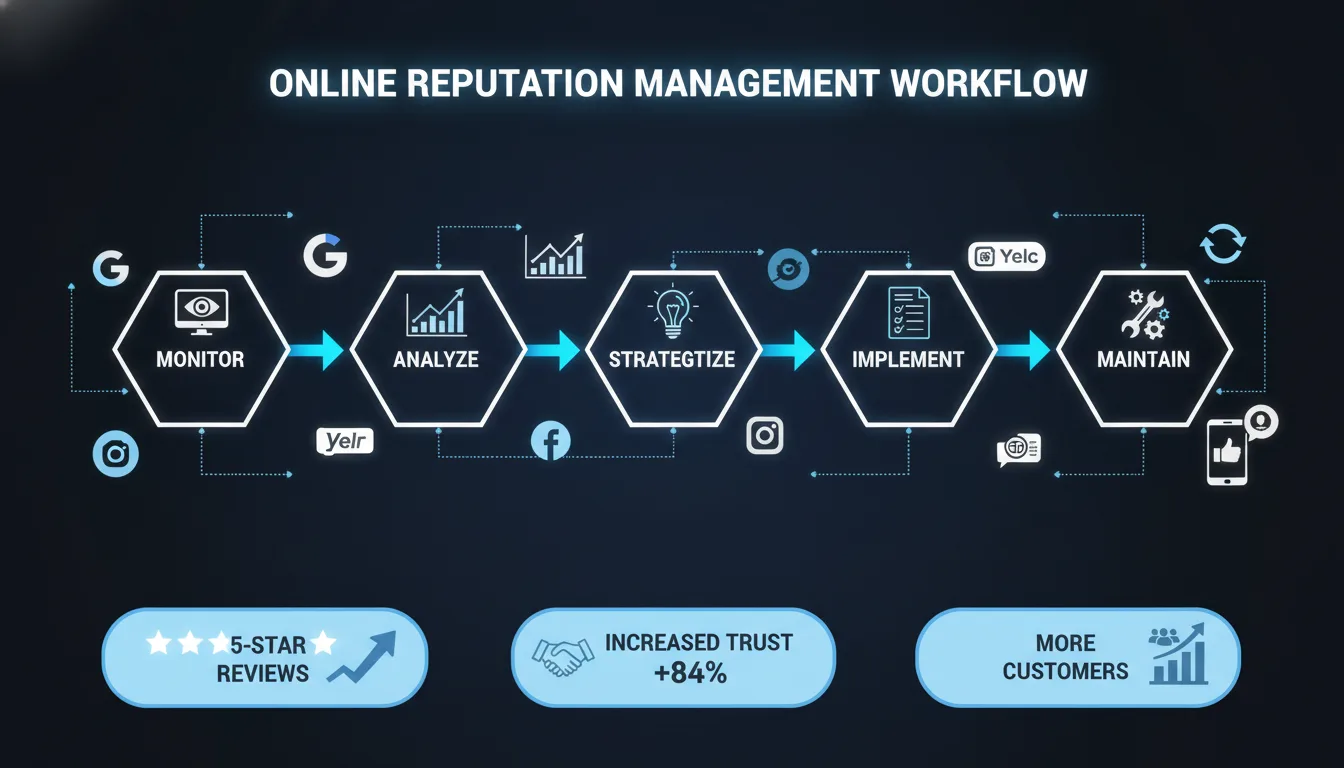
Online reputation management (ORM) is the ongoing process of monitoring, influencing, and improving how your business appears online. It combines review management, search engine strategy, content creation, and social media oversight to shape public perception and build customer trust across every digital channel.
Your business reputation has never been more exposed.
Every day, people in Lafayette, LA search your business name on Google before they call you, visit your location, or trust you with their money. What they find in those first five seconds shapes every decision they make. One unaddressed negative review, one damaging news article, or one outdated business listing can cost you real revenue, quietly and repeatedly.
Most business owners know reputation matters. Fewer understand exactly how to manage it. That gap is costly. According to a BrightLocal consumer survey, 98% of people read online reviews for local businesses, and 49% trust online reviews as much as a personal recommendation from someone they know. Those numbers are not slowing down in 2025.
This guide breaks down exactly how online reputation management works, step by step. You will learn what ORM includes, how the monitoring and response process runs, how it connects to your local SEO performance, and what tools and strategies actually move the needle for businesses like yours.
Online reputation management is the practice of actively shaping the digital perception of a business, brand, or individual. It includes monitoring brand mentions, managing reviews, producing positive content, and optimizing search results. The goal is to make sure that when someone searches your name, they find accurate, positive, and credible information.
ORM is not a one-time fix. It is an ongoing system that combines technology, strategy, and communication.
Your online reputation functions as your permanent, publicly visible first impression. Before a potential customer speaks to anyone on your team, they have already formed an opinion based on your Google reviews, your search results, and your social media presence.
According to Moz’s research on local search ranking factors, review signals (including review quantity, velocity, and diversity) account for a meaningful portion of local pack rankings. A poor reputation does not just cost you customer trust. It actively suppresses your visibility in Google search.
For professional service providers, attorneys, healthcare providers, and home service businesses, the stakes are even higher. One highly visible negative review or news article can override years of good work.
The core goals of ORM are straightforward:
The three pillars of ORM are monitoring, management, and improvement.
Monitoring means tracking what people say about your business across search engines, review platforms, social media, and news sites.
Management means responding to reviews, addressing complaints, and correcting misinformation in real time.
Improvement means creating positive content, earning new reviews, and optimizing your search presence so that your best self shows up first.
Every effective ORM strategy operates across all three pillars simultaneously.
Online reputation management works through a repeating cycle of auditing, monitoring, responding, and creating. Each step builds on the previous one to produce a digital presence that accurately reflects the quality of your business.
Before you manage anything, you need to see exactly where you stand. A reputation audit is a structured review of every place your business appears online.
Search your business name on Google. Note what appears on page one. Look at the map pack, the knowledge panel, any news articles, and any third-party review profiles. These are the first things your customers see.
Also search your business name plus common complaint terms (“business name + complaint,” “business name + scam,” “business name + review”). This reveals hidden reputation risks most business owners never check.
Check your ratings and review content on Google Business Profile, Yelp, Facebook, industry-specific platforms (Houzz, Avvo, Healthgrades, etc.), and the Better Business Bureau. Note your average rating, the most recent reviews, and any patterns in negative feedback.
Beyond review sites, look at social media mentions, blog posts, forum threads, and local news articles. Some mentions are helpful. Others may contain outdated or inaccurate information about your business.
Record your current state as a baseline. Note your average star rating on each platform, total review count, most recent review date, and top three recurring complaints. You will use this baseline to measure improvement over time.
Reputation monitoring is the process of tracking every new mention of your brand name as it happens. Manual monitoring is time-consuming and unreliable. Most businesses use tools like Google Alerts (free), ReviewTrackers, or Mention to automate this process.
Set up alerts for your business name, your owner’s name, your address, and common misspellings. Every time your brand appears in a new review, article, or social post, you receive a notification.
This step keeps you from missing important conversations in real time.
Raw review data tells you your rating. Sentiment analysis tells you why customers feel the way they do. Reading patterns across your reviews reveals operational problems you may not have noticed.
For example, if twelve different customers over six months mention that your staff seems rushed, that is a management insight disguised as a reputation problem. Fixing the root issue produces better reviews automatically, without asking for them.
Look for themes in both positive and negative reviews. Positive patterns reveal your strengths worth promoting. Negative patterns reveal the operational fixes that will improve your reputation at the source.
Review response is one of the most visible and highest-impact actions in ORM. Every response you write is read not just by the person who left the review, but by every future customer who reads your profile.
For positive reviews: thank the reviewer by name, mention a specific detail from their review, and reinforce your business value naturally.
For negative reviews: acknowledge the experience without admitting fault where facts are disputed, invite the customer to continue the conversation privately, and demonstrate that you take quality seriously. Never argue. Never copy-paste the same generic apology.
According to Harvard Business Review research on hotel review responses, businesses that respond to reviews see a measurable improvement in their average ratings over time, because response behavior signals that the business listens and improves.
You cannot just respond your way to a strong reputation. You also need to produce content that earns visibility. This includes blog posts, case studies, service pages, press releases, and social media content that positions your expertise and highlights your results.
Positive content serves two purposes. First, it gives search engines more positive, keyword-relevant pages to index. Second, it pushes negative or irrelevant content further down in search results, where most users never go.
Search engine reputation management (SERM) specifically focuses on what appears when someone searches your business name. The goal is to control the first page of branded search results with content you own or influence.
This includes your website, your Google Business Profile, your social media profiles (LinkedIn, Facebook, Instagram), directory listings, and any press coverage. When you fill page one with credible, positive, and accurate results, negative mentions have nowhere visible to land.
ORM without measurement is guesswork. Track your results monthly. Key metrics include your average rating trend on Google and Yelp, total review volume and velocity (how many new reviews per month), sentiment ratio (positive vs. negative), branded search impressions in Google Search Console, and website traffic from branded keyword searches.
When something improves, you understand what to keep doing. When something stalls, you can identify the gap and correct it.
Brand monitoring covers every place your business name, products, or key personnel are mentioned online. The most practical free tool is Google Alerts, which sends an email each time Google indexes a new mention. Paid tools like Mention, Brand24, or Semrush’s Brand Monitoring tool provide more comprehensive coverage across social media, forums, and news sites simultaneously.
Set up monitoring for your business name in quotes, your owner’s name, your primary products or services, and your address. This gives you a complete picture of your digital footprint.
Social listening goes beyond watching for direct mentions. It tracks industry conversations, competitor mentions, and relevant keywords across platforms like Facebook, Instagram, X (formerly Twitter), LinkedIn, and Reddit.
For local businesses in Lafayette, LA, social listening can reveal neighborhood conversations about your industry, local news stories that reference your sector, and competitor weaknesses you can address through your own positioning.
News mentions can spread faster than review content. A single local news story about a business dispute or service failure can outrank your website for years. Monitor local news outlets, community Facebook groups, and industry forums where your customers might discuss your business.
Knowing about a problem within hours gives you the ability to respond and potentially request corrections before the story hardens into a permanent search result.
Reputation risks include sudden spikes in negative reviews, an unusual number of one-star ratings from accounts with no review history (a signal of fake review attacks), emerging news coverage with incorrect information, and social media posts gaining unexpected traction.
Catching these signals early, before they compound, is the primary value of consistent monitoring.
Each digital channel requires a different communication style. A response on Google reviews should be professional and brief. A response on Facebook can be slightly warmer and more conversational. A response to a public tweet requires speed and brevity. Consistency in tone and values matters across all of them, even when the format changes.
Online reviews are the single most trusted form of social proof for local businesses. Customers trust them because they come from people with nothing obvious to gain. A high volume of recent, detailed, positive reviews signals to both customers and search algorithms that your business reliably delivers quality.
According to BrightLocal’s 2024 Local Consumer Review Survey, 49% of consumers trust online reviews as much as personal recommendations, and the recency of reviews matters just as much as the rating itself.
The most effective strategy for generating reviews is a simple, direct, timely ask. Send a follow-up text or email within 24 to 48 hours of a completed transaction. Include a direct link to your Google review page. Keep the message personal and brief.
Train your team to verbally mention reviews at the end of positive customer interactions. Make it feel like a natural request from one person to another, not a corporate mandate. Consistency produces volume. Volume produces trust.
Positive review responses reinforce customer loyalty and give future readers a preview of how you treat people. Thank the reviewer specifically, mention their experience by name where possible, and use natural language that reflects your brand personality.
Avoid over-formal responses that feel robotic. A genuine “Thank you, Maria, we loved helping you with your kitchen renovation!” accomplishes more than a five-sentence corporate acknowledgment.
Negative reviews feel personal. They rarely are. The customer is expressing a gap between what they expected and what they received. Your job in your response is to acknowledge that gap, show empathy, and invite resolution.
A well-written response to a negative review often earns more customer trust than the review lost. Future customers see that you take concerns seriously. That signal of accountability matters.
Never attack the reviewer. Never dispute facts publicly. Never paste the same response across multiple negative reviews. Each one deserves an individual, genuine reply.
Negative feedback is operational intelligence. If your reviews consistently mention long wait times, billing confusion, or difficulty reaching your team, those are solvable problems. Solving them reduces future negative reviews at the source while improving the actual customer experience.
The businesses that close the loop between feedback and operations outpace those that only manage optics.
Search engine reputation management focuses specifically on the results that appear when someone types your business name into Google. These branded search results matter more than almost any other digital asset, because customers searching your name already have purchase intent.
Your goal is to own or influence as many results on page one as possible. That includes your website, your Google Business Profile, your social media profiles, your Yelp and BBB listings, and any press coverage or directory profiles with authority.
Google ranks pages based on relevance, authority, and user signals. To promote positive content, you need to produce it consistently, build backlinks to it, and optimize it with your branded keywords.
Publishing a detailed “About Us” page, a company history, team bio pages, and a blog with expert content creates more indexed pages tied to your business name. Each one is another potential result on your branded search page.
Suppression does not mean removing negative content (which is often impossible). It means pushing that content off page one by filling the space with stronger, more authoritative positive content.
If a negative review on a third-party site ranks on page one for your business name, the answer is to create, optimize, and build links to five or six pieces of positive content that outrank it. Most users do not go past the first few results.
SERM is a long-term investment. Building brand authority in search engines takes months of consistent effort. However, businesses that invest in it create a durable digital reputation that holds up through individual negative events.
Think of your branded search page as a permanent first impression. The effort you put into it now pays off every time someone new searches your name.
Reputation assets are any pieces of content or profiles that you own, control, or heavily influence. These include your website pages, social profiles, Google Business Profile, directory listings, press releases, and authored articles.
Each asset is a potential result in your branded search page. The more credible assets you have, the more control you have over what your customers find.
Thought leadership content positions you as the expert in your field. For a Lafayette HVAC company, that might be a detailed guide to maintaining air conditioning in Louisiana’s climate. For a local attorney, it might be an explanation of how Louisiana’s civil law system differs from common law states.
This type of content earns organic backlinks, gets cited in local publications, and signals expertise to Google’s quality algorithms. It also directly answers questions your customers are already searching.
Consistent, complete, and accurate business listings across Google, Yelp, Facebook, the BBB, and industry directories are foundational to local reputation. Inconsistent NAP (name, address, phone number) data across listings undermines trust with both customers and search engines.
Audit your listings at least twice a year. Remove duplicates, correct outdated information, and add photos, service descriptions, and category tags that reflect your current business accurately.
A single mention in a credible local or industry publication can rank on page one for your business name for years. Actively pursue press coverage through local news outreach, press releases for business milestones, and contributions to industry publications.
Local media relationships matter. When a local journalist covers your industry, being a known, accessible expert means they are more likely to call you for a quote, which earns you both visibility and credibility.
Digital PR earns backlinks and brand mentions from credible third-party sources. For local businesses, this includes sponsoring community events, participating in local business associations, contributing to charity initiatives, and earning coverage in publications like the Acadiana Advocate or local business journals.
Each earned mention adds to your brand’s authority, improves search rankings, and contributes to a positive digital footprint that individual negative reviews cannot easily erase.
Social media is where your reputation plays out in real time. Regular, authentic engagement builds trust with your existing audience while demonstrating to new visitors that your business is active and responsive.
A business that posts consistently and replies to comments quickly signals professionalism and reliability. One that hasn’t posted in eight months sends the opposite message, even if the content it posted years ago was strong.
Brand consistency means your tone, values, and visual identity look and feel the same across every social platform. Inconsistency creates uncertainty. Customers who find a warm, professional business on Google but a neglected, generic-looking Instagram account get a mixed signal.
Audit your social presence for consistency in bio information, contact details, visual branding, and posting frequency at least quarterly.
A social media crisis happens when negative sentiment about your business spreads publicly and quickly. Common causes include a viral complaint, a mishandled customer situation caught on video, or an employee post that reflects poorly on the business.
The response protocol is: acknowledge the situation quickly, avoid defensive or dismissive language, take the conversation offline to a private channel when possible, and follow up publicly when the situation is resolved. Speed matters more than perfection in the first 24 hours.
Local businesses that participate visibly in their communities build a layer of goodwill that no single negative event can quickly erase. Feature community involvement on your social channels. Share team volunteer days, local event sponsorships, and customer success stories (with permission).
Community engagement humanizes your business and creates positive associations that reinforce your reputation across every channel.
| Factor | Online Reputation Management | SEO |
| Primary goal | Shape public perception | Improve organic search rankings |
| Main focus | Brand trust and sentiment | Keyword visibility and traffic |
| Content type | Reviews, PR, brand assets | Blog posts, service pages, technical optimization |
| Timeline | Ongoing, long-term | 3 to 6 months minimum |
| Audience | Existing and prospective customers | Searchers across intent types |
| Success metric | Sentiment, star ratings, branded search quality | Rankings, traffic, conversions |
ORM and SEO are deeply connected. Your Google Business Profile review rating affects your local search rankings. The content you create for reputation purposes also earns organic search traffic. The backlinks you earn through digital PR improve your domain authority.
In practice, a strong reputation makes your SEO results more effective, because customers who find you in search are more likely to trust and contact you when your reviews and branded search results reinforce your credibility.
You need SEO when you want more people to find your business for specific search terms. You need ORM when the people who find you are not converting because of what they see when they look you up.
Most local businesses in Lafayette, LA need both, running in parallel. SEO drives traffic. ORM converts that traffic into trust.
Your Google Business Profile is the most visible reputation asset for any local business. It appears in the map pack, in branded search results, and in Google’s AI-generated local recommendations. Keeping it fully optimized, with accurate information, current photos, and consistent review responses, is the single highest-impact ORM action available to local businesses.
Claim your profile if you have not already. Update your hours, services, and contact information. Respond to every review, positive and negative.
Google Maps ranking depends on relevance, distance, and prominence. ORM directly affects prominence through review volume, review recency, and the quality of your responses. Businesses with more recent, positive reviews rank higher in the local pack than businesses with older, sparse review histories.
Encourage every satisfied customer to leave a Google review. Even five new reviews per month compounds into a meaningful advantage over competitors who never ask.
Local citations are mentions of your business name, address, and phone number across directories like Yelp, the BBB, Apple Maps, Bing Places, and industry-specific sites. Consistent citations reinforce your business’s legitimacy with Google.
Use a tool like BrightLocal or Yext to audit your citation health and correct inconsistencies at scale.
Local trust signals include the number of Google reviews, your average rating, whether your GMB profile is verified, whether your website has a Louisiana-based address and phone number displayed prominently, and whether local publications have mentioned your business.
Each signal adds weight to your local authority. Businesses with strong trust signals rank higher and convert more of the traffic they receive.
The local pack (the top three Google Maps results that appear for local searches) is the most valuable piece of real estate in local SEO. Review signals, including your average rating and review volume, are among the factors Google uses to determine which businesses appear there.
Businesses in Lafayette, LA that actively manage their reviews and Google Business Profile consistently outperform those that leave their digital reputation to chance.
One negative review will not destroy a strong reputation. Ten negative reviews concentrated over a short period can. Recovery starts with responding professionally to every negative review, then systematically generating new positive reviews to improve your overall average.
Do not try to remove legitimate negative reviews. Focus instead on building enough positive volume that the negative reviews become statistically insignificant.
Negative press coverage is more serious than a bad review because it often ranks for your business name in search results and reaches an audience far beyond your existing customers. Address press coverage by contacting the publication for a correction if the content is factually inaccurate.
If correction is not possible, produce and promote positive counter-content that outranks the article over time.
Trust rebuilds through consistent, visible action over time. Responding to reviews, improving operations, sharing genuine customer success stories, and earning positive media coverage all contribute. Customers are forgiving when they see a business that acknowledges problems and improves.
The timeline for reputation recovery varies. A business that acts quickly and consistently can see meaningful improvement in 90 to 180 days. Severe damage may take 12 months or more.
Every business should have a written crisis response plan before a crisis happens. This plan should include:
A plan created before a crisis allows for calm, consistent action when emotions run high.
Tools like ReviewTrackers, Podium, Birdeye, and Grade.us aggregate reviews from multiple platforms into a single dashboard. They send alerts for new reviews, enable templated responses, and provide reporting on rating trends over time.
For small businesses just starting out, Google’s built-in review notifications and a simple tracking spreadsheet are enough to begin.
Mention, Brand24, and Sprout Social’s listening features track brand mentions across social platforms, blogs, and news sites. They provide sentiment analysis and volume trends that help you spot reputation shifts early.
Google Alerts is the free baseline. For deeper monitoring, tools like Meltwater and Cision track news and media coverage at scale, including syndicated press releases and TV/radio mentions where digital transcripts are available.
Semrush and Ahrefs allow you to track your branded keyword rankings, monitor who is linking to your site, and identify new content opportunities that support your reputation strategy. The Sites N Apps website offers local SEO and reputation services tailored to Lafayette, LA businesses that want expert support rather than managing these tools independently.
Google Analytics and Google Search Console track the downstream effects of ORM work. Increases in branded search volume over time reflect growing reputation awareness. Improvements in organic click-through rate on branded searches reflect improvements in how your search results present your business.
Track your average Google rating monthly. Track the number of new reviews per month. Both metrics should trend upward consistently over a 90-day period if your strategy is working.
Sentiment analysis tools break down review and mention content into positive, negative, and neutral categories. A rising positive sentiment ratio over time confirms that your reputation is improving, not just growing in volume.
Track your Google Search Console data for branded keyword impressions and clicks. As your ORM strategy produces more positive, optimized content, your branded search visibility should expand.
Track profile views on your Google Business Profile, website sessions from branded search, and social media engagement rates. These metrics reflect how actively your reputation is driving customer interest.
Ultimately, the goal of ORM is business growth. Monitor the relationship between reputation improvements and business outcomes: more calls, more form submissions, more booked appointments. When your reputation improves and your conversions do not, the gap often points to a website or offer problem worth addressing separately.
Fake reviews are a real and growing problem. Competitors, disgruntled former employees, or reputation attack services sometimes post false one-star reviews to damage a business artificially. If you suspect a review is fake, report it to the platform with documented evidence. Google removes reviews that clearly violate its policies, though the process can take time.
Build enough genuine review volume that fake reviews become a small statistical outlier rather than a visible problem.
Old news articles, critical blog posts, and negative directory profiles can persist in search results for years. Suppression through positive content creation is the most reliable long-term strategy. In cases involving demonstrably false or defamatory content, consult a qualified attorney before taking any public action.
Some businesses face coordinated reputation attacks involving false claims circulated across social media or review platforms. Document everything, respond calmly and factually where appropriate, and escalate through platform reporting channels and, where warranted, legal counsel.
Public disputes rarely end well for either party. Your goal is credibility, not winning an argument online.
As your business grows, your team grows, and consistency becomes harder to maintain. Reputation policies, response templates, and regular training for anyone who interacts with customers online help maintain the same quality of engagement at scale.
Businesses that do not respond to reviews signal to customers that feedback is not valued. Review response rate is visible on some platforms and is a quality signal to Google. Responding to every review, including the positive ones, outperforms silence on every meaningful metric.
Defensive, angry, or dismissive responses to negative reviews do more damage than the original review. Before responding to any negative review, pause. Read the response out loud. Ask whether a future customer reading this would trust you more or less.
A negative review that sits unanswered for months tells every future reader that no one is watching. Weekly review monitoring takes less than 30 minutes and ensures that nothing damaging sits unaddressed.
Purchasing fake reviews, incentivizing reviews with discounts (against Google’s guidelines), or using review-gating tools (where only happy customers get review links) violates platform policies and risks severe penalties. These shortcuts also produce fragile reputations that collapse under scrutiny. Build real reviews through real customer relationships.
Meaningful ORM results typically appear within 90 to 180 days for businesses that start from a solid baseline. Businesses recovering from significant reputation damage should plan for 12 months or more. The process does not stop after results appear. Ongoing ORM maintains the ground you have gained.
ORM costs depend on the complexity of the reputation problem, the number of platforms requiring management, the level of content production involved, and whether you use tools, a freelancer, or a full-service agency. Monthly ORM retainers for small businesses typically range from $300 to $2,000 depending on scope. Crisis management and legal-level reputation recovery cost significantly more.
| Factor | DIY ORM | Professional ORM Services |
| Cost | Low (tools only) | Moderate to high |
| Time required | 5 to 15 hours per week | Minimal (managed for you) |
| Expertise level | Self-taught | Specialist-level strategy |
| Results speed | Slower | Faster and more consistent |
| Best for | Small businesses starting out | Growing businesses with limited time |
The right solution depends on your current reputation health, your available time, and your growth goals. Businesses facing active reputation damage or seeking aggressive growth in local search visibility benefit most from professional support. Businesses in a stable position with time to invest can manage much of the process with the right tools and a consistent commitment.
Online reputation management is not optional for any business that competes for customers online. Every search, every review read, and every unanswered complaint shapes a customer’s decision before you ever speak to them. The businesses that manage this process intentionally gain a compounding advantage in trust, visibility, and conversion over those that leave it to chance.
The process is not complicated, but it does require consistency. Audit your starting point, monitor what people say, respond to every review with professionalism, create content that reflects your expertise, and measure what changes. Each step reinforces the others, and over time, the result is a digital reputation that actively drives business growth instead of quietly costing you customers.
At Sites N Apps, we work with local businesses in Lafayette, LA to build, protect, and grow their online reputation alongside high-performing websites and local SEO strategies. If you are ready to take control of what your customers find when they search your business name, we are here to help. Visit Sites N Apps to schedule a consultation, or request a free reputation and website audit to see exactly where your business stands and what we can do together to improve it.
Most businesses see measurable improvement in their review ratings and branded search results within 90 to 180 days of consistent ORM activity. Recovery from significant reputation damage takes longer, typically 12 months or more. Ongoing maintenance prevents the problem from rebuilding.
You cannot force Google to remove a review unless it clearly violates Google’s content policies (fake reviews, spam, off-topic content, or policy violations). You can flag the review for removal through your Google Business Profile. Building a higher volume of positive reviews is more reliable than waiting for removal.
ORM focuses on shaping brand perception through review management, content creation, and search result control. Local SEO focuses on ranking your business higher for location-based search queries. Both disciplines overlap significantly and work best when run together, since reputation signals directly affect local search rankings.
There is no fixed minimum, but businesses with fewer than 10 reviews are often seen as low-credibility by cautious consumers. Most local competitors in established markets have 50 or more reviews. Aim for consistent monthly new reviews rather than a one-time burst, since recency matters as much as volume.
Yes. Responding to every review signals to customers and search engines that your business is active and engaged. Positive responses reinforce customer loyalty. Negative responses demonstrate accountability. Both types of response influence how future customers perceive your business before they make contact.
Yes, most businesses recover with consistent effort and the right strategy. The key factors are how quickly you respond, how professionally you handle public communications, and how systematically you rebuild positive content and review volume. Businesses that act decisively recover faster than those that wait for problems to resolve themselves.
Struggling to compete for high-search-volume keywords? We help businesses like yours increase visibility, drive more traffic, and dominate competitive search terms—all while keeping your costs low. Our proven strategies focus on long-term growth and measurable results.