Home / Blog Details
Take your digital marketing to the next level with data-driven strategies and innovative solutions. Let’s create something amazing together!
From Google search results to AI chatbots, we optimize your website so customers can find you faster — and choose you over competitors.
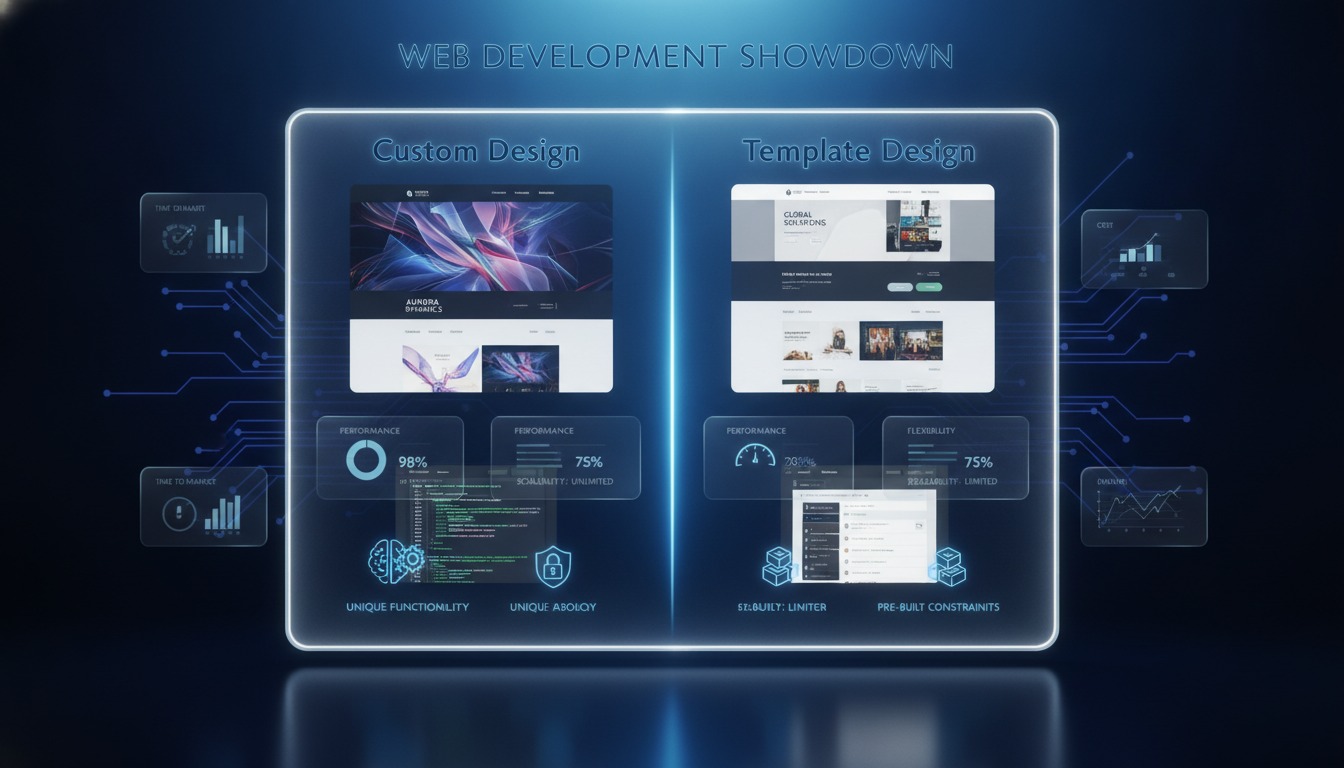
Custom website design gives you a fully built, one-of-a-kind site coded to your business goals. A template website uses a pre-built layout from platforms like Wix, Squarespace, or GoDaddy. Templates cost less and launch faster. Custom sites perform better on SEO, speed, and lead generation. Your best choice depends on your growth stage, budget, and how central your website is to your revenue.
You’ve probably typed it into Google at least once: “How much does a website cost?” The results send you in five directions at once. Wix says you can go live today for free. A web agency quotes you thousands. A cousin tells you their nephew built their site on Squarespace and it “works fine.”
The confusion is real. But the decision matters more than most small business owners realize. Your website isn’t just a digital business card. For most local service businesses, it’s the first impression, the lead form, and the sales closer, all on one page.
At Sites N Apps, we’ve built both template-based and fully custom websites for small businesses across Lafayette, LA, and beyond. We’ve watched the same pattern repeat: businesses that choose wrong for their situation waste money or lose customers. This article breaks down everything you need to know so you can make the right call.
Template website: A website built on a pre-designed layout from a website-building platform, requiring no custom code.
Template platforms give you a drag-and-drop editor tied to a pre-built visual structure. You replace placeholder text and images with your own content. The platform handles hosting, security updates, and technical maintenance. You don’t touch a line of code.
Most platforms charge a monthly subscription. That fee covers the builder, the hosting, and any premium features you need. You’re essentially renting a digital storefront.
The most widely used template website builders in 2025 include:
Each has its own pricing tier, feature limits, and SEO toolset.
Template sites offer a few genuine advantages that make them the right call in specific situations.
Speed to launch is the biggest one. You can have a basic site live in a day or two. No design brief, no development timeline, no waiting.
Lower upfront cost matters when cash flow is tight. Monthly plans start as low as $16–$29 per month on most platforms.
Ease of use keeps you in control. You can update your hours, add a photo, or swap out a headline without calling a developer.
These are real benefits. But they come with trade-offs you need to know before committing.
The limitations show up the moment your business starts growing or competing seriously for local search visibility.
Design flexibility is capped. You’re working within a structure someone else designed for a general audience. Changing the fundamental layout usually means starting over on a different template.
Site speed suffers. Template platforms load bloated code that your visitor never sees. This slows your page load time, and slow sites rank lower on Google. According to Google’s research, 53% of mobile users leave a site that takes more than three seconds to load.
SEO control is limited. Most template builders offer basic SEO fields, but they don’t let you control technical elements like structured data (schema markup), canonical tags, or site architecture in the way a custom build can.
You don’t fully own the site. If the platform shuts down or triples its pricing, your site goes with it. You’re building on rented land.
Those limitations are exactly why custom development exists as an option, and why so many businesses eventually outgrow their template.
Custom website design: A website built from scratch by a developer or agency, coded specifically to your business requirements, branding, and technical goals.
A custom build starts with strategy. Your web agency asks about your goals, your customers, and your competitors before touching a design tool. From there, a designer creates wireframes (structural layouts) and mockups (visual designs) specific to your brand.
A developer then builds the site using code, usually on a content management system like WordPress, or a platform like Webflow, or a fully custom stack. The final site is tested for speed, mobile performance, and SEO before launch.
The process takes longer, typically four to twelve weeks, depending on the scope. But the output is a website that works exactly the way your business needs it to.
Full design control is the most immediate benefit. Every element, from font choices to button placement to page layout, is designed with your audience in mind, not a generic user base.
Better SEO performance is where the real ROI often shows up. Custom-built sites can be optimized at a technical level that template platforms simply can’t match. Structured data, optimized site architecture, and lightning-fast load times all of these feed into how well Google ranks your site.
Higher conversion rates follow from better design. A custom site can be built around a specific conversion goal: a phone call, a form fill, or a booking. Every section can be structured to move a visitor toward that action.
You own everything. The code, the content, the domain, it’s yours. No platform dependency, no monthly rent, no surprises.
For businesses where the website drives revenue, these advantages compound over time. According to a 2023 WebFX study, businesses that invest in professional web design see an average ROI increase of 200% or more within the first year when measuring leads and conversions.
Yes, and it’s worth being honest about them.
Higher upfront cost is the primary barrier. A quality custom website from a professional agency starts around $2,500–$5,000 for small businesses, and scales up with complexity.
Longer build time means you’re not live next week. Expect weeks, not days.
Ongoing maintenance is your responsibility (or your agency’s). Updates, security patches, and plugin management require attention that template platforms handle automatically.
These are real considerations. But for businesses serious about using their website as a growth tool, the math usually favors the custom investment within 12–18 months.
AI website builders have entered the conversation in the last two years, and they’re worth understanding before you decide.
AI builders like Wix ADI, Jimdo Dolphin, and Durable use machine learning to generate a website based on a few prompts. You describe your business, and the tool builds a draft site in minutes, complete with copy, images, and a basic layout.
It sounds impressive. In some narrow use cases, it actually is.
AI builders make sense when you need a placeholder site fast, before you’re ready to invest in something more serious. They also work reasonably well for very simple one-page sites for events, freelancers, or pop-up businesses.
If your goal is a temporary online presence with minimal cost, an AI builder can get you there.
AI builders inherit all the limitations of template platforms, plus a few new ones. The copy they generate is generic. The layouts are predictable. Local SEO optimization is close to nonexistent.
More importantly, an AI can’t replace a strategist who understands your market, your competitors, and your customers’ decision-making process. For any business relying on its website for leads, AI-generated sites consistently underperform compared to professionally designed ones.
Think of an AI builder as a rough draft that still needs a professional editor before it goes public.
Here’s how the two approaches compare across the factors that matter most to small business owners.
| Factor | Template Website | Custom Website |
| Upfront Cost | Low ($16–$50/month) | Higher ($2,500–$10,000+) |
| Launch Time | 1–3 days | 4–12 weeks |
| Design Flexibility | Limited by template structure | Fully customizable |
| SEO Control | Basic fields only | Full technical SEO access |
| Core Web Vitals | Often below Google’s threshold | Optimized for performance |
| Conversion Optimization | Generic layouts | Goal-specific design |
| Scalability | Hit limits quickly | Built to scale |
| Ownership | Platform-dependent | You own it completely |
| Local SEO | Minimal schema support | Full schema and GBP integration |
| Long-Term ROI | Lower for growing businesses | Higher for lead-dependent businesses |
Templates look cheaper until you calculate the real cost. Monthly fees, premium app upgrades, and the lost revenue from poor conversion rates add up. A custom site costs more day one, but often pays for itself within the first year for businesses actively generating leads online.
With a template, you’re rearranging furniture inside a room you didn’t design. With a custom site, you’re designing the room. For businesses with a strong visual identity or a complex service offering, that difference directly affects how potential customers perceive your credibility.
Custom websites win on SEO. Full access to site architecture, schema markup, page speed optimization, and technical SEO elements gives your developer the tools to build a site that Google actually rewards. Template platforms restrict many of these controls, especially for local search signals.
Google’s Core Web Vitals (loading speed, interactivity, and visual stability) are a ranking factor. Template platforms often load unnecessary code that drags these scores down. Custom-built sites, optimized from the ground up, consistently score higher. A faster site ranks better and converts more visitors.
Custom sites convert better. Every section can be designed around your specific customer journey. Template layouts are built for everyone, which means they’re optimized for no one in particular. If your website is supposed to generate phone calls or form fills, a custom design delivers measurably better results.
Templates hit a ceiling. Adding new service pages, integrating a booking system, or building out a content hub becomes difficult or impossible without switching platforms. Custom sites are built to grow with you.
With a template, the platform does. With a custom site, you do. This matters more than it sounds. If you ever want to move hosts, redesign, or hand your site to a new agency, ownership makes that easy. Platform dependency makes it painful.
For small businesses in competitive local markets, this section might be the most important one in the article.
Local schema markup is code added to your website that tells Google exactly what your business is: your name, address, phone number, service area, hours, and reviews. Template platforms offer minimal support for this. Custom-built sites can implement a full LocalBusiness schema, service schema, and review schema that significantly improve your chances of appearing in local search results.
Google Business Profile (GBP) integration, including NAP (Name, Address, Phone) consistency between your website and your GBP listing, is another area where custom sites have a clear edge. According to BrightLocal’s 2024 Local Consumer Review Survey, 87% of consumers used Google to evaluate local businesses. Your website needs to match what Google expects to see.
Custom websites let you build dedicated location pages, each optimized for a specific city or service area. Template platforms limit how many unique URL structures you can create and how much control you have over on-page optimization for each page.
If you serve multiple areas around Lafayette, LA, a custom site lets you build a page for each one. A template usually forces you to list service areas as a bullet point on a single page, which provides far less local SEO value.
They can, but they’re playing with one hand tied behind their back. Template sites can rank for low-competition local keywords with good content. But in competitive niches, like HVAC, legal services, or web design, the technical SEO advantages of a custom-built site make a measurable difference in where you land on page one.
Templates aren’t the wrong choice for every business. In fact, they’re the right choice for several specific situations.
If you launched in the last six months and your primary goal is just having a web presence while you validate your business model, a template is perfectly appropriate. You need something professional-looking at low cost. Get it live, focus on getting customers, and revisit your website investment once revenue is more consistent.
Budget reality matters. A $300 upfront investment in a Squarespace site is a legitimate business decision when $5,000 isn’t accessible. A good template site with quality content and basic SEO setup beats no site at all, by a wide margin.
Yes. If you’re launching a new service line or entering a new geography, a template landing page is a low-risk way to test demand before committing to a full build. This approach makes financial and strategic sense.
The key is treating the template as a bridge, not a destination.
For businesses in the growth or optimization stage, custom design is almost always the smarter path.
Lawyers, contractors, medical professionals, marketing agencies, and other service businesses compete heavily on credibility. A template site that looks generic works against you. A professionally designed custom site reinforces expertise before a prospect ever speaks with you.
At Sites N Apps, we’ve seen service businesses double their consultation rate after moving from a template to a custom-built site, simply because the new design communicated professionalism that the old one couldn’t.
If you’re running paid ads, optimizing for local search, or building a content marketing strategy, you need a website that can support all of it. That means clean landing pages, fast load times, schema markup, and conversion-optimized layouts. Templates can’t reliably deliver all four.
A custom site is the foundation. Everything else, ads, SEO, and content, builds on top of it.
Multi-location businesses need individual location pages, each with unique local SEO signals. E-commerce stores need custom product structures, inventory management integrations, and payment systems that template platforms don’t always support cleanly.
For both cases, the complexity of the business requires a site built to match it.
Watch for these signals:
If you recognize two or more of these, it’s time to talk to a professional.
Before making a final call, run through these questions honestly.
If your website is purely informational and customers find you through referrals or walk-ins, a template can work. If your website is expected to generate leads, rank on Google, and close sales, a custom build is the right tool for that job.
Think forward, not just about today. A business planning to scale, add service lines, or expand geographically will hit the ceiling of a template platform faster than expected. Building right once is cheaper than rebuilding twice.
For any business that competes for local customers, your website’s technical SEO directly affects how often you appear when someone searches “near me” or “in Lafayette.” If local search matters, custom wins this category clearly.
Do you want to rent a space or own it? If you build on a template platform and that platform changes its pricing, discontinues your plan, or shuts down, your website disappears with it. With a custom-built site on your own hosting, you hold the keys permanently.
Custom website design vs template isn’t a question with one universal answer. Templates serve a real purpose for new businesses, budget-constrained startups, and market tests. But for any business serious about local search visibility, lead generation, and long-term digital growth, custom design is the higher-return investment almost every time.
The real cost of a template site isn’t the monthly subscription fee. It’s the missed leads, the lower search rankings, and the eventual rebuild you’ll need when the platform can’t keep up with your business. Choosing custom from the start, when the time is right, saves money over a three-to-five-year window.
We built Sites N Apps to help Lafayette, LA, small businesses make this exact decision without guesswork. Whether you need a polished template site to get started or a fully custom build to compete at the next level, we assess your specific situation before we recommend anything. Book a free website strategy consultation or explore our custom web design services to see how we approach this for businesses like yours.
For most small businesses that rely on their website for leads or local search traffic, yes. Custom sites consistently outperform templates on SEO, speed, and conversion rate. The higher upfront cost typically pays for itself within 12 to 18 months when measured against qualified leads generated.
Yes, template websites can rank on Google, especially for low-competition keywords. However, they have limited access to technical SEO controls like structured data, site architecture optimization, and Core Web Vitals tuning. Custom-built sites have a clear performance edge in competitive local markets.
Most small business custom website projects take between four and twelve weeks from strategy to launch. The timeline depends on the number of pages, custom features required, and how quickly the client can provide content and approvals.
You lose it. Template websites are hosted on third-party platforms, and if that platform discontinues service, changes its pricing model, or alters its features, your site is affected. A custom-built site hosted on your own server gives you full ownership and independence.
Custom websites are significantly better for local SEO. They support full schema markup implementation, location-specific page structures, and technical SEO optimizations that help Google understand and rank your business for local searches. Template platforms limit many of these capabilities.
Template websites typically run $16–$50 per month, plus optional premium apps. Custom websites for small businesses start around $2,500–$5,000 and scale up based on complexity. Over a three-year period, the total cost of ownership is often closer than it first appears, especially when factoring in conversion rates and revenue impact.
Struggling to compete for high-search-volume keywords? We help businesses like yours increase visibility, drive more traffic, and dominate competitive search terms—all while keeping your costs low. Our proven strategies focus on long-term growth and measurable results.