
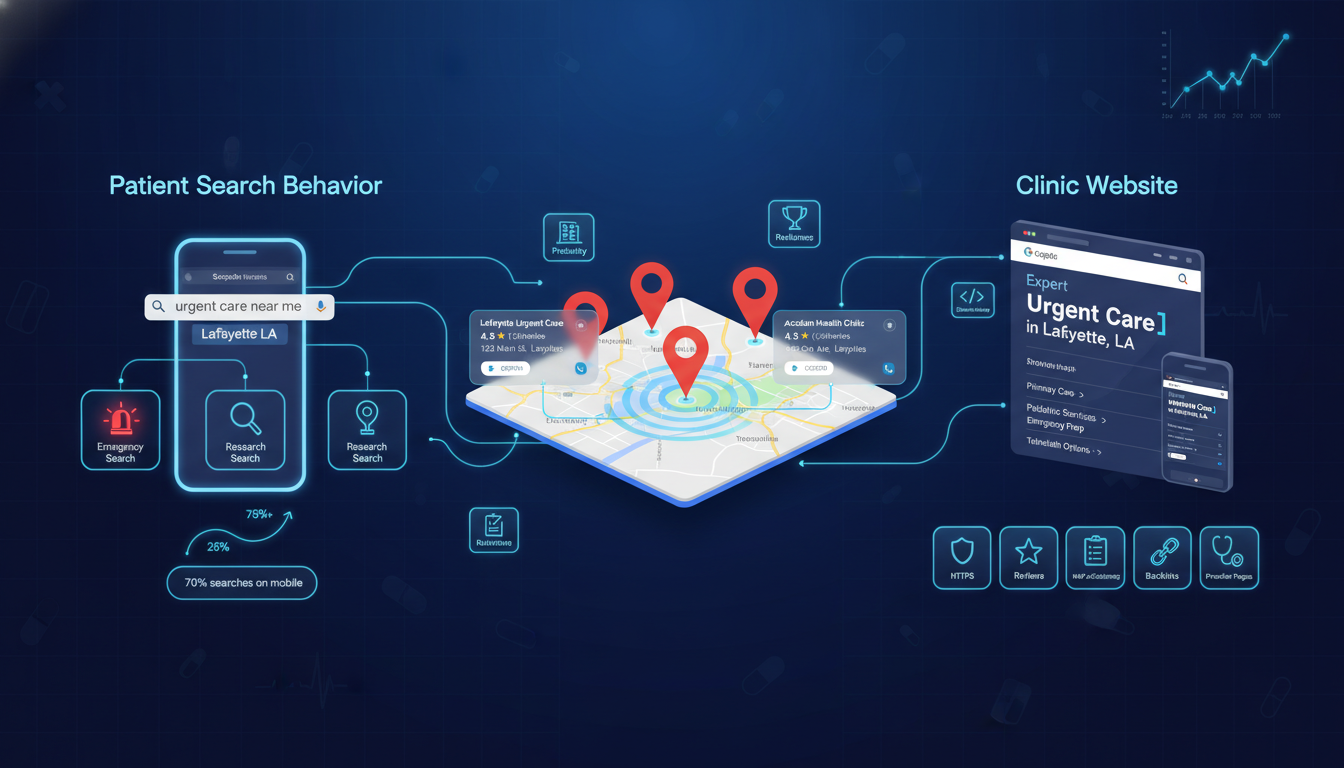
If you run a medical clinic in Lafayette, LA, you want people to find you online. Not just anyone, you want people nearby who need a doctor right now.
That is exactly what local SEO for medical clinics does. It helps your clinic show up when people in your area search for healthcare services on Google.
This guide covers everything. From setting up your Google Business Profile to getting more patient reviews, you will know what to do and why it works.
SEO stands for Search Engine Optimization. It is the process of helping your website show up on Google.
Local SEO is a smaller part of that. It focuses on helping your clinic show up for people searching in your city or neighborhood.
So when someone in Lafayette types “family doctor near me” or “urgent care Lafayette LA,” local SEO is what puts your clinic in front of them.
For medical clinics, this matters a lot. Most patients do not drive far for healthcare. They search online, pick one of the top results, and book. If your clinic is not in those top results, you are losing patients to competitors who are.
Learn more about how local SEO works for service businesses at Sites N Apps.
When you search for a local business on Google, you often see a map with three listings below it. This is called the Map Pack or Local Pack.
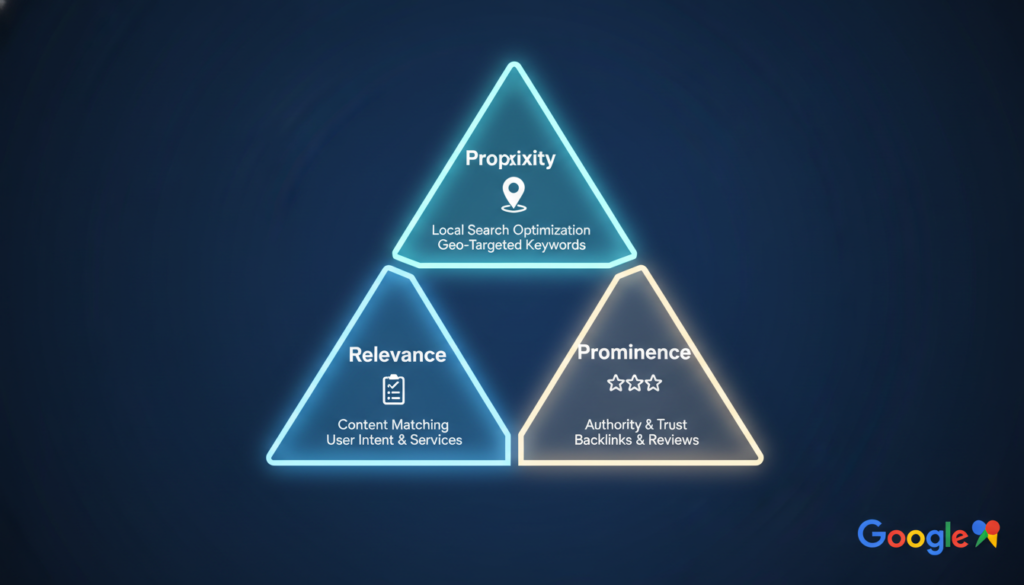
Google decides who shows up there based on three things:
Proximity: How close is the clinic to the person searching?
Relevance: Does the clinic match what the person is looking for?
Prominence: Is the clinic well-known online? Does it have good reviews and a strong website?
You cannot control proximity that depends on where the patient is. But you can work hard on relevance and prominence. That is what this guide is about.
People used to find doctors through referrals or phone books. That has changed completely.
Today, most people start their search for a doctor online. They type something into Google and pick from the first few results. If your clinic does not appear there, it simply does not exist for those patients.
Voice search is also growing. People ask their phones things like “find a doctor near me” or “what clinic is open now.” Local SEO helps you show up for those searches, too.
More visibility on Google means more patients. More patients mean more revenue. It is that simple.
The clinics that invest in local SEO for medical clinics today will have a strong advantage in 2026 and beyond. The ones that do not will keep losing patients to competitors who rank higher.
Local SEO also brings in patients who are ready to book. These are not random visitors. They searched for a doctor, found you, and want to make an appointment. That is a high-quality lead.
Not every patient searches the same way. Understanding how they search helps you create the right content for the right moment.
Emergency searches: These are urgent. Someone types “emergency clinic near me” or “urgent care open now Lafayette.” They need help fast and will call the first option they trust.
Research searches: These patients are not in a rush. They type things like “best pediatrician in Lafayette, LA” or “what is a good family doctor near me.” They are comparing options before deciding.
Navigational searches: These people already know your clinic. They just search for your name to find your address, phone number, or hours.
Each type needs a different approach. Your Google Business Profile handles emergency and navigational searches well. Your website content handles research searches.
Most local searches happen on a phone. Someone is out, feels sick, and pulls out their phone to search.
“Near me” searches have grown a lot in recent years. Google uses the person’s location to show nearby clinics. This means your Google Business Profile and your website need to be optimized for mobile users.
If your website loads slowly on a phone or is hard to read, patients will leave and call a competitor.
Lafayette is a mid-size city with a mix of neighborhoods, growing suburbs, and a strong Cajun culture. Patients here value trust and community reputation.
Many patients in Lafayette ask neighbors or friends for doctor recommendations. Online reviews carry a lot of weight because they feel like those personal recommendations.
Spanish and French-speaking communities are present in the area, too. If your clinic serves those patients, having content in their language can help you reach them.
Generic keywords like “family doctor” are hard to rank for. There is too much competition. Instead, focus on location-specific keywords.
Examples of good local keywords for a Lafayette clinic:
Use these keywords naturally in your page titles, service descriptions, and blog content. Do not stuff them in. Write like a human, and mention the location where it makes sense.
For a deeper look at building a local SEO plan, check out our local SEO guide at SiteSnaps.
We covered these briefly in section one. Here is a closer look.
Proximity is how close your clinic is to the person searching. You cannot change your physical location, but you can make sure your address is listed correctly everywhere online.
Relevance is about matching what the patient is searching for. If someone searches “sports medicine doctor Lafayette,” Google wants to show them clinics that actually offer sports medicine. Your website content and Google Business Profile need to clearly list your services.
Prominence is how well-known and trusted your clinic is online. A clinic with 200 five-star reviews, links from local websites, and a well-optimized site will rank above a clinic with none of that, even if they are the same distance from the patient.
These three things build your prominence score:
Reviews: Google looks at how many reviews you have, your average rating, and how recent they are. Fresh reviews from real patients signal that your clinic is active and trusted.
Backlinks: When other websites link to yours, Google sees your site as more credible. Local news sites, community organizations, and healthcare directories are good sources of backlinks.
On-page signals: This includes your page titles, content, headings, and schema markup. When your website clearly explains who you are, where you are, and what you do, Google understands your clinic better.
Your Google Business Profile (GBP) is the single most important tool for local SEO for medical clinics. It controls what patients see in Google Maps and the Map Pack.
Go to Google Business Profile and create a listing if you do not have one. Fill in every field. Google will send you a postcard, call, or email to verify that the business is real and at that address.
Make sure your clinic name, address, and phone number are exactly the same as what is on your website. This consistency matters.
Choose the most specific primary category. For a family clinic, that is “Family Practice Physician.” Do not pick something generic like “Medical Clinic.”
Add secondary categories for any other services you offer. Add a full list of your services with descriptions. Fill in your hours, website, appointment link, and a description of your clinic.
Write your business description naturally. Include your main services and your city. Do not stuff it with keywords.
Google Business Profile has tools that many clinics ignore. Use them.
Posts: Share health tips, clinic news, or seasonal reminders. This keeps your profile active and can attract more clicks.
Q&A: Patients can ask questions on your profile. Answer them quickly. You can also add your own common questions and answers before patients even ask.
Photos: Add real photos of your clinic, staff, and waiting room. Profiles with photos get more clicks. Update photos regularly.
Messaging: Allow patients to message you directly from your profile. Respond quickly. Google tracks your response time.
Every page on your website needs a title tag. This is the blue link people see in Google search results.
A good title tag for a service page looks like this: “Family Doctor in Lafayette, LA | [Clinic Name].”
Your meta description is the short text below the title. It does not directly affect rankings, but it does affect clicks. Write it like an ad — make it helpful and clear.
Use H1, H2, and H3 headings to organize your pages. Your H1 should include your main keyword. Your H2s and H3s can include related terms.
Create a separate page for each service you offer. Do not put everything on one page.
Good service pages to have:
Beyond service pages, create content around health conditions your patients search for. Things like “high blood pressure treatment Lafayette, LA” or “diabetes care Acadiana.” These condition-based pages help you capture patients who are searching for help with a specific problem.
Schema markup is code you add to your website to help Google understand what your pages are about. It does not change what visitors see, but it helps Google display rich results.
For medical clinics, use:
LocalBusiness schema — Tells Google your clinic name, address, phone, and hours.
Physician schema — Use this on provider pages to list each doctor’s name, specialty, and credentials.
Schema markup can help your site appear in AI-generated answers and rich snippets on Google.
Link your pages together. If your homepage mentions family medicine, link that phrase to your family medicine service page. If a blog post talks about blood pressure, link to your chronic care page.
Internal links help patients navigate your site. They also help Google understand the structure of your website and which pages are most important.
Each doctor at your clinic should have their own page on your website. Patients often search for doctors by name or specialty.
A good doctor profile page includes:
If your clinic has more than one location, each location needs its own page. Do not copy and paste the same content for every location.
Each page should include the specific address, phone number, hours, services offered at that location, and content that is unique to that area.
For example, a location page for your Broussard office should mention Broussard, not just Lafayette. This helps you rank in searches from that specific neighborhood.
Thin content means pages with very little useful information. Google does not rank thin pages well.
If you have five location pages that all say the same thing with just the address changed, that is thin content. Write real, helpful content for each page. Explain what makes that location special, who it serves, and what services it offers.
More than half of local searches happen on a phone. Your website must work perfectly on mobile.
Use a responsive design that adjusts to any screen size. Make sure buttons are easy to tap. Make sure the text is large enough to read without zooming. Test your site on a real phone, not just a desktop.
Google measures how fast your pages load. Slow pages rank lower and lose patients. If your site takes more than three seconds to load on a phone, many visitors will leave before it finishes.
Compress your images. Use a fast hosting provider. Minimize unnecessary code. Tools like Google PageSpeed Insights can show you exactly what to fix.
Your website must use HTTPS, not HTTP. HTTPS means the connection between your site and the visitor is secure. It shows a padlock icon in the browser.
Patients trust HTTPS sites more. And Google ranks HTTPS sites higher. If your site still uses HTTP, fix this immediately.
A citation is any mention of your clinic’s name, address, and phone number online. These citations help Google confirm that your clinic is real and where it says it is.
Make sure your clinic is listed on these platforms:
Each listing should have the exact same name, address, and phone number as your Google Business Profile.
NAP stands for Name, Address, Phone. These three pieces of information must be identical everywhere online.
Even small differences matter. If your address is “Suite 200” on your website but “Ste. 200” on Healthgrades, that inconsistency can confuse Google.
Go through your listings regularly and correct any errors. Use a tool like BrightLocal or Whitespark to find and manage your citations.
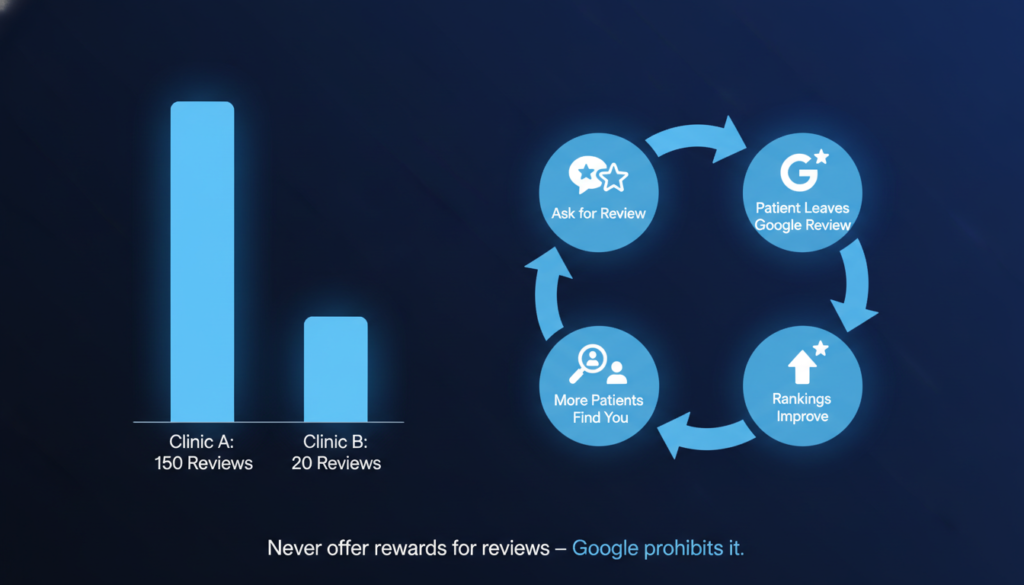
Reviews are one of the strongest local ranking signals. A clinic with 150 four-star reviews will almost always outrank one with 20.
The best way to get reviews is to ask. After a positive visit, send the patient a text or email with a direct link to your Google review page. Make it as easy as possible.
Train your front desk staff to mention reviews when patients check out. You can say something like: “If you had a good experience today, we would love it if you left us a review on Google.”
Do not offer rewards for reviews. Google does not allow this.
Always respond to reviews — good and bad. It shows patients and Google that you are active and care about feedback.
When responding, never confirm or deny that someone is a patient. Do not share any health information. A simple, professional response is enough.
For negative reviews, thank the person for their feedback and invite them to call your office to resolve the issue. Do not argue or get defensive in public.
Google uses reviews as a signal of trust and quality. More reviews, higher ratings, and recent activity all contribute to better Map Pack rankings.
Reviews also include keywords naturally. When a patient writes “great family doctor in Lafayette,” that phrase helps confirm to Google what your clinic offers and where you are.
Content marketing means creating helpful articles and resources that answer the questions your patients are searching for.
For a Lafayette clinic, this could include:
This type of content attracts patients who are in the research phase. They are not ready to book yet, but they are looking for a clinic they can trust. Good content builds that trust.
Topical authority means Google sees your website as an expert on a subject. You build it by writing a lot of helpful, well-organized content around your medical specialty.
If you are a family medicine clinic, write articles about family health, preventive care, vaccinations, chronic disease, and seasonal health tips. Over time, Google starts to associate your website with those topics and ranks you higher for related searches.
A backlink is when another website links to yours. Google treats backlinks like votes of confidence. The more quality backlinks you have, the more authority your site gets.
For a Lafayette clinic, good places to earn backlinks include:
Sponsor a local event. Partner with a school for health screenings. Participate in community health fairs.
These activities often result in backlinks from the event websites or news coverage. They also build your real-world reputation, which leads to more word-of-mouth referrals and online mentions.
Getting to the top of Google is only half the job. Once patients find you, your website needs to turn them into booked appointments.
Make it easy to book. Have a clear “Book Appointment” button visible on every page. If you use an online booking system, make sure it works perfectly on mobile.
Reduce friction. Do not make patients fill out long forms just to schedule a visit. Ask for the minimum information needed.
On mobile, a phone number should be a tap-to-call link. If a patient has to copy and paste your number, many will give up.
Put your phone number in your header and footer. Add it to every service page. Make contacting you as easy as possible.
Patients need to trust you before they book. Add these trust signals to your website:
Use call tracking to see how many patients call from your website or Google Business Profile. This tells you which pages and listings are driving the most patient contact.
Track form submissions and online appointment bookings. Set these up as goals in Google Analytics so you can measure them over time.
Google Business Profile Insights shows you how many people viewed your profile, how many clicked your website, how many called, and how many asked for directions.
Watch these numbers month over month. If they go up, your local SEO is working. If they drop, something may have changed that needs attention.
Local SEO takes time. You may not see big results in the first month. But over six to twelve months, you should see more website traffic, more calls, and more booked appointments.
Track your cost per new patient. Compare it to what you spend on paid ads or other marketing. Most clinics find that organic local SEO delivers a much lower cost per patient over time.
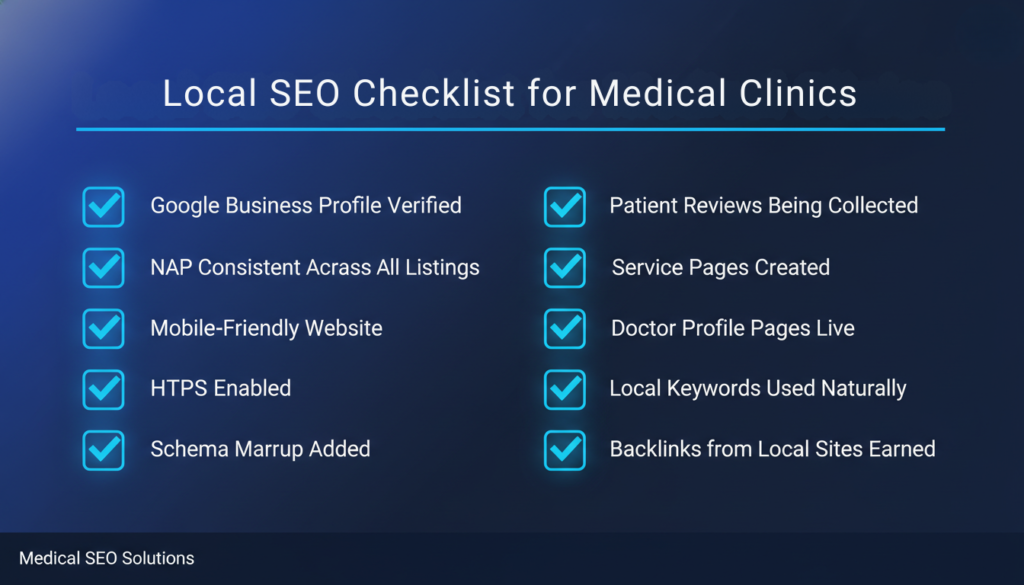
If your clinic name, address, or phone number is different across your listings, Google gets confused. Fix every inconsistency. This alone can improve your local rankings.
A negative review that goes unanswered looks worse than the review itself. Always respond. Show potential patients that you take feedback seriously.
Writing “local SEO for medical clinics Lafayette, LA, Lafayette, Louisiana clinic doctor” over and over does not help. Google can detect this and will penalize your site. Write naturally. Use your keywords where they make sense.
More patients are using voice search. They ask their phones and smart speakers questions like “find a doctor near me” or “what clinic is open on Sunday in Lafayette.”
Voice searches are more conversational. Optimize your content for natural questions. An FAQ section on your website helps a lot with this.
Google is using AI more than ever to understand search intent and personalize results. It also uses E-E-A-T, which stands for Experience, Expertise, Authoritativeness, and Trustworthiness.
For medical clinics, E-E-A-T is very important. Google wants to show patients content written by real medical professionals. Make sure your website lists your doctors’ credentials. Have doctors write or review your health content. Show that your clinic is a real, trusted part of the Lafayette community.
AI overview results on Google, those AI-generated summaries at the top of the page, tend to pull from clear, well-structured content. Use headings, keep your answers short and direct, and cover topics completely. This guide is written with exactly that in mind.
Local SEO for medical clinics is not a one-time project. It is an ongoing process. Google changes. Competition grows. Patient behavior shifts.
But the clinics that stay consistent with their local SEO will keep growing their patient base year after year.
Start with the basics: claim and optimize your Google Business Profile, fix your listings, get more reviews, and make sure your website is fast and mobile-friendly. Then build from there.
If you want expert help with local SEO for your medical clinic in Lafayette, SiteSnapps is here to help. We specialize in helping local businesses grow through search.
You can also read our complete local SEO guide to go even deeper on the strategies covered here.