

Are you a dentist in Lafayette, LA? Do you want more patients to find your practice on Google?
You are not alone. Most dentists know they need to show up online but they do not know where to start.
Here is the truth. When someone in Lafayette needs a dentist, the first thing they do is grab their phone and search on Google. If your practice is not showing up, that patient is going straight to your competitor.
That is where local SEO for dentists comes in. Local SEO is not complicated. It does not require a big budget. And you do not need to be a tech expert to do it.
In this guide, we will walk you through every single step from setting up your Google profile to getting more patient reviews to making your website work harder for you.
By the end, you will know exactly what to do to get your dental practice ranking at the top of Google in Lafayette, LA in 2026.
Have you ever typed “dentist near me” into Google? Then you already know what local SEO is you just did not know the name.
Local SEO means making your dental practice easy to find when people nearby search for a dentist online. It is all about showing up on Google when someone close to your office is looking for help.
When you do local SEO right, your practice shows up at the top of Google Search and Google Maps. That means more people click on your name, call your office, and book an appointment.
Regular SEO tries to get your website seen by anyone on the internet. It does not matter where they live.
Local SEO is different. It only tries to get your practice seen by people near you people who can actually walk through your door.
So instead of trying to rank for “best dentist in the world,” you want to rank for “dentist in Lafayette, LA.” That is local SEO.
Lafayette is a growing city. More people means more competition between dental offices. If your practice does not show up on Google, patients will just go to someone else.
The good news? Most dental offices in Lafayette are not doing local SEO well. That means if you start now, you can get ahead of them fast.
This guide will show you exactly how to get your dental practice to rank higher on Google in Lafayette, LA.
By the end, you will know how to set up your Google profile, get more patient reviews, build your website the right way, and much more.
Everything is written in simple steps. You do not need to be a tech expert. You just need to follow along.
Local SEO for dentists is not just a nice thing to have anymore. In 2026, it is something you must do if you want to grow your practice.
Think about what you do when you need a new dentist. You pull out your phone and type something like “dentist near me” or “family dentist in Lafayette.” Then you look at the top results and pick one.
Your patients do the exact same thing. In fact, most people never scroll past the first few results on Google. If you are not there, you are invisible to them.
Most people also search on their phones. They are in their car, at work, or sitting on the couch. They want a quick answer. If your practice shows up and looks good, they will call you.
Every day your practice does not show up on Google, you are losing patients to someone else.
Those patients do not even know you exist. They are not choosing another dentist over you they simply never saw your name.
Local SEO fixes that. It puts your name in front of people who are already looking for a dentist right now.
Local SEO has changed a lot over the years. In 2026, it is about more than just putting your address on a website.
Google wants to give people exactly what they are looking for. If someone searches “kids dentist in Lafayette,” Google will show practices that clearly offer pediatric dentistry in Lafayette.
This means your website and Google profile need to be very clear about what services you offer and where you are located. Do not make Google guess.
Google looks at three big things when deciding who to show in local search results how close you are to the person searching, how trustworthy your practice looks online, and how well your services match what they searched for.
Building trust takes time. It comes from patient reviews, your website content, and how consistent your information is across the internet.
Imagine your practice is listed on Google with one phone number, but your website shows a different number. That confuses Google and it confuses patients too.
Everything needs to match. Your name, address, phone number, hours, and services should be the same everywhere online. When they all match, Google trusts you more.
You may have noticed that Google now sometimes shows AI-written answers at the very top of search results. This is called Generative Engine Optimization, or GEO.
This means Google’s AI reads your website and decides if your practice is worth recommending. If your content is clear, helpful, and trustworthy, the AI may include your practice in its answer.
This is brand new, and most dentists are not thinking about it yet. Getting ahead of this now gives you a big advantage.
Google uses three main things to decide which dental practices to show first. Understanding these helps you know where to focus your energy.
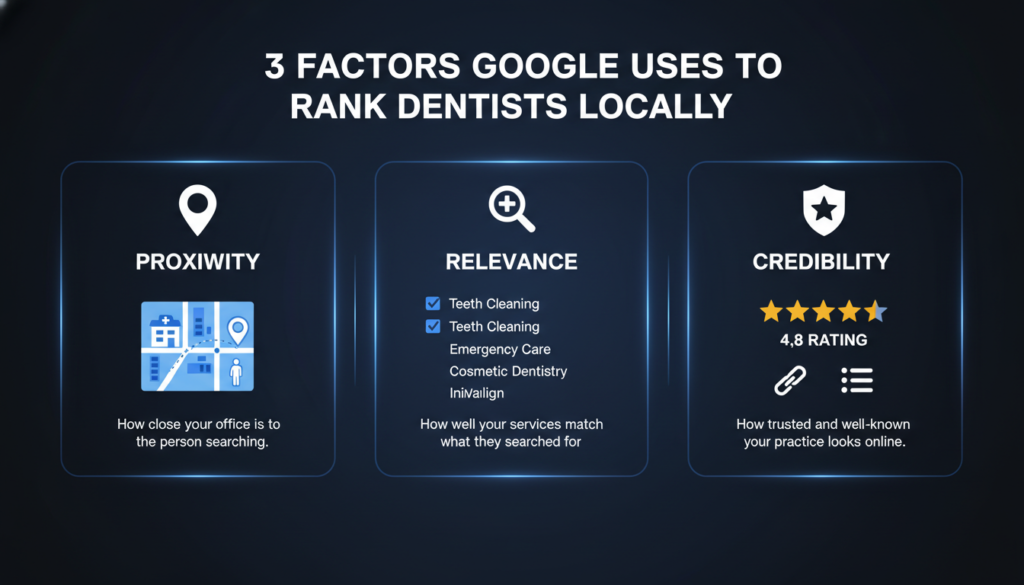
This one is simple. The closer your practice is to the person searching, the better your chances of showing up.
You cannot move your office, but you can make sure Google knows exactly where you are. A complete and accurate Google Business Profile helps a lot here.
If someone searches “emergency dentist Lafayette,” Google will favor practices that clearly offer emergency dental care.
Make sure your website and Google profile clearly list all your services. The more specific you are, the better Google can match you to the right searches.
Google checks how trustworthy your practice looks. It looks at your patient reviews, how many websites link to yours, and how consistent your information is online.
More positive reviews, more local mentions, and a well-built website all help Google see you as a credible practice.
If your practice is not showing up on Google, do not panic. There is a clear order to fix things. Start with the basics before moving to the advanced stuff.
What to Prioritize in the First 30 Days
In your first month, focus on the foundation. Claim and complete your Google Business Profile. Make sure your name, address, and phone number are correct everywhere online. Ask your happy patients to leave you a Google review.
These three things alone can make a big difference fast.
What to Focus on at the 60 to 90 Day Mark
Once your foundation is solid, start working on your website. Add pages for each service you offer. Write some simple blog posts about dental care in Lafayette. Start building your reputation by responding to every review you get.
By month three, you should start to see your practice climbing up in local search results.
Now, let us get into the actual work. Here are the seven steps to rank higher in Lafayette.
Your Google Business Profile, or GBP, is the little box that shows up on the right side of Google when someone searches for your practice. It also shows up on Google Maps.
This is the single most important thing you can set up for local SEO for dentists. It is free and powerful.
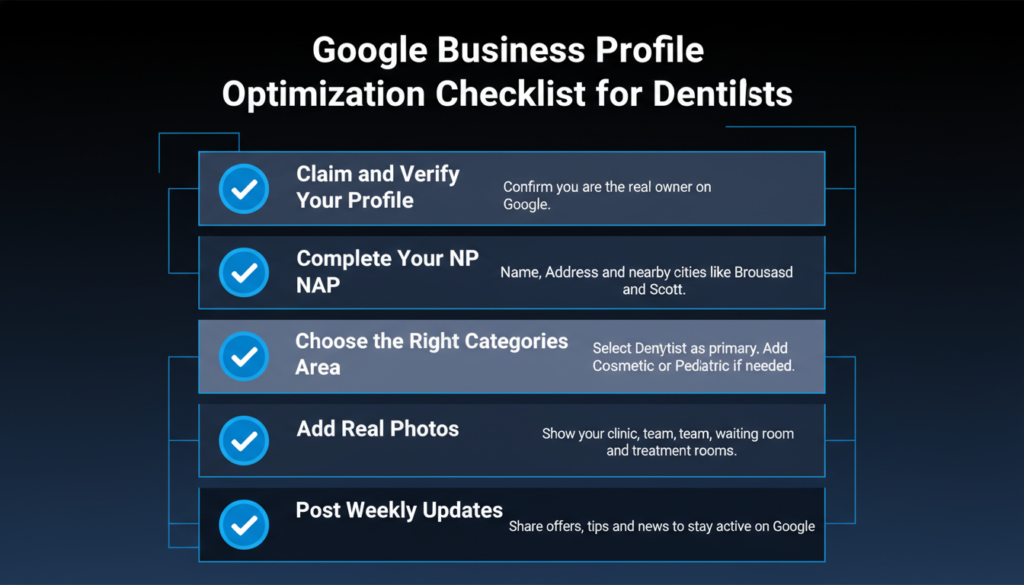
Go to Google Business Profile and search for your practice. If it is already there, claim it. If not, create it. Google will send you a postcard or call to verify you are the real owner.
Do not skip this step. Without verification, your profile will not show up properly.
NAP stands for Name, Address, and Phone number. Fill these in exactly as they appear everywhere else online.
Add your opening hours, your website link, and choose the right categories. Your main category should be “Dentist.” You can add others like “Cosmetic Dentist” or “Pediatric Dentist” if they apply.
If you serve patients from nearby areas like Broussard, Scott, or Youngsville, add those to your service area. This helps you show up when people in those towns search for a dentist too.
When you describe your services, write the way your patients talk not the way dentists talk. Instead of “comprehensive oral prophylaxis,” say “regular teeth cleaning.”
Simple words help both patients and Google understand what you offer.
Add real photos of your office, your team, and your waiting room. Practices with photos get far more clicks than those without.
Post updates regularly special offers, holiday hours, dental tips. Use the Q&A section to answer common questions patients might have before they even call you.
Your website is your online home. It needs to be set up in a way that helps Google understand who you are, what you do, and where you are located.
Before you write anything, find out what words your patients are actually searching for. Think about phrases like “dentist in Lafayette LA,” “teeth whitening Lafayette,” or “emergency dentist near me.”
You can use free tools like Google’s search bar — just start typing and see what it suggests. Those suggestions are real searches people are making.
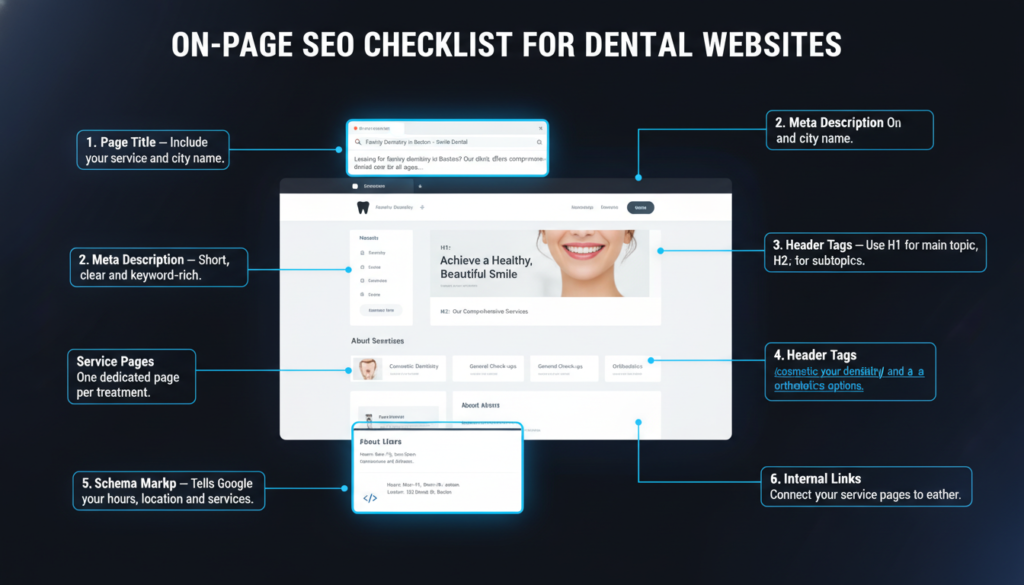
Every page on your website has a title and a short description that shows up in Google search results. Make sure these include your location and your main service.
For example, instead of “Welcome to Our Practice,” your homepage title could be “Family Dentist in Lafayette, LA Accepting New Patients.”
Do not put all your services on one page. Create a separate page for each main service — one for teeth cleaning, one for braces, one for teeth whitening, and so on.
Each page should mention Lafayette and explain the service in simple, helpful language.
Schema markup is a small piece of code you add to your website. It tells Google extra details about your practice — like your hours, location, and the type of business you are.
You do not need to write the code yourself. Your website designer can do it, or you can use a plugin if your site runs on WordPress.
When you mention teeth whitening on your homepage, link that text to your teeth whitening page. This helps Google understand how your pages connect and makes it easier for patients to find what they need.
A landing page is a page built specifically for one topic or location. For local SEO for dentists, this means creating pages designed for Lafayette and nearby areas.
A good location page has your practice name, address, and phone number at the top. It mentions the city by name several times. It lists the services you offer there, includes patient reviews, and has a clear button for booking an appointment.
It should also have a Google Map embedded on the page so patients can see exactly where you are.
Do not just stuff the word “Lafayette” into every sentence. That looks bad to Google and reads terribly for patients.
Instead, mention local landmarks, talk about the community, and write content that actually feels like it belongs in Lafayette. That kind of natural local content works much better.
A citation is any place online where your practice name, address, and phone number appear. Think of it like a listing in a phone book, but online.
Every time your practice is listed correctly on a trusted website, Google gets more confident that your information is accurate. That confidence helps your rankings.
Citations also help patients find you on sites other than Google like when someone searches for dentists on Yelp or Healthgrades.
Make sure your practice is listed on Google Maps, Yelp, Healthgrades, Zocdoc, the American Dental Association directory, and your local Lafayette business directories. These are the most trusted places to be listed.
Your name, address, and phone number must be exactly the same on every single listing. Even small differences like writing “Street” on one site and “St.” on another can hurt your rankings.
Go through each listing every few months to make sure nothing has changed.
Reviews are one of the biggest factors in local SEO for dentists. They help you rank higher, and they help patients trust you before they even walk in the door.
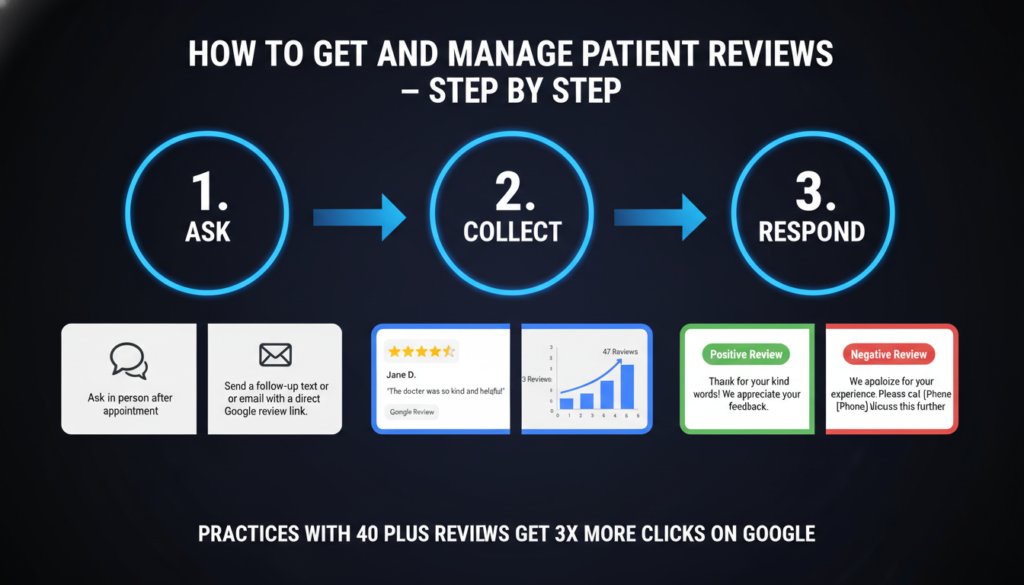
Google uses reviews as a sign that your practice is real, active, and trustworthy. More positive reviews mean better rankings. It is that simple.
But it is not just about the number of reviews. Google also looks at how recent they are and whether you respond to them.
The easiest way is to just ask. After a good appointment, say something like “We would really appreciate it if you left us a quick Google review — it helps other families find us.”
You can also send a follow-up text or email with a direct link to your Google review page. Make it as easy as possible for patients to do it.
Always respond to every review — good or bad. For positive ones, say thank you and mention something specific. For negative ones, stay calm, apologize for the bad experience, and invite them to call you to sort it out.
Never argue with a reviewer online. It looks bad to everyone who reads it.
A backlink is when another website links to your website. It is like a vote of trust. The more trusted websites that link to you, the more Google trusts you, too.
Local backlinks, ones from other Lafayette websites, carry extra weight for local SEO. They tell Google that your practice is a real, known part of the Lafayette community.
Start with the easy ones. Make sure you are listed on Healthgrades, Zocdoc, and the ADA directory. Each of these sends a backlink to your website and helps patients find you.
Sponsor a local event, donate to a school, or partner with a Lafayette charity. These organizations often put your name and a link to your website on their site.
This is good for the community and good for your SEO at the same time.
Google loves websites that are active. Publishing new content regularly tells Google your site is alive and worth paying attention to.
Write about topics your Lafayette patients actually care about. Some easy ideas: “How to Find a Good Family Dentist in Lafayette,” “What to Do If You Have a Dental Emergency in Lafayette,” or “Best Foods for Healthy Teeth — A Lafayette Dentist’s Tips.”
These posts bring in local traffic and show Google that your site is packed with helpful information.
Think about the questions patients ask you every day. How much does teeth whitening cost? Does getting a filling hurt? How often should kids go to the dentist?
Write a simple blog post answering each question. These posts bring in people searching for those exact questions — and those people may become your next patients.
Reviews are important, but they are not the only thing that builds trust online. There are other signals that Google and patients look at, too.
Third-Party Mentions and Directory Authority
When trusted health websites mention your practice — even without a link — it adds to your credibility. Being listed in respected directories like Healthgrades and Zocdoc tells Google you are a legitimate practice.
Brand Searches as a Trust Signal
When people search for your practice by name, Google notices. It means people already know about you and are actively looking for you. The more people search for your practice name, the more Google sees you as a real, trusted business.
How Reputation Signals Work Alongside Your Review Strategy
Think of your online reputation as a puzzle. Reviews are one piece. Directory listings are another. Brand searches are another. All together, they build a picture of a trustworthy practice that Google wants to recommend.
Most people search for dentists on their phones. If your website does not work well on a phone, you are losing patients before they even read a word.
A mobile-friendly website adjusts itself to fit any screen size. Buttons are easy to tap. Text is easy to read. The phone number is clickable so patients can call with one tap.
If your website looks messy on a phone, it is time for an update.
Google checks how fast your website loads. If it takes more than a few seconds, people leave — and Google ranks you lower because of it.
Compress your images, use a fast hosting service, and remove anything on your site that slows it down. A web developer can help you with this.
More and more people talk to their phones instead of typing. They say things like “Hey Google, find a dentist near me open on Saturday.”
To show up in voice searches, write your website content the way people actually talk. Use simple sentences and answer common questions directly.
Google’s AI now reads websites and gives answers directly in search results. Getting your practice featured there is the next big opportunity in local SEO for dentists.
Write your content in a clear question-and-answer style. Use simple headings. Answer questions directly and quickly. The AI looks for content that is easy to read and clearly answers what the searcher is asking.
The AI favors practices that have strong reviews, consistent information across the web, and helpful website content. Everything you are doing for regular local SEO also helps you show up in AI answers.
Local SEO takes time to work. While you are building your rankings, Google Local Services Ads can help you get seen right away.
Local Services Ads show up at the very top of Google — even above regular search results. They show your practice name, rating, and phone number. Patients can call you directly from the ad.
The best part is that you only pay when someone contacts you through the ad. Not just when they see it.
Think of Local Services Ads as a shortcut while your local SEO builds up. Once your organic rankings are strong, you can reduce your ad spend and rely more on free search traffic.
Many successful dental practices in competitive cities use both at the same time.
Doing the work is important. But you also need to check if it is actually working.
Google Analytics shows you how many people visit your website, where they came from, and what they do when they get there. It is free and very useful.
Google Search Console shows you which search terms people use to find your website. It also tells you if there are any problems Google found with your site.
Inside your Google Business Profile, there is a section called Insights. It shows how many people found your profile, how many clicked to call you, and how many asked for directions. Check this every month.
Numbers on a screen are only useful if they lead to real patients. Ask new patients how they found you. If they say Google, your SEO is working.
Track how many calls and appointment requests come through your website and GBP each month. That is the real measure of success.
If a certain page on your website gets lots of visits but no calls, something is off. Maybe the page needs a clearer call to action. Maybe the phone number is hard to find.
Use the data to find what is working and do more of it. Find what is not working and fix it.
Sometimes, a dental practice that was ranking well suddenly drops. This is more common than you think, and it is usually fixable.
The most common reasons are a Google algorithm update, a change in your NAP information, a spike in negative reviews, or a competitor doing better SEO than you.
Check your Google Business Profile first. Make sure nothing has changed. Then look at your reviews and your website. Usually, the problem is something simple.
If your rankings dropped after a Google update, give it a few weeks. Sometimes rankings settle back on their own. If they do not, review your content and make sure it is still helpful, honest, and clear.
Many dental practices make the same mistakes over and over. Here are the most common ones to avoid.
Not claiming or completing their Google Business Profile. Leaving it half-done is almost as bad as not having one at all.
Having different phone numbers or addresses on different websites. This confuses Google and hurts your rankings.
Never asking patients for reviews. Reviews do not come in on their own. You have to ask.
Writing website content that sounds like a textbook. Use simple words that real people use.
Building a beautiful website that loads slowly. A slow website frustrates patients and Google alike.
Ignoring their analytics. If you never check your numbers, you will never know what is working.
Here are a few extra tips that can give you an edge over other dental practices in Lafayette.
Keep your Google Business Profile fresh. Post updates at least once a week. Google rewards active profiles.
Get reviews from patients consistently — not just in one big push. A steady stream of new reviews over time looks more natural and trustworthy than fifty reviews all at once.
Create content about Lafayette specifically. Mention local neighborhoods, schools, events, and landmarks. It makes your content feel genuinely local.
Build relationships with other local businesses. A referral from a local pediatrician or pharmacy can bring in backlinks and new patients at the same time.
Stay patient. Local SEO is not instant. But the practices that stick with it for six to twelve months see real, lasting results.
This is a real example of what local SEO for dentists can do when done right.
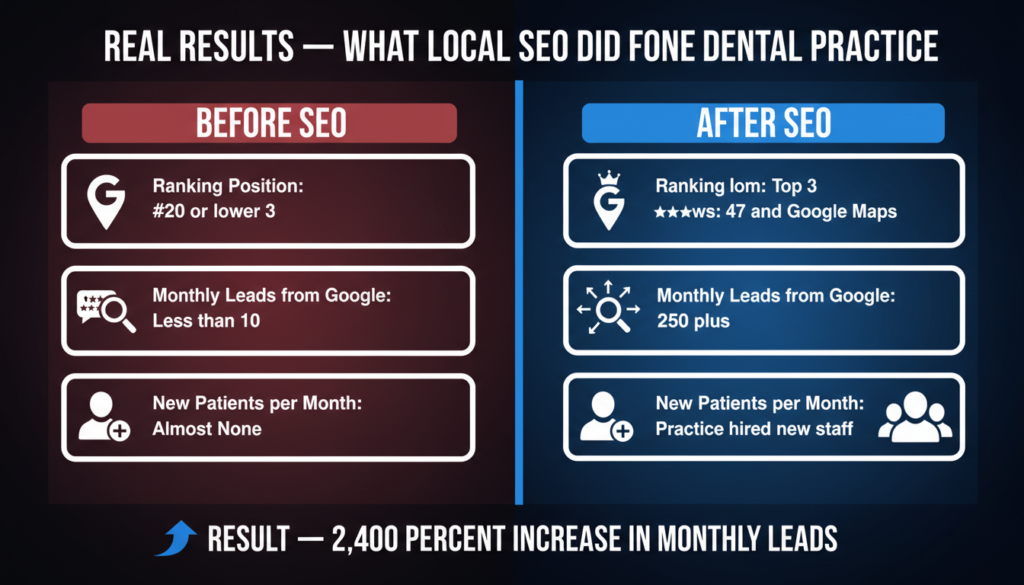
A dental practice was getting almost no traffic from Google. They had a website but it was old, slow, and had no local content. Their Google Business Profile was half-empty. They had only three reviews.
New patients were barely coming in and the practice was worried about staying open.
The team started with the basics. They claimed and fully completed the Google Business Profile. They fixed the NAP across all online directories. They asked existing patients for reviews and got to over forty within two months.
Then they rebuilt the website with service pages for each treatment and location pages for nearby cities. They started a blog with simple dental tips and local content. They added schema markup and fixed the mobile experience.
Within six months, the practice went from almost invisible on Google to ranking in the top three for multiple local search terms.
Monthly leads from Google went from less than ten to over two hundred and fifty. That is a jump of more than 2,400 percent. The practice went from worried about closing to hiring new staff to handle the demand.
Most practices start seeing small improvements within 30 to 60 days. Bigger results usually come at the three to six-month mark. The more competitive your area, the longer it may take. But the results last much longer than paid ads.
A solid checklist includes a complete Google Business Profile, consistent NAP across all directories, patient reviews, a mobile-friendly website, service pages with local keywords, schema markup, and a blog with local content.
Yes. Local SEO levels the playing field. A small practice with great reviews, a complete Google profile, and helpful website content can absolutely outrank a larger practice that is not doing SEO well.
The most common reasons are inconsistent NAP information, too few reviews, thin website content, or a Google Business Profile that is not fully completed. Start by checking all of these.
Start with your Google Business Profile. Make sure it is fully complete and verified. Then check that your NAP is consistent everywhere online. Then look at your reviews. These three things have the biggest impact fastest.
Schema markup helps Google read your website more clearly. It can make your practice show up with extra details in search results like your star rating or your hours which makes more people click on your listing.
At least once a week. Post updates, add new photos, and check that your information is still correct. Google rewards active profiles with better visibility.
Look at your GBP Insights for more calls and direction requests. Check Google Analytics for more website visitors. And simply ask new patients how they found you. If more are saying Google, it is working.
The top factors are your Google Business Profile completeness, the number and quality of patient reviews, NAP consistency, your website content, local backlinks, and how active you are online.
Fully complete your Google Business Profile and ask five to ten happy patients for a Google review this week. These two things alone can move the needle faster than anything else.
Yes, especially in the early months when your organic rankings are still building. LSAs put you at the very top of Google right away. Over time, as your local SEO kicks in, you can scale back your ad spending.
The core strategies are the same everywhere. But in Lafayette, you want to tailor your content to the local community mention neighborhoods, local events, and nearby areas like Broussard and Scott. That local flavor makes a real difference in a close-knit city like Lafayette.
Local SEO for dentists is one of the best things you can do for your practice in 2026. It takes a little time and effort at the start. But once it kicks in, it keeps bringing you new patients every single day without paying for ads.
Start small. Claim your Google Business Profile. Ask a few happy patients for a review. Add your practice to local directories. Then slowly work through the rest of the steps in this guide.
You do not have to do everything at once. Even small steps add up over time. If you are a dentist in Lafayette, LA and you want to grow your practice, local SEO is your best friend. The patients are already out there searching for you. Your job is simply to make sure they can find you.
Now go get started your next patient is already searching on Google.