

Why does your competitor show up in Google Maps above you, even though you have been in business longer and your service is better?
In many cases, the answer is local citation building.
Citations are one of the most important and most overlooked parts of local SEO. When done right, they tell Google exactly who you are, where you are, and that your business is real and trustworthy. When done wrong, or not done at all, your local rankings suffer, even if everything else looks good.
In this guide, Sites N Apps will walk you through everything you need to know about local citation building: what citations are, why they matter, how to build them the right way, and how to avoid the common mistakes that hurt local businesses every day.
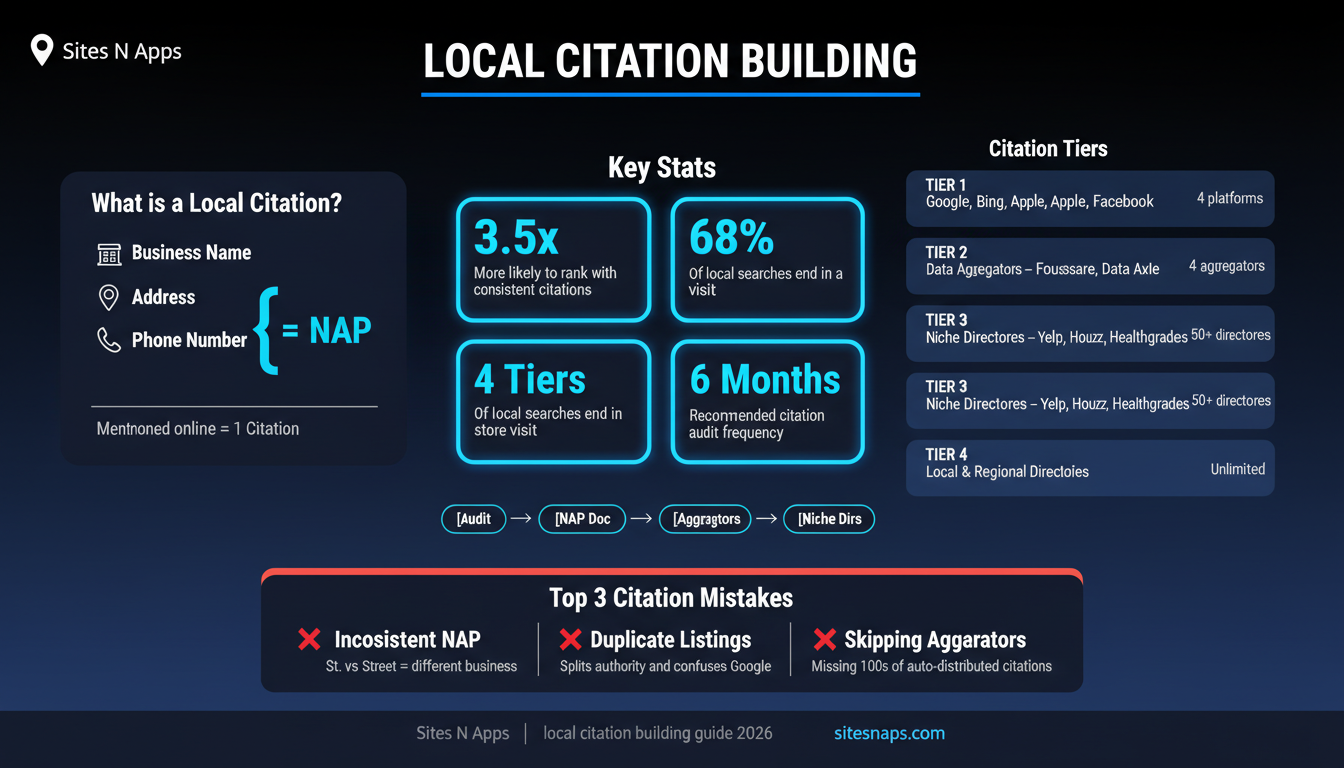
A local citation is any online mention of your business that includes your Name, Address, and Phone number. In the SEO world, this combination is known as NAP.

Citations can appear on business directories like Yelp or Yellow Pages, on social media profiles, on map platforms, or even in a news article about your business. Any place online where your business details show up counts as a citation.
Think of local citations as digital references. The more consistent and widespread they are, the more Google trusts that your business is legitimate.
There are two main types of local citations:
Structured citations appear on business listing sites and directories. These are platforms that have a specific format for business information, name, address, phone, hours, website, and so on. Examples include Google Business Profile, Yelp, Bing Places, and Facebook.
Unstructured citations are mentions of your business in places that are not traditional directories. This could be a local blog post, a news article, a sponsor page on a community website, or a social media post. These are less predictable but still carry real value for local SEO.
This is one of the most important things to understand about local citation building: your Name, Address, and Phone number must be exactly the same everywhere.
If your business is listed as “Sites N Apps” on one site and “Sites and Apps” on another, or if your address says “Street” in one place and “St.” in another, Google sees those as two different businesses. That inconsistency hurts your local rankings.
Before you build a single new citation, make sure your NAP information is correct, consistent, and ready to use across all platforms.
Google uses hundreds of signals to decide which businesses to show in local search results. Local citations are one of the most significant signals in that mix. Here is why:
When Google finds your business information mentioned consistently across many trusted websites, it gains confidence that your business is real, active, and relevant to a specific location. That confidence translates directly into higher rankings in the local pack, the map results that appear at the top of Google for local searches.
If someone searches “plumber near me” or “best coffee shop in [city],” the businesses with strong, consistent citations are far more likely to show up.
Citations do not just help with search rankings; they also help customers find and trust you. When someone sees your business listed on multiple well-known platforms, it adds credibility. A business that appears on Google, Yelp, and several local directories feels more established than one that only has a website.
Every citation is a new place where someone can discover your business. Many people use Yelp, TripAdvisor, or Apple Maps directly; they never start with a Google search. A strong citation profile means you are visible across all those platforms, not just one.
Directories like Yelp, Houzz, and Healthgrades send real visitors to business websites. These are people who are actively looking for a service you offer. A well-optimized citation on the right platform is not just an SEO signal; it is a lead generation source.
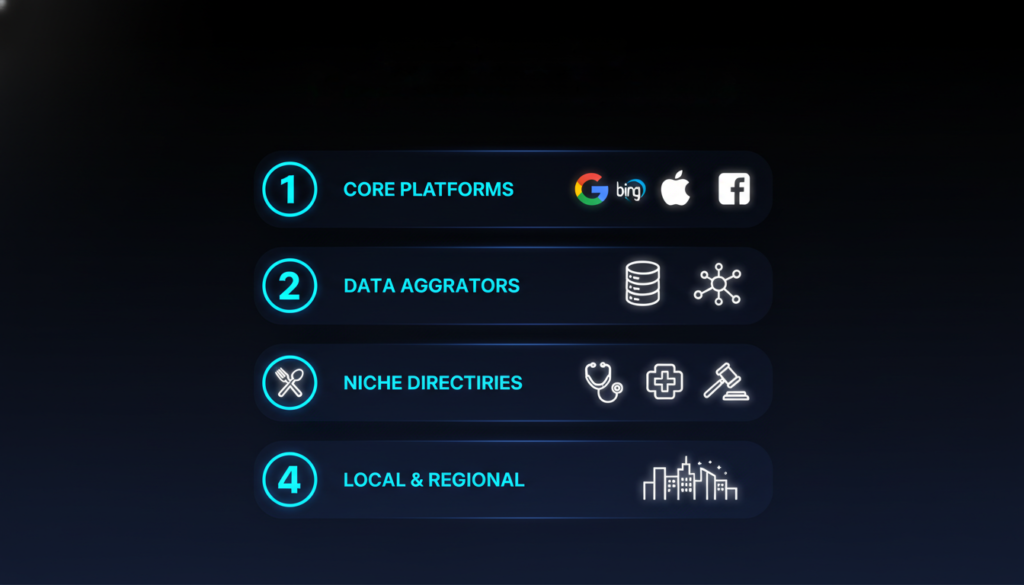
Not all citation sources are equal. To build citations strategically, think of them in four tiers:
These are the most important citation sources and should always be your starting point. They carry the most authority and are trusted universally by Google.
• Google Business Profile
• Bing Places for Business
• Apple Maps
• Facebook Business Page
• LinkedIn Company Page
Data aggregators are companies that collect business information and distribute it to hundreds of other directories and apps. When you get listed on an aggregator, your information can spread to dozens of other platforms automatically.
• Foursquare
• Data Axle (formerly Infogroup)
• Neustar Localeze
• Factual
Data aggregators are often ignored by businesses, but they are one of the highest-leverage citation-building tactics available. One submission can create dozens of citations across the web.
These are directories built for specific industries. A citation here is more relevant and often more trusted within your field than a generic directory listing.
| Industry | Recommended Directories |
| Restaurants & Cafes | TripAdvisor, Zomato, OpenTable, Foursquare |
| Healthcare & Medical | Healthgrades, Zocdoc, WebMD, RateMDs |
| Legal Services | Avvo, FindLaw, Justia, Lawyers.com |
| Home Services | Houzz, HomeAdvisor, Angi, Thumbtack |
| Hotels & Travel | TripAdvisor, Booking.com, Expedia, Hotels.com |
| Real Estate | Zillow, Realtor.com, Trulia, Redfin |
These include your local Chamber of Commerce website, city business directories, community blogs, local newspaper websites, and regional event pages. They may have lower overall authority, but they are extremely relevant for your specific location, which is exactly what local SEO is about.
One of the biggest mistakes in local citation building is jumping straight into creating new citations without checking what already exists. If you have old or incorrect information out there, building more citations will just spread the wrong data further.

Here is how to do a proper pre-build audit:
Step 1: Run a Citation Audit
Search Google for your business name and phone number to see where you are already listed. You can also use tools like BrightLocal, Whitespark, or Moz Local to do a more thorough scan of your existing citations.
Look for:
• Incorrect NAP information
• Outdated addresses or phone numbers
• Duplicate listings on the same platform
• Listings with missing information (no website, no hours)
Step 2: Create a Master NAP Document
Before submitting anywhere, create a simple document with your official business information. This will be your reference for every submission:
• Full legal business name
• Full address (including suite/unit number if applicable)
• Primary phone number
• Website URL
• Business hours
• Short business description (150-200 words)
• Long business description (300-500 words)
• Business categories
• Profile photos
Keeping a master NAP document saves you from typos and inconsistencies. Copy and paste from it every time you submit to a new directory.
Step 3: Fix Duplicates and Incorrect Listings
If you find duplicate listings on any platform, claim the correct one and request removal or suppression of the others. Most directories have a process for this. Leaving duplicates unchecked can send confusing signals to Google and hurt your local rankings.
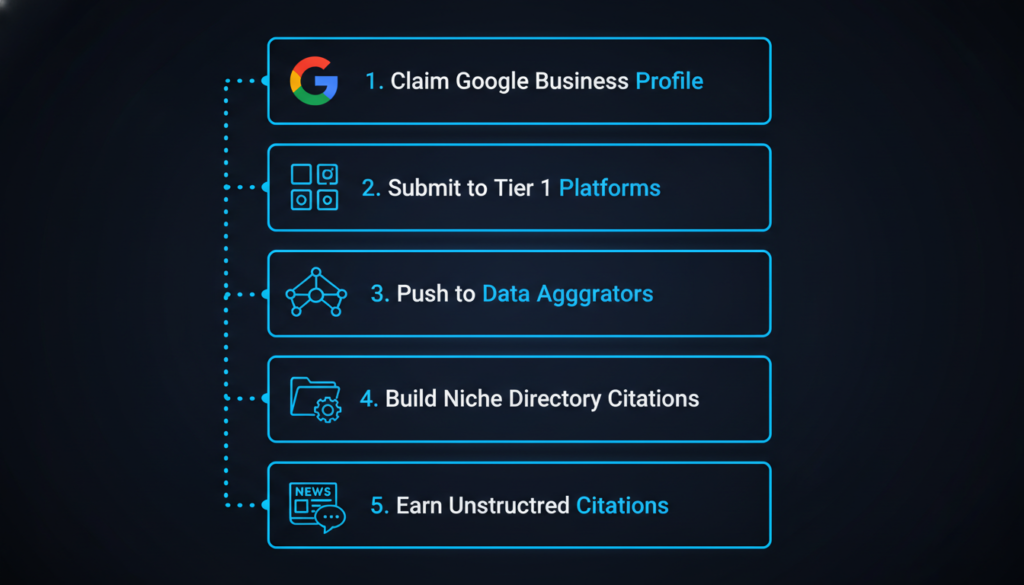
Now that your NAP information is clean and ready, here is how to build local citations the right way:
Step 1: Claim and Optimize Your Google Business Profile
This is the single most important citation you will ever create. Google Business Profile (GBP) is the foundation of your entire local SEO presence.
When optimizing your GBP, make sure to:
• Verify your business (via phone, email, or postcard)
• Choose the most accurate primary and secondary categories
• Write a keyword-rich but natural business description
• Add your full address, phone number, and website
• Upload high-quality photos of your business
• Set accurate business hours, including holiday hours
• Enable messaging and questions if relevant to your business
Step 2: Submit to Tier 1 Platforms
After Google Business Profile, claim and optimize your listings on:
• Bing Places for Business (bing.com/business)
• Apple Maps Connect (mapsconnect.apple.com)
• Facebook Business Page
• LinkedIn Company Page
• Yelp for Business
Each of these platforms has a verification process. Complete it fully; unverified listings have less authority and are harder to manage.
Step 3: Push to Data Aggregators
Submit your business to the major data aggregators. This step multiplies your citation footprint because aggregators distribute your information to hundreds of smaller directories and apps automatically.
You can submit manually or use a service like Moz Local or Yext to push your data to multiple aggregators at once.
Step 4: Build Niche and Industry-Specific Citations
Find the top directories for your specific industry (see the Tier 3 table above) and create listings there. These citations are highly relevant to what your business does, which makes them especially valuable for local SEO.
Take your time with each listing. A complete, well-written profile performs much better than a bare-minimum submission with just your NAP.
Step 5: Earn Unstructured Citations
Reach out to local blogs, sponsor community events, or connect with local news websites. When your business gets mentioned in an article, even without a link, that is an unstructured citation.
These are harder to get but often carry strong local relevance. A mention in a city news article or a community organization website tells Google you are genuinely part of the local area.
Most businesses stop at NAP. That is a missed opportunity. A fully optimized citation does a lot more for your local search visibility than a bare-bones listing.
Write a Strong Business Description
Your business description is one of the most underused parts of any citation. A good description should explain what you do, who you serve, and where you are located, naturally weaving in your primary keywords without sounding forced.
Avoid copying and pasting the same description to every platform. Each directory may have different length limits, and unique content performs better than duplicate text across the web.
Choose the Right Business Categories
Many directories allow you to select primary and secondary categories. Choose the most specific and accurate categories available. Wrong or vague categories confuse both Google and customers.
Add Photos and Videos
Listings with photos get significantly more views and clicks than those without. Add photos of your storefront, team, products, or services. On platforms like Google Business Profile, regularly updated photos are a positive engagement signal.
Add Your Website and Social Links
Always include your website URL. Where the platform allows, add links to your social media profiles. These connections make your listing more complete and give visitors more ways to learn about your business.
Encourage and Respond to Reviews
Many citation platforms display reviews, and those reviews affect how your listing performs. Encourage satisfied customers to leave reviews on your key citation platforms. And always respond to both positive and negative feedback. Active listings with reviews signal a healthy, engaged business.
If your business serves customers at their location rather than at a fixed address, a plumber, a mobile dog groomer, a cleaning service, or a home inspector, you are what is known as a service-area business (SAB).
The good news is that local citation building still works for you. Here is how to approach it:
Hide Your Address Where Needed
On Google Business Profile, service-area businesses can choose to hide their physical address and show only the areas they serve. This is the correct setup for SABs. Many other directories offer a similar option. Take advantage of it; showing a residential address you do not want the public to see can create confusion and trust issues.
Which Directories Accept Service-Area Businesses
Most major directories support SABs. Google Business Profile, Bing Places, Yelp, and most industry directories all allow you to list a service area instead of a physical address. Some smaller directories may require a physical address; in those cases, skip them or use a registered business address.
Citation Strategy for Multiple Locations
If your business operates in multiple cities or areas, create a separate citation profile for each location. Each profile should have a unique phone number and address (or service area), and a description that reflects the specific location. Do not use the same phone number for all locations; it makes it very difficult for Google to differentiate between them.
Building citations manually is time-consuming but gives you full control. Tools can speed up the process significantly. Here is a neutral comparison of the most widely used options:
| Tool | Best For | Key Feature | Pricing Model |
| BrightLocal | Agencies and SMBs | Citation audit + manual submissions | Pay per campaign |
| Whitespark | Agencies needing niche citations | Local citation finder tool | Pay per project |
| Moz Local | Automated distribution | Pushes to aggregators + directories | Annual subscription |
| Semrush Listing Mgmt | All-in-one SEO users | Integrated with a full SEO suite | Subscription add-on |
| Yext | Enterprise businesses | Real-time updates across 200+ sites | High annual cost |
Manual submission takes more time, but gives you full control over every detail of your listing. It is the best choice when you are just starting out or when you only need to target a focused list of high-priority directories.
Automated tools are better when you need to manage citations at scale, for multiple locations, for agency clients, or when you want to push updates across hundreds of directories at once.
For most small and medium-sized businesses, a hybrid approach works best: manually handle Tier 1 platforms, use a tool for data aggregators, and build niche directories by hand.
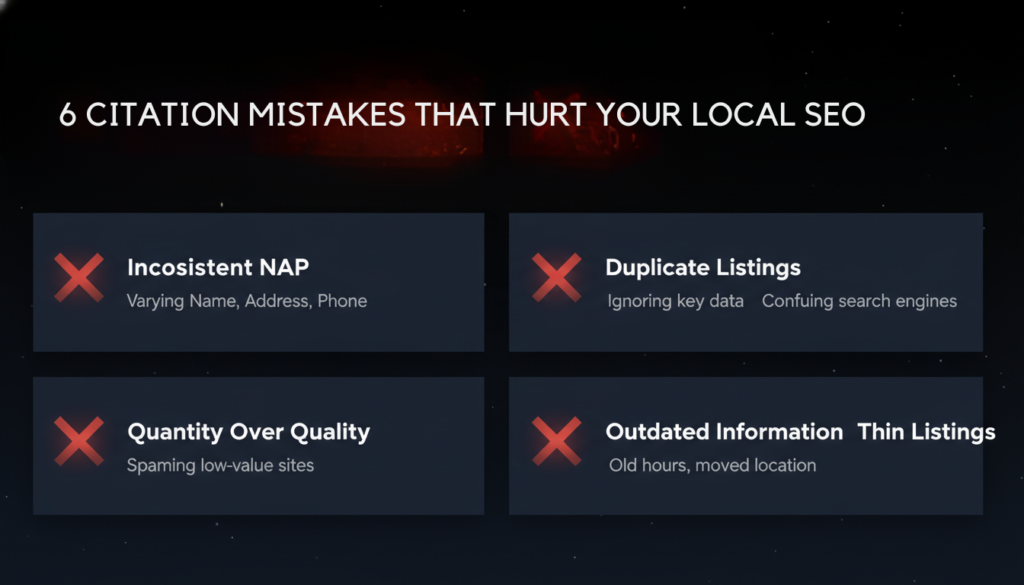
Even small mistakes in your citation strategy can have a real impact on your local rankings. Here are the most common ones:
• Inconsistent NAP information. “St.” vs “Street” or “Suite 5” vs “#5”, even small differences confuse Google’s matching algorithm. Always use your master NAP document and copy-paste rather than typing.
• Ignoring data aggregators. Most businesses focus only on big directories and skip aggregators. This leaves a huge gap in your citation footprint.
• Leaving duplicate listings uncleaned. Duplicates split your citation authority and can show contradictory information. Find them and fix them.
• Choosing quantity over quality. One hundred low-quality, spammy directory listings do far less good than twenty strong, well-optimized listings on trusted platforms.
• Not updating citations when business info changes. If you move, change your phone number, or rebrand, update every citation. Stale information is as harmful as wrong information.
• Thin or incomplete listings. A listing with just a name and phone number is far less valuable than one with a full description, photos, categories, and reviews.
Building citations is not a one-time task. Once you have a strong citation profile, the work shifts to maintaining and improving it.
How Often Should You Audit?
Run a citation audit at least twice a year. Directories sometimes update their data from aggregators, which can overwrite your information with incorrect details. Regular audits catch these changes before they do lasting damage.
Track Citation-Driven Traffic
Use UTM parameters on the website links in your citation listings. This lets you see in Google Analytics exactly how much traffic is coming from each directory. Over time, you can identify which platforms are worth maintaining and which can be deprioritized.
What to Do When Business Info Changes
If your phone number, address, or business name changes, update your master NAP document first. Then work through your citation list systematically, start with Tier 1 platforms, then aggregators, then niche directories. It takes time, but consistency is critical.
There is no magic number. Quality matters far more than quantity. A business with 50 strong, accurate, well-optimized citations will almost always outperform one with 500 thin, inconsistent, low-quality listings. Focus on the most authoritative and relevant sources for your industry and location first.
Both matter, but for different reasons. Citations help Google verify your business identity and location. Backlinks build your overall domain authority. For local SEO specifically, citations are often more immediately impactful, especially for new businesses without many backlinks. Ideally, you build both over time.
Yes, absolutely. Manual citation building is free and gives you full control. It takes time; expect to spend several hours on Tier 1 and aggregator submissions, but it is completely manageable for most small business owners or their marketing team.
Local SEO is not instant. After building or correcting citations, you may start to see movement in local rankings within 4-8 weeks. Larger improvements often take 3-6 months, especially if you are cleaning up significant inconsistencies or building citations in a competitive market.
Yes. Duplicate listings with conflicting information send contradictory signals to Google and can hurt your rankings. They also give potential customers a bad experience if they find outdated information. Always find and fix duplicates as part of your citation strategy.
Use this checklist to get your local citation building done the right way:
1. Create a master NAP document with accurate, consistent business information
2. Run a full citation audit to find existing listings and errors
3. Fix NAP inconsistencies and remove or suppress duplicate listings
4. Claim and fully optimize your Google Business Profile
5. Submit to Bing Places, Apple Maps, Facebook, and LinkedIn
6. Submit to major data aggregators (Foursquare, Data Axle, Neustar)
7. Build listings on the top niche/industry directories for your field
8. Target local and regional directories relevant to your city or area
9. Fully optimize every listing: description, categories, photos, website link
10. Set a reminder to audit citations every 6 months
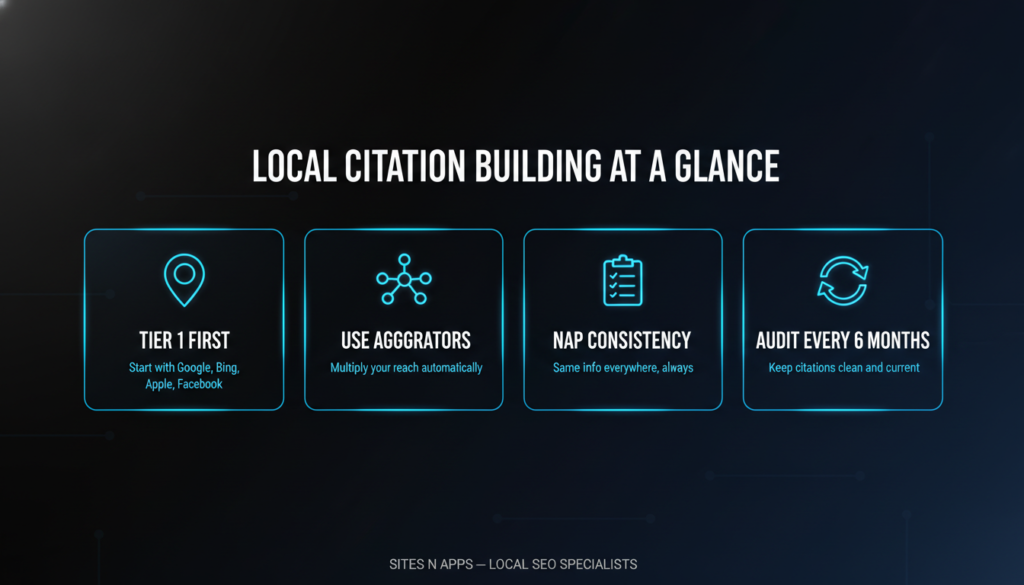
Local citation building is one of the most straightforward and highest-impact things a local business can do for its online visibility. It does not require a big budget or advanced technical skills. It requires consistency, accuracy, and a bit of patience.
If your business information is spread across the web in a consistent, well-optimized way, Google has every reason to trust you, and that trust shows up in your local search rankings.
At Sites N Apps, we help local businesses build strong citation profiles that drive real local search visibility. Whether you are starting from scratch or cleaning up a messy citation history, the right strategy makes a measurable difference.
Start with your Google Business Profile, keep your NAP consistent, and build outward from there. It really is that simple, and that powerful.