Home / Blog Details
Take your digital marketing to the next level with data-driven strategies and innovative solutions. Let’s create something amazing together!


From Google search results to AI chatbots, we optimize your website so customers can find you faster — and choose you over competitors.
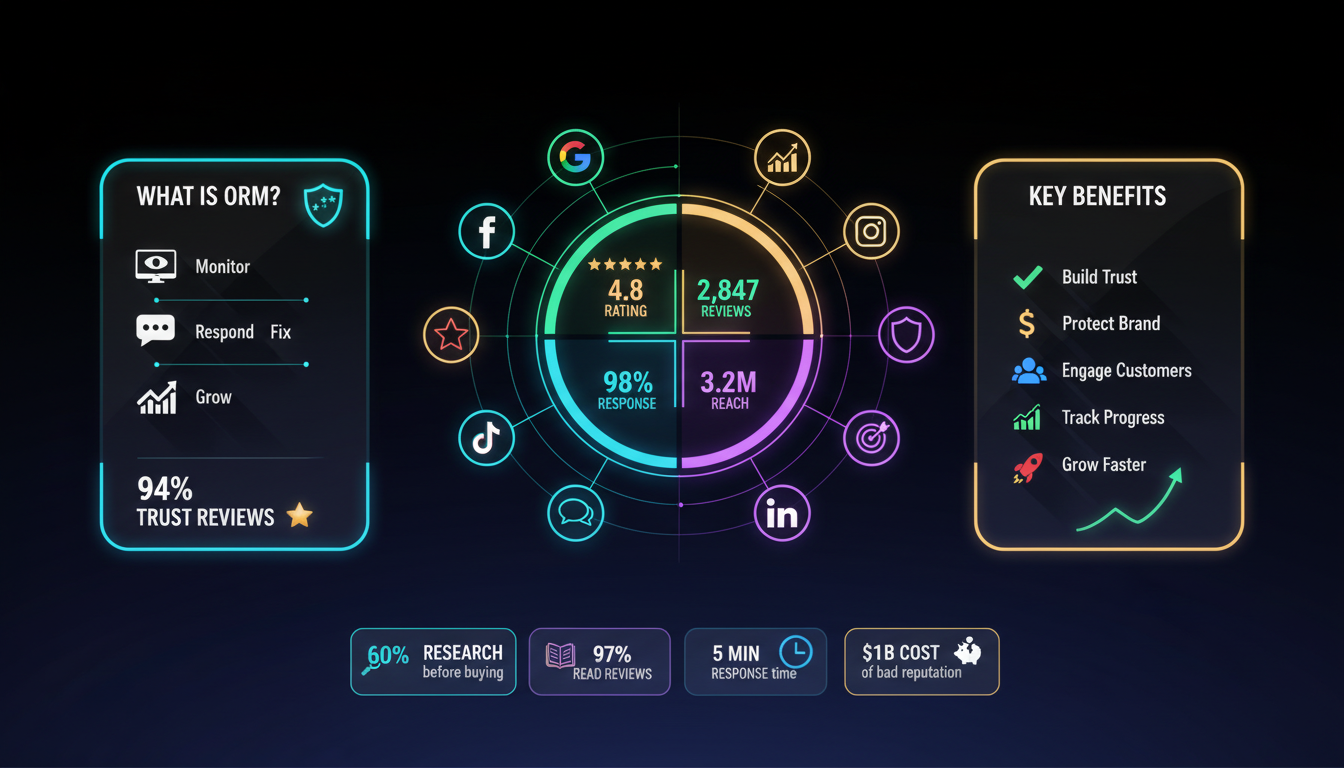
Online reputation management (ORM) is the practice of monitoring, influencing, and improving how your business appears online. It involves managing reviews, search results, social media mentions, and brand content to shape public perception and build digital trust with potential customers.
Your online reputation is working for you or against you right now. Every day, potential customers in Lafayette, LA, search your business name, read your reviews, and scan your Google results before deciding whether to call, visit, or move on. What they find in those first few seconds shapes their entire perception of your business, and most of them will never tell you what made them choose someone else.
This is the challenge that makes online reputation management one of the most important, yet most overlooked, aspects of running a local business today. You can have the best service in your market, but if your online presence tells a different story, customers will never give you the chance to prove it. According to a 2023 BrightLocal Consumer Survey, 98% of people read online reviews for local businesses, and 87% use Google to evaluate local businesses before visiting.
In this guide, you will learn exactly what online reputation management is, why it matters for businesses in Lafayette, LA, how it works in practice, and what strategies actually move the needle. Whether you are starting from scratch or recovering from reputation damage, this guide gives you a clear, actionable framework to follow.
Online reputation management is the ongoing process of monitoring what people say about your business online, responding to that feedback, and actively creating content and signals that reinforce a positive brand image.
ORM covers everything that appears when someone searches your business name: Google reviews, news articles, social media posts, directory listings, forum mentions, and search engine results pages (SERPs). Managing all of these channels together is what separates businesses that thrive online from those that quietly lose customers to a competitor with a cleaner digital presence.
Every piece of content about your business that exists online contributes to your public perception. A 4.8-star rating on Google tells one story. A string of unanswered 2-star reviews tells a very different story.
Most customers form an opinion about your business before they ever contact you. They read your reviews, scan your website, check your social media, and look at whether you respond to feedback. Each of those signals adds up to a judgment: is this business trustworthy?
ORM gives you the tools to influence those signals, not by faking them, but by earning positive ones and addressing the negative ones professionally.
The core objectives of ORM are:
Each objective serves the same ultimate goal: ensuring that customers who search your business online find content that builds confidence and drives them to take action.
Any business with an online presence needs some level of ORM. Specifically, it is most critical for:
If customers can leave a review about your business, ORM is not optional.
You never get a second chance at a first impression. Online, that impression happens in under 10 seconds.
When someone searches your business name, the results they see form an instant judgment. A well-rated Google Business Profile, a professional website, and positive press tell customers they are in good hands. A page filled with low ratings, complaints, or no content at all sends them looking elsewhere.
For local businesses in Lafayette, LA, this first impression is often the deciding factor between a new customer and a lost lead.
Trust is the foundation of every purchase decision. According to Edelman’s 2023 Trust Barometer, 81% of consumers say they need to trust a brand before making a buying decision.
Online reviews, consistent business information, and professional responses to feedback all signal trustworthiness. A business that responds thoughtfully to negative reviews, for example, demonstrates accountability. That single habit builds more credibility than any advertisement could.
ORM creates a consistent pattern of trust signals across every platform where your customers are looking.
Reviews are one of the most powerful forms of social proof in existence. Customers treat peer reviews as personal recommendations. A business with 200 reviews and a 4.7-star rating carries social weight that a business with 12 reviews and a 3.1-star rating simply cannot compete with.
Consider a local law firm in Lafayette, LA. If a potential client searches for “personal injury attorney Lafayette” and finds one firm with 85 glowing reviews and another with 9 mixed reviews, the choice is almost always driven by that review data, not the firm’s credentials or fee structure.
ORM ensures your review profile is actively managed so it works in your favor, not against you.
In competitive local markets, your reputation is a differentiator. If a competitor has a stronger review profile, better search rankings, and more visible positive content, they will capture customers who should have been yours.
Reputation management for businesses actively counters this by building your brand’s digital footprint, earning reviews consistently, and ensuring your business appears professional and credible across every channel.
Your online and offline reputation feed each other directly. A great in-person experience generates positive reviews online. Those positive reviews attract new customers offline. Conversely, a poor customer experience offline can become a public negative review that damages your online reputation for months.
ORM helps you close the loop by turning satisfied customers into online advocates and addressing problems before they compound.
Ignoring your online reputation does not make problems disappear. It lets them grow unchecked.
The risks include:
Businesses that treat ORM as optional often discover its importance only after they have already lost customers they could not afford to lose.
Google is where reputation lives. When someone wants to know whether your business is trustworthy, credible, or even legitimate, they go to Google first. Whatever appears on page one of your branded search results becomes your reputation in the eyes of that customer.
This is why reputation management SEO is a core discipline inside ORM. You are not just managing reviews; you are actively shaping what Google shows when someone searches your name.
Research from Advanced Web Ranking shows that the top 3 Google results capture over 54% of all clicks. Most people never scroll past page one.
This means that if a negative news article, a complaint thread, or an unflattering review site ranks on page one for your business name, it will be seen by nearly every customer who searches you. The only way to counter it is to outrank it with stronger, more credible content.
Branded search refers to searches that include your business name, such as “Sites N Apps Lafayette” or “Sites N Apps reviews.” These searches come from people who already know you exist and are evaluating whether to hire you.
Controlling what appears in your branded search results is one of the highest-value ORM activities you can perform. It directly influences the decision of a warm prospect who is already considering you.
High-ranking content is perceived as more credible. Google’s algorithm rewards expertise, authority, and trustworthiness, which are the same qualities your customers are looking for.
A business with a well-optimized website, a strong Google Business Profile, and consistent positive reviews across authoritative platforms will naturally rank higher and appear more trustworthy. These two things reinforce each other continuously.
For Lafayette, LA Local Businesses
Sites N Apps offers professional reputation management, local SEO, and website design services built for local business growth.
Reputation management starts with listening. You cannot manage what you do not know exists.
Monitoring tools such as Google Alerts, Mention, and dedicated ORM platforms track every time your business name appears online, across news sites, review platforms, forums, and social media. This continuous monitoring ensures you never miss a review, a complaint, or a brand mention that needs a response.
Setting up Google Alerts for your business name is a free, immediate first step any business owner can take today.
Review management involves three specific activities:
Each of these activities requires a documented process. Ad hoc review management almost always produces inconsistent results.
Content is one of the most effective tools in reputation management. Blog posts, case studies, press releases, service pages, and social media content all create positive brand signals that can rank in search results.
When you publish authoritative content under your business name consistently, you build a body of work that dominates your branded search results. This makes it harder for negative content to rank prominently.
Reputation management SEO works by optimizing your owned content (website, blog, Google Business Profile) and earned content (reviews, press mentions) to rank above any negative content on page one.
If a complaint forum post ranks fifth for your business name, the goal is to push it down by getting positions one through five occupied by your own credible content. This is methodical and takes time, but it is highly effective.
Responding to reputation issues means addressing negative content directly and professionally. This includes responding to negative reviews with empathy and solutions, reaching out to review platforms to flag false or malicious reviews, and, in serious cases, engaging with legal or PR resources.
Speed matters. A response within 24 to 48 hours signals that your business takes customer concerns seriously.
You measure ORM success through metrics such as:
Tracking these metrics monthly gives you a clear picture of whether your ORM strategy is moving in the right direction.
Reputation monitoring is the continuous tracking of all online mentions, reviews, and search results related to your business. It is the foundation of ORM because you cannot respond to, build on, or protect against things you are not aware of.
Monitoring covers Google reviews, Yelp, Facebook, industry-specific review sites, social media mentions, and news results.
Reputation building is the proactive side of ORM. It involves generating positive reviews consistently, publishing authoritative brand content, optimizing your Google Business Profile, earning press coverage, and building citation authority through directory listings.
Reputation building is what separates businesses that simply react to their reputation from those that actively shape it.
Reputation protection is the defensive layer of ORM. It includes monitoring for threats, having a crisis response plan, flagging fake or malicious reviews, and ensuring that your owned content is strong enough to contain any negative content that emerges.
Think of reputation protection as insurance. You hope you never need it, but when you do, having it in place is the difference between a recoverable setback and a business crisis.
Owned media includes every digital asset you control directly: your website, blog, email newsletter, and branded social media profiles. These are your most stable reputation assets because you control the content and narrative entirely.
Optimizing your owned media is the first step in any serious ORM strategy.
Earned media includes press coverage, third-party reviews, backlinks from authoritative sites, and organic social media shares. You cannot buy earned media; you earn it through quality, credibility, and relationship-building.
Earned media carries significant weight in Google’s algorithm because it signals that external sources vouch for your business.
Shared media refers to content that others share about your business on social media platforms. This includes customer posts, tagged mentions, shares of your content, and community discussions.
Shared media can amplify both positive and negative narratives quickly, making monitoring especially important here.
Paid media in the context of ORM includes sponsored content, paid search ads, and social media advertising used to promote positive brand content. While not a substitute for organic reputation building, paid media can support reputation recovery efforts by increasing the visibility of positive content.
SERPs are the most visible reputation battleground for any business. Whatever Google shows on page one of a branded search is what customers see and believe.
Owning as many page-one results as possible with your own controlled content (website, blog, GBP, LinkedIn, news coverage) is a primary ORM goal.
Your Google Business Profile (GBP) is often the first thing customers see when they search your business. It shows your rating, review count, hours, location, and photos in a highly visible format before they even visit your website.
An incomplete, unmonitored, or low-rated GBP actively hurts your reputation. A fully optimized, actively managed GBP is one of the highest-return ORM investments you can make.
Review platforms like Google, Yelp, Facebook, and industry-specific directories (Healthgrades, Avvo, Houzz, etc.) are where customers publicly evaluate your business. Your performance on these platforms directly shapes first impressions.
Monitoring and actively managing your presence on the platforms most relevant to your industry is a core ORM activity.
Social media profiles often rank on page one of branded search results. A complete, active, professionally managed social media presence strengthens your brand image and gives you additional controlled real estate in your search results.
Inactive or incomplete social media profiles, by contrast, can make your business appear neglected or even defunct.
Directory listings on platforms like Google, Yelp, Facebook, Better Business Bureau, and local directories create additional brand touchpoints. Consistent, accurate listings across directories also improve your local SEO performance, which feeds directly into your reputation management outcomes.
Conducting a reputation audit is the essential starting point for any ORM strategy. Here is a straightforward process to follow:
Open an incognito browser window and search your exact business name on Google. Look at what appears on page one. Note which results are positive, neutral, or negative, and which ones you control.
Examine the top 10 results for your business name. Ask: do these results build confidence or raise doubts? Are there any negative articles, complaint pages, or unflattering listings appearing here?
Check your ratings and reviews on Google, Yelp, Facebook, and any industry-specific platforms. Note your average rating, total review count, most recent reviews, and whether anyone has responded to negative feedback.
Check your social media profiles on every platform where your business has a presence. Are profiles complete? Are they active? Do they appear professional?
Read through the language customers use when writing about your business. Are the themes positive (fast, friendly, professional) or negative (slow, unresponsive, overpriced)? This gives you clear insight into perception gaps you need to address.
A review management strategy is a documented, systematic approach to generating, monitoring, and responding to customer reviews. It includes:
Consistency is what makes a review management strategy effective. One-time efforts produce one-time results.
Reputation management SEO involves optimizing your website content, Google Business Profile, blog posts, and directory listings so that your most positive, authoritative content ranks above any negative content.
This includes targeting branded keywords, building backlinks from credible sources, and consistently publishing content that signals authority in your industry. For local businesses in Lafayette, LA, this means prioritizing local SEO alongside brand reputation signals.
Content marketing for ORM means creating and publishing content that establishes your expertise, answers customer questions, and builds brand authority in search results. Blog posts, guides, FAQs, and case studies all serve this purpose.
Every piece of content you publish is a new opportunity to occupy more of your branded search real estate with positive, credible material.
A social media strategy for ORM involves maintaining active, professional profiles on platforms where your customers spend time, responding to comments and messages promptly, and consistently sharing content that reinforces your brand values.
Social media also serves as an early warning system. Customer complaints often surface on social media before they reach Google, giving you a chance to address them before they escalate.
Your customer service operations are the engine behind your online reputation. Happy customers generate positive reviews. Frustrated customers generate negative ones.
Investing in customer service training, response protocols, and feedback systems reduces the frequency of negative reviews at the source. Treating every customer interaction as a potential review is a mindset shift that produces measurable results over time.
PR strategy in ORM involves building relationships with local media, earning press coverage, and getting your business mentioned in authoritative publications. Each positive media mention creates an earned media asset that can rank in search results and strengthen your brand authority.
For businesses in Lafayette, LA, this could mean contributing expert commentary to local news outlets, sponsoring community events, or partnering with regional business organizations.
Online reviews are one of the primary factors in both local search rankings and customer purchase decisions. According to Moz’s Local Search Ranking Factors research, review signals (quantity, velocity, diversity, and sentiment) are among the top local ranking factors.
Beyond rankings, reviews function as public testimony. A potential customer reading your reviews is essentially watching others describe their experience with you. That testimony is far more persuasive than any marketing message you could write yourself.
The best time to ask for a review is immediately after a positive customer experience. You can do this via:
Keep the request simple and genuine. Do not offer incentives in exchange for reviews, as this violates Google’s review policies and can result in penalties.
Responding to positive reviews shows appreciation and signals to potential customers that you are engaged and attentive. Best practices include:
Negative review responses are your most visible reputation management activity. Every potential customer who reads a bad review also reads your response.
Best practices include:
A well-written negative review response often converts a skeptical reader into a new customer.
Fake reviews from competitors or disgruntled individuals are a real problem. Here is how to address them:
Google does not remove flagged reviews automatically or quickly. Building a consistent volume of genuine reviews is your best long-term defense.
Track your average star rating across all platforms monthly. Also, track your total review count and the number of new reviews added each month. Growth in both metrics over time signals a healthy, improving reputation.
Brand sentiment refers to the ratio of positive to negative mentions of your business name across reviews, social media, and the web. Tracking sentiment over time reveals whether your reputation is trending up or down, even when your star rating looks stable.
Monitor which pages appear on page one of your branded search results each month. Note whether you are gaining or losing control of those positions. Tools like Google Search Console can help track branded keyword performance on your own website.
Indirect trust indicators include website traffic from branded searches, phone call volume from Google Business Profile, click-through rates on branded search results, and repeat customer rates. These metrics tell you how your reputation is translating into real business outcomes.
Set a monthly review of all reputation metrics in a single report. This gives you a consistent baseline to measure improvement, identify new threats early, and demonstrate the value of your ORM investment over time.
Start with a full reputation audit (outlined earlier in this guide). Identify the specific sources of damage: Is it a cluster of negative reviews? A negative article ranking prominently? Social media complaints? Knowing the source is the first step to addressing it correctly.
During reputation recovery, prioritize responding to every outstanding negative review professionally. If you have a backlog of unanswered negative reviews, work through them oldest to newest. Each professional response signals that you take feedback seriously, even retroactively.
Misinformation can take the form of incorrect business details on directory sites, false claims in reviews, or inaccurate articles. Address each source directly:
During reputation recovery, actively increase the velocity of positive content. Publish new blog posts and service pages, request reviews from recent satisfied customers, earn local press mentions, and update your social media profiles with fresh, professional content.
This creates a wave of positive signals that progressively pushes negative content lower in search results.
A reputation crisis requires a structured response plan:
Reputation crisis recovery is not fast. Depending on the severity, it can take 3 to 12 months to fully restore brand authority. Starting immediately is the only way to shorten that timeline.
Lafayette, LA, is a tight-knit market where word-of-mouth carries significant weight, both online and off. Customers trust community voices. A business with strong local reviews, active community presence, and consistent visibility across local platforms has a meaningful competitive advantage.
Local reputation is also directly tied to local search rankings. Google’s local algorithm rewards businesses with strong, consistent review profiles and accurate business information across platforms.
Your Google Business Profile is the centerpiece of local reputation management. A fully optimized GBP includes:
Every one of these elements contributes to both your local search visibility and your first impression on potential customers.
For local businesses, Google reviews are the primary reputation currency. Focus the majority of your review generation effort on Google first, then Yelp, Facebook, and any industry-specific platform relevant to your business type.
Build a local review generation system that asks customers for reviews consistently at the right moment in their experience with your business. Respond to every review, positive or negative, within 48 hours.
Local citations are mentions of your business name, address, and phone number across online directories, industry databases, and local platforms. Consistent citations across platforms like Yelp, Google, Facebook, the Better Business Bureau, and Lafayette-specific local directories improve your local search authority.
Audit your citations regularly and correct any inconsistencies you find.
NAP consistency (Name, Address, Phone Number) means your business information is identical across every platform where it appears. Even small differences (Suite 100 vs. Ste. 100, or a missing area code) can confuse Google’s algorithm and weaken your local search performance.
Conduct a NAP audit across your top 20 directory listings and correct any discrepancies as a priority task.
Local search visibility improves when your GBP is fully optimized, your reviews are growing consistently, your citations are accurate, and your website content includes location-specific keywords and service information relevant to Lafayette, LA.
These signals work together in Google’s local ranking algorithm. Improving each one incrementally produces compounding results over time.
Trust in a local market is built through visibility, consistency, and community participation. Sponsor local events, partner with complementary Lafayette businesses, contribute to local publications, and actively engage with your community on social media.
These offline trust-building activities generate online reputation signals: photos, tags, mentions, and reviews that reinforce your presence across every digital channel.
| Factor | Online Reputation Management | Search Engine Optimization |
| Primary Goal | Shape brand perception and trust | Improve search ranking for target keywords |
| Focus | Branded search results and reviews | Organic traffic from non-branded keywords |
| Content Type | Reviews, press, social, brand content | Blog posts, service pages, landing pages |
| Success Metrics | Star ratings, sentiment, and branded SERP control | Keyword rankings, organic traffic, conversions |
| Timeline | Immediate impact on reviews; 3–12 months for SERP changes | 3–12 months for organic ranking improvements |
| Primary Channels | Reviews, GBP, social media, directories | Website, backlinks, on-page optimization |
ORM and SEO overlap significantly. Review signals influence local SEO rankings. Branded content created for ORM builds domain authority that benefits SEO. Local citation management serves both disciplines simultaneously.
The most effective digital marketing strategies treat ORM and SEO as complementary disciplines rather than separate activities. Each one strengthens the other when managed together.
Most local businesses need both. SEO brings new customers to your digital doorstep. ORM ensures that what they find when they arrive builds enough trust for them to walk in.
Running SEO without ORM is like running ads to a store with an unwelcoming entrance. Running ORM without SEO means you have a great reputation that fewer people ever discover. Together, they form a complete digital presence strategy.
Consider professional ORM if you recognize any of the following:
Any one of these signals is enough to warrant a professional reputation assessment.
DIY ORM is possible and appropriate for businesses in the early stages of building a reputation. Setting up Google Alerts, responding to reviews, and optimizing your GBP are all activities you can manage internally.
Professional ORM services become necessary when the volume of work exceeds what your team can manage consistently, when reputation damage requires technical search suppression work, or when a crisis demands a coordinated, strategic response. Professional ORM also brings tools, experience, and established processes that produce faster, more reliable results than a DIY approach.
When evaluating professional ORM services, look for:
A reputable ORM provider will perform a reputation audit before recommending a strategy, not sell you a package without assessing your specific situation first.
Online reputation management is not a one-time project. It is an ongoing business function that directly affects how many customers choose you over your competitors every single day. From review management and search visibility to local citations and crisis response, every element of ORM works together to build a digital presence that earns trust before a customer ever makes contact.
For small businesses and professional service providers in Lafayette, LA, the stakes are especially high. Local markets reward consistent, visible credibility. A well-managed online reputation gives you that credibility at scale, turning every satisfied customer into a visible advocate and every search result into a trust signal that drives new business.
At Sites N Apps, we work with local businesses across Lafayette, LA to build and protect the online reputations that drive real growth. Whether you are starting from scratch, recovering from reputation damage, or ready to take your online presence to the next level, we can help you build a clear, actionable strategy. Schedule a consultation with our team today, and let us show you exactly what your reputation looks like online and what it will take to make it work harder for your business.
Basic improvements like resolving unanswered reviews and optimizing your Google Business Profile can produce visible results within 30 to 60 days. Suppressing negative search results or recovering from a reputation crisis typically takes 3 to 12 months of consistent, strategic effort.
Yes, to a point. Responding to reviews, claiming directory listings, and optimizing your GBP are tasks any business owner can handle. However, technical search suppression, crisis management, and large-scale review generation strategies generally require professional tools, experience, and dedicated time that most business owners do not have available.
There is no universal number, but research from BrightLocal suggests that the average consumer reads approximately 10 reviews before forming a trust judgment. In competitive local markets, businesses with 50 or more reviews and a rating above 4.5 stars tend to outperform those with lower volume, regardless of overall rating.
Google is the most important review platform for the vast majority of local businesses, because Google reviews appear directly in search results and in your Google Business Profile. After Google, the next most relevant platform depends on your industry: Yelp for restaurants and retail, Healthgrades for healthcare, Avvo for legal, Houzz for home services, and Facebook for community-driven businesses.
Do not respond with accusations or inflammatory language. Write a calm, factual response that addresses the review professionally. Then flag the review through Google’s reporting tool citing the specific policy it violates. Document all evidence of the review being fake, including screenshots. Most importantly, continue generating genuine reviews to prevent one fake review from having an outsized effect on your overall rating.
They overlap but are distinct disciplines. Public relations focuses on managing media narratives and earned press coverage, often for larger brand events. Online reputation management is broader and more operational, covering reviews, search results, directory listings, social media, and ongoing brand monitoring for businesses of all sizes.
Struggling to compete for high-search-volume keywords? We help businesses like yours increase visibility, drive more traffic, and dominate competitive search terms—all while keeping your costs low. Our proven strategies focus on long-term growth and measurable results.