Home / Blog Details
Take your digital marketing to the next level with data-driven strategies and innovative solutions. Let’s create something amazing together!
From Google search results to AI chatbots, we optimize your website so customers can find you faster — and choose you over competitors.
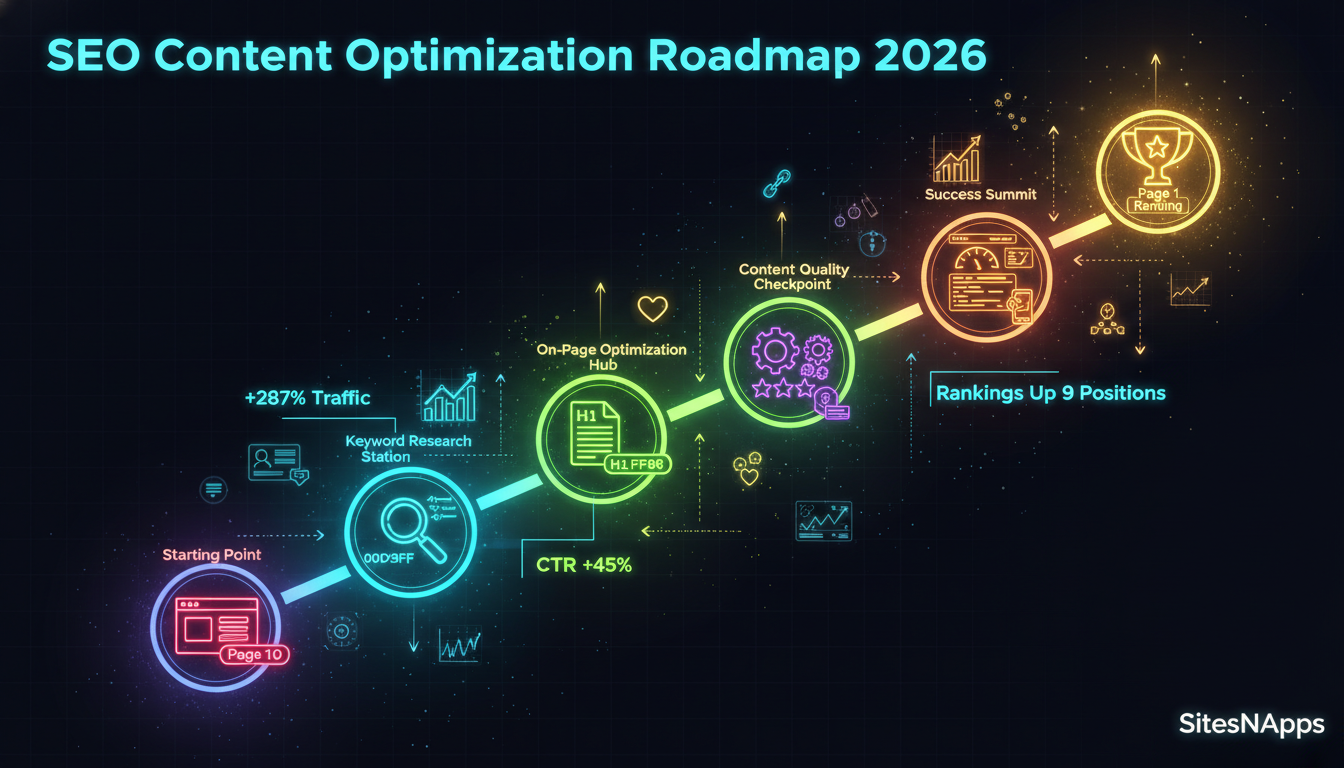
How to optimize website content for SEO, you need to align every page with search intent, use semantically relevant keywords, build a clear content structure, and apply on-page signals like title tags, headers, and schema markup. Done consistently, this process improves rankings, drives qualified traffic, and increases conversions.
Key Takeaways
Search intent is the reason behind a query. Google’s primary job is to match the most relevant result to that reason. If your content type or depth doesn’t match what the searcher actually wants, you won’t rank, regardless of how well-written the content is.
According to a 2023 analysis by Semrush, pages that match search intent rank significantly higher and hold their positions longer than technically optimized pages that miss the intent entirely. That single factor is why some sites with fewer backlinks consistently outrank stronger domains.
Informational intent means the user wants to learn something. Commercial intent means they’re comparing options before making a decision. The content format, depth, and call to action differ for each.
For informational queries, write guides, how-tos, or definitions. For commercial queries, write comparisons, reviews, or service breakdowns. Mixing the two without purpose confuses both Google and the reader.
The search funnel moves from awareness to consideration to decision. Top-of-funnel content targets broad educational queries. Middle-of-funnel content addresses comparisons and specific solutions. Bottom-of-funnel content speaks directly to someone ready to act.
Each page on your site should target one stage clearly. A page trying to serve all three stages at once usually serves none of them well.
Before writing any piece of content, search your target keyword in Google and study the top five results. Ask yourself: Are the top pages blog posts or service pages? Long guides or short answers? That tells you exactly what content type Google has validated for that query.
If every top result is a listicle, writing a long-form narrative will work against you. The SERP is your content brief.
Each page should target one primary keyword and a tight cluster of semantically related terms. Avoid assigning the same keyword to multiple pages. That creates keyword cannibalization, where your own pages compete against each other and dilute ranking signals.
Build a simple spreadsheet that maps one primary keyword and two to four supporting terms to each URL. Revisit it every quarter to catch overlap before it becomes a ranking problem.
Keyword research in 2025 is no longer just about search volume. Google’s algorithms now process content through natural language understanding, which means it looks for entities, concepts, and relationships, not just exact keyword matches.
Start with your primary keyword and use tools like Google Search Console, Ahrefs, or Semrush to find what variations and related phrases people actually search. Secondary keywords are supporting terms that add context and help Google understand the full scope of your page’s topic.
For example, a page targeting “website content optimization” should also include terms like “on-page SEO,” “content structure,” “meta tags,” and “SEO writing techniques.” These aren’t stuffed in; they belong naturally in the content.
Semantic keywords are words and phrases that are conceptually related to your primary keyword but aren’t necessarily synonyms. Search entities are specific people, places, products, or concepts that Google associates with a topic.
For a page about SEO content optimization, relevant entities include Google Search Console, Core Web Vitals, E-E-A-T, and schema markup. Including these natural signals to Google that your content covers the topic with appropriate depth.
Pull the top three competing URLs for your target keyword into a tool like Ahrefs or Semrush. Look at which keywords those pages rank for beyond the primary term. Those additional rankings show you the semantic territory you need to cover to compete.
This isn’t about copying competitors. It’s about identifying gaps in your content that, once filled, give Google more reasons to trust your page as a more complete resource.
A topic cluster is a group of related pages linked together around a central pillar page. The pillar covers a broad topic at a high level. The cluster pages cover specific subtopics in detail.
When Google crawls this structure, it sees your site as a credible, organized source on the subject rather than a collection of disconnected articles. According to HubSpot’s research, sites using topic clusters report measurable improvements in organic traffic and domain-level rankings over time. This structure is now a core part of how serious SEO teams build content.
Structure affects both rankings and reader experience. A page with clear, logical organization is easier for Google to parse and easier for users to navigate. Both signals matter.
The H1 is your page title and appears exactly once. H2s are your main section headers. H3s are subsections within each H2. Think of it as an outline: H1 is the book title, H2s are chapters, H3s are sections within chapters.
Use your primary keyword in the H1. Include it in at least two H2s. Write H2s and H3s as questions where possible, since question-based headings directly match how people type queries and how Google surfaces featured snippets.
Keep paragraphs to two to four sentences. Long blocks of text increase bounce rates because readers scan before they commit. Short, focused paragraphs signal confidence, not laziness.
Target a Flesch-Kincaid reading grade of 6 to 8 for most marketing and SEO content. That doesn’t mean oversimplifying; it means removing unnecessary complexity that makes the content harder to process than it needs to be.
Use numbered lists for steps or rankings. Use bulleted lists for features, tips, or grouped items. Use tables when comparing two or more options across shared criteria.
These formats do two jobs: they make content easier to scan for human readers, and they signal structure to Google, which increases the chance of earning a featured snippet or inclusion in an AI Overview.
For long-form content above 1,500 words, a table of contents with anchor links improves usability significantly. It also increases the chance that Google surfaces a sitelinks search box or expandable TOC in the search result itself.
Use HTML anchor IDs on each section heading and link to them from the top of the page. This keeps readers on your page longer by letting them navigate directly to what they need.
To target a featured snippet, identify the question your page answers and provide a concise, direct answer in 40 to 60 words immediately after the relevant heading. Follow that paragraph with supporting detail.
Google pulls snippet answers from the section most directly responding to the query. Position that answers near the top of the most relevant section, not buried three paragraphs down.
Rankings today depend less on technical tricks and more on whether your content actually earns trust from readers and search engines. Google’s E-E-A-T framework (Experience, Expertise, Authoritativeness, Trustworthiness) is the lens through which content quality is now evaluated.
Write from a position of first-hand knowledge where possible. Reference real scenarios, specific client outcomes, or practical examples from the industry. Vague generalizations signal low expertise. Specific, grounded examples signal credibility.
If you’re a marketing agency writing about SEO, mention the types of clients you’ve worked with, the problems you’ve solved, and the measurable outcomes you’ve achieved. That’s experience, and Google’s quality raters are trained to recognize it.
Trust signals include: citing named sources, linking to authoritative external references, showing author credentials, displaying real case data, and keeping content factually accurate and current. Every paragraph you write should be defensible.
For example, instead of writing “SEO takes time,” write “According to Ahrefs’ study of two million pages, 95% of newly published content takes more than a year to reach Google’s first page.” The second version is citable, trustworthy, and far more useful to the reader.
Comprehensive doesn’t mean long. It means complete. Your content should answer the primary question and every reasonable follow-up question a reader might have before leaving the page.
Use the People Also Ask section of Google’s SERP to identify those follow-up questions. Cover each one with a dedicated subsection or FAQ entry. Completeness is one of the clearest signals of topical authority.
Thin content is content that adds little value relative to what’s already available. It typically lacks depth, specificity, or original perspective. Google’s Helpful Content system is specifically designed to identify and suppress thin content in rankings.
To avoid it, ask yourself after writing each section: Does this give the reader something they couldn’t find in the top three competing articles? If not, go deeper, add data, or add a real example.
Always write for the human reader first. Content that reads naturally, provides clear value, and respects the reader’s time will also perform well technically because Google’s algorithms are built to reward exactly that kind of content.
Think of search engine optimization as the final layer, not the foundation. Get the substance right first, then make sure the technical signals support it.
On-page SEO covers everything within your control on a single page: the title, meta description, URL, headers, and structured data. These elements directly influence whether Google shows your page and whether users click on it.
Your title tag is the first thing a potential visitor sees in search results. It should include your primary keyword near the front, communicate a specific benefit or promise, and stay within 50 to 60 characters to avoid truncation.
Avoid writing title tags that just state the topic. Write them to answer a specific reader concern. “How to Optimize Website Content for SEO: A 2026 Guide” outperforms “SEO Content Optimization Tips” because it signals recency, completeness, and a direct match to the query.
A meta description doesn’t directly affect rankings, but it directly affects click-through rate, which does influence rankings over time. Write descriptions that tell the reader exactly what they’ll get, not just what the page is about.
Include a specific number, a time reference, or an action-oriented hook. Keep it between 140 and 155 characters. End with a natural, low-pressure CTA like “See how it works” or “Find out what to fix first.”
URLs should be short, readable, and keyword-relevant. Use hyphens between words. Remove stop words like “a,” “the,” and “and” unless removing them makes the URL unreadable.
A URL like /how-to-optimize-website-content-for-seo is clean, descriptive, and crawlable. A URL like /blog/?p=4821 tells Google nothing about the page’s content and creates a worse user experience in the process.
Place your primary keyword in the H1 and at least two H2 headings. Use secondary and semantic keywords in additional H2s and H3s. Don’t force keywords into headings where they don’t belong naturally.
Google uses header tags to understand page structure and identify the main topics covered. Well-structured headers improve both rankings and the chance of appearing in featured snippets and AI Overviews.
Schema markup is structured data code added to your page that tells search engines what type of content they’re looking at. For blog posts, FAQ pages, and service pages, schema markup increases the chance of earning rich results in the SERP.
Use the FAQ schema to mark up your question-and-answer sections. Use Article or BlogPosting schema on editorial content. Use the LocalBusiness schema on service pages. These additions don’t guarantee rich results, but they significantly improve eligibility for them.
Semantic SEO: an approach to content optimization that focuses on meaning, context, and entity relationships rather than exact-match keywords. Google’s understanding of content is no longer keyword-based; it’s concept-based.
An entity is any real-world concept that Google has catalogued in its Knowledge Graph: people, places, products, organizations, and events. When your content mentions and correctly contextualizes these entities, it gives Google more confidence in your page’s relevance and accuracy.
For example, a page about SEO content optimization that correctly references Google Search Console, Core Web Vitals, and E-E-A-T signals to Google that the author understands the technical ecosystem around the topic.
Identify terms that naturally co-occur with your primary keyword in top-ranking content. These aren’t just synonyms; they’re the vocabulary of the topic. Include them where they fit naturally, not as a checklist exercise.
Tools like Clearscope, Surfer SEO, or even Google’s “People Also Ask” and “Related Searches” sections show you which terms belong in your semantic field. Use them with purpose.
A content cluster starts with a pillar page that covers a broad topic at a strategic level. Cluster pages then cover each subtopic in depth, with internal links pointing back to the pillar and between related cluster pages.
For a marketing agency, a pillar page on “SEO Services” might link to cluster pages on keyword research, on-page optimization, local SEO, technical SEO, and content strategy. Each cluster page strengthens the authority of the pillar through contextual linking.
Internal links pass authority between pages and tell Google how your content is organized. When cluster pages link back to the pillar and to each other contextually, they reinforce the topical relationship and help Google understand which page should rank for broader versus narrower queries.
Anchor text matters here. Use descriptive, keyword-relevant anchor text rather than generic phrases. “Our guide to on-page SEO optimization” is better than “click here.” This is where professional SEO optimization services make a measurable difference, particularly for agencies managing multiple content clusters simultaneously.
Images and media affect page speed, accessibility, and contextual relevance. Ignoring them leaves real ranking value on the table.
Alt text serves two purposes: it describes images to visually impaired users and tells Google what an image depicts. Write alt text as a short, accurate description of the image. Include the target keyword only if it genuinely describes what’s in the image.
Avoid stuffing multiple keywords into alt text. A description like “marketing team reviewing SEO content strategy on laptop” is accurate and contextually useful. “SEO content optimization marketing agency website traffic” is stuffed and provides less value.
Large image files slow down page load times, which directly affects Core Web Vitals and, by extension, rankings. Compress all images before uploading using tools like Squoosh, TinyPNG, or ShortPixel.
Use next-gen formats like WebP instead of JPEG or PNG where supported. Set image dimensions explicitly in HTML so the browser can reserve space for them before they load, reducing Cumulative Layout Shift.
Video content should include a text transcript on the same page to make it indexable. Add schema markup for VideoObject to help Google understand the video’s topic, duration, and thumbnail. Host video on a fast CDN or use YouTube with embedded players rather than self-hosting large files.
Multimedia content that slows a page down hurts SEO more than it helps. Performance comes first; richness comes second.
Google uses mobile-first indexing, meaning it crawls and ranks your site based on the mobile version. Images and videos that look fine on desktop but load slowly or display poorly on mobile actively hurt your rankings.
Test every media element on a real mobile device or through Google’s Mobile-Friendly Test tool. Lazy-load images below the fold to improve initial load time without removing content.
Internal linking is one of the most underused and highest-leverage SEO tactics available. It costs nothing and, when done well, distributes authority across your site while improving the reader’s experience.
Contextual internal links appear within body copy, connecting related ideas naturally. They differ from navigational links in menus or footers because they carry more topical relevance signals for Google.
Link from high-authority pages to pages that need ranking support. Use descriptive anchor text that tells both the reader and Google what the destination page covers. Every link should add value for the person reading, not just serve the algorithm.
Google’s crawlers follow links to discover and index pages. Pages buried more than three clicks from the homepage are harder to crawl and tend to accumulate less authority. Flat site architecture, where important pages are reachable within one to two clicks, improves both crawlability and rankings.
For large sites, use your XML sitemap alongside internal links. The sitemap tells Google which pages exist; internal links tell Google which pages matter most.
A broken internal link points to a URL that no longer exists. An orphan page is a page with no internal links pointing to it. Both are common problems that limit how effectively Google can crawl and rank your content.
Audit internal links quarterly using tools like Screaming Frog or Ahrefs. Redirect broken URLs with 301 redirects to the most relevant live page. Add internal links to orphan pages from relevant, high-traffic content.
In a topic cluster, internal links are what give the structure meaning. Without links, your pillar and cluster pages are just separate articles. With intentional linking, they become an interconnected authority network.
Link every cluster page back to the pillar. Link between cluster pages where the content is logically connected. Avoid creating a hub-and-spoke model where only the pillar links out, but cluster pages never link to each other.
Technical SEO provides the infrastructure your content needs to perform. Even the best-written content will struggle to rank if the site it lives on is slow, poorly structured, or difficult to crawl.
Core Web Vitals are Google’s performance metrics that measure loading speed (LCP), interactivity (INP), and visual stability (CLS). Pages that fail these thresholds receive a ranking disadvantage relative to comparable pages that pass them.
According to Google’s own documentation, Core Web Vitals are a confirmed ranking signal as of 2021 and remain relevant in 2025. Use Google Search Console’s Core Web Vitals report to identify which pages need performance improvements.
Mobile usability covers tap target size, font readability, viewport configuration, and content accessibility on small screens. Google’s mobile-first indexing means these issues affect rankings directly.
Check your site using Google’s Search Console under “Mobile Usability.” Fix any flagged issues before publishing new content. A site that functions well on mobile gives every piece of content you publish a stronger starting point.
If Google can’t crawl a page, it can’t rank it. Common crawlability issues include pages blocked by robots.txt, missing from the sitemap, returning non-200 HTTP status codes, or blocked by JavaScript rendering issues.
Check the “Coverage” report in Google Search Console to see which pages are indexed, excluded, or erroring. Resolve indexing errors before optimizing content on affected pages.
A canonical tag tells Google which version of a page should be treated as the primary one. Use them when you have similar or duplicate content accessible at multiple URLs, such as paginated content, filtered product pages, or syndicated articles.
Without canonical tags, Google may split authority between duplicate URLs or index the wrong version. This is especially common on e-commerce sites and content-heavy platforms.
HTTPS is a baseline ranking requirement. Sites still serving content over HTTP receive a ranking disadvantage and display a “Not Secure” warning in Chrome, which erodes user trust before they’ve read a word.
Accessibility features like descriptive alt text, proper heading hierarchy, and sufficient color contrast also improve SEO indirectly. They reduce bounce rates, improve engagement, and align with Google’s push to surface content that serves all users equally.
AI Overviews and featured snippets now appear above traditional organic results for millions of queries. If your content isn’t structured to answer questions directly, you’re missing a significant visibility opportunity.
AI Overviews pull content that directly and completely answers a question in a short passage. Write an answer paragraph of 40 to 60 words immediately after the relevant heading. Make it self-contained, declarative, and specific.
Don’t build up to the answer over three paragraphs. State it first, then support it. That answer-first structure is exactly what AI systems are trained to extract and surface.
AI systems, including Google’s, assign higher confidence to content that defines terms clearly and correctly contextualizes known entities. Use the format: “Term: one-sentence definition” where appropriate.
For example: “Schema markup: structured data code that tells search engines what type of content a page contains, enabling rich results in search.” That sentence is precise, entity-rich, and citation-ready.
Featured snippets appear in three main formats: paragraph, list, and table. Match your content format to the format Google is already showing for your target query.
For paragraph snippets, use an answer paragraph directly below a question-format heading. For list snippets, use numbered or bulleted lists under a question heading. For table snippets, use HTML tables with labeled columns and rows.
Every Google SERP for an informational query includes a “People Also Ask” (PAA) section. These questions represent related queries that Google has identified as important follow-ups.
Target PAA questions by creating dedicated H3 subsections for each relevant question within your content. Answer each question in 40 to 60 words using the same answer-first structure used for featured snippets.
Zero-click searches occur when the SERP itself answers the question without the user clicking any result. While this reduces click-through volume, appearing as the source of that answer builds brand authority and increases branded search volume over time.
Optimize for zero-click visibility by targeting PAA questions, featured snippet formats, and structured data-rich results. Appearing consistently in these positions trains users to associate your brand with reliable, authoritative answers.
For businesses serving Lafayette and the surrounding Louisiana market, local SEO content optimization requires specific strategies that go beyond standard national SEO. The goal is to appear in local search results for queries that include a geographic modifier or show clear local intent.
Each core service your business offers should have a dedicated page targeting that service, plus the Lafayette location. A page titled “SEO Services in Lafayette, LA” performs better for local queries than a generic “SEO Services” page because it matches the geographic intent directly.
Include Lafayette-specific context on each page: reference the local business environment, mention neighborhoods or surrounding areas like Broussard or Youngsville, and address challenges specific to businesses operating in the Acadiana region.
Research keyword variations that include “Lafayette,” “Lafayette, LA,” “Acadiana,” and surrounding city names. Use these variations naturally in headings, body copy, and image alt text across your location pages.
Avoid repeating “Lafayette” in every other sentence. One to two natural mentions per section, combined with strong service-relevant content, is more effective than forced geographic repetition that disrupts the reading experience.
Your Google Business Profile (GBP) is one of the most powerful local SEO assets you control. Keep your business name, address, and phone number (NAP) exactly consistent across your GBP, website, and all local directories.
Write a keyword-rich business description using your core services and the Lafayette location. Add posts regularly, upload real photos of your team and work, and respond to every review to signal engagement and credibility to Google’s local algorithm.
A local content cluster works like a standard topical cluster but with geographic context. Create a pillar page on your core service for Lafayette, then build cluster content addressing local pain points, industry-specific challenges in the region, and location-based questions your target customers ask.
For a marketing agency, this might include pages like “Why Lafayette Small Businesses Struggle With SEO” or “How to Choose a Digital Marketing Agency in Lafayette, LA.” Each page builds authority for the local market and links back to the pillar.
LocalBusiness schema markup tells Google your business name, address, phone number, hours, and service area in a format it can directly interpret. Adding this markup to your homepage and contact page increases the chance of appearing in Google’s local Knowledge Panel and map pack results.
Use Google’s Rich Results Test to confirm your schema is valid and correctly implemented. For service-area businesses that don’t have a physical storefront visible to customers, use the ServiceArea schema instead of a physical address.
Google’s local ranking algorithm places significant weight on review quantity, recency, and sentiment. Actively ask satisfied clients for Google reviews, and respond to every review, both positive and negative, within 48 hours.
Trust signals beyond reviews include: local citations (consistent NAP mentions in directories like Yelp, Bing Places, and industry-specific sites), local backlinks from Lafayette news outlets or business organizations, and case studies featuring local client results.
Traffic without conversions is just a vanity metric. Every piece of SEO content should be designed not just to attract visitors but to move them toward a specific action.
Before writing any piece of content, define the conversion goal: a form submission, a phone call, a booked consultation, or a product purchase. Every structural and copy decision should serve that goal.
For a marketing agency, most organic content should funnel toward a consultation booking or a discovery call. That means including relevant CTAs throughout the content, not just at the end, and connecting the reader’s problem directly to the solution your agency provides.
A strong CTA is specific, low-friction, and benefit-driven. “Book a free SEO audit” outperforms “Contact us” because it names the action, removes cost risk, and states the outcome.
Place CTAs within the body of long-form content, not just at the top and bottom. When a reader finishes a section that resonates with a problem they’re experiencing, that’s the ideal moment to present a solution-oriented next step.
Bounce rate increases when readers arrive and immediately decide the page won’t help them. The most common causes are slow load times, content that doesn’t match the search intent of the query, and poor mobile experience.
Fix the technical issues first: page speed, mobile layout, and readability. Then ensure your opening paragraph delivers on the promise of your title tag within the first 100 words. Readers make their stay-or-leave decision within seconds.
Organic traffic generates leads when the content is matched to a specific reader problem, the solution is clearly connected to your service, and the path to conversion is obvious and low-effort.
Add a lead capture offer relevant to the content: a free audit, a downloadable checklist, or a short video walkthrough. Position it as a natural next step within the content flow rather than a separate pop-up that interrupts the reading experience. The SitesNApps team specializes in building this kind of SEO-to-conversion content architecture for service businesses.
Publishing content is only half the job. The other half is knowing what’s working, what’s declining, and where your biggest improvement opportunities are hiding.
Google Search Console (GSC) is the most direct window into how Google sees your content. The Performance report shows which queries your pages appear for, how many clicks they receive, and what their average position is.
Filter by page to see the performance of individual pieces of content. Look for pages with high impressions but low click-through rates; those titles and meta descriptions need optimization. Look for pages ranking in positions 4 to 15; those are your fastest improvement opportunities.
Use a rank tracking tool like Semrush, Ahrefs, or Moz to monitor keyword rankings weekly. Compare rankings against CTR data from GSC to identify gaps between where you rank and how often users actually click.
A page ranking in position 3 with a 1% CTR has a title or meta description problem. A page ranking in position 7 with a 4% CTR is punching above its weight; investigate what’s driving that engagement and replicate it.
Pull a list of pages that receive fewer than 100 clicks per month from GSC. For each page, check: Does the content match search intent? Is the page optimized for a keyword that actually has search volume? Has it earned any backlinks?
Underperforming pages usually have one of three problems: wrong intent match, insufficient depth, or no authority signals. Identify which problem applies and fix it before creating new content on the same topic.
Connect Google Analytics 4 to your site and set up conversion events for your key goals: form submissions, phone number clicks, scroll depth milestones, and time on page. These metrics tell you whether readers are engaging with content or abandoning it.
High scroll depth combined with low conversion suggests the CTA or offer isn’t compelling. Low scroll depth suggests the content isn’t delivering on its opening promise. Each data point tells you something specific and actionable.
Content doesn’t stay fresh on its own. Rankings decline as search behavior shifts, competitors publish newer content, and Google’s algorithms evolve. A content maintenance strategy is as important as a content creation strategy.
Content decay happens when a page’s rankings and traffic decline over time without any action on your part. It’s typically caused by newer competitors, shifting search intent, or outdated information that reduces content quality signals.
Monitor your pages’ ranking trends monthly. A consistent decline over three to six months in the absence of algorithm updates is a signal of decay. Pages that previously ranked on page one but have slipped to page two or three are the highest priority for refresh.
Start by updating any statistics, references, or recommendations that are no longer current. Add new sections to address questions or subtopics that now appear in the PAA box for your target keyword. Improve the content structure if top-ranking competitors now use a format your page doesn’t.
After refreshing, update the published date in your CMS and resubmit the URL to Google Search Console for recrawling. According to Moz, content refreshes on established pages often produce faster ranking improvements than publishing entirely new content on the same topic.
When you significantly update a piece of content, treat the republication as a content event. Update the meta title and description to reflect the new version. Share the updated page through your distribution channels.
If you’ve added more than 30% new content, consider updating the title to include “Updated for 2025.” This signals freshness to both readers and search engines without creating a new URL that would start with zero authority.
Not every page deserves to be kept. Pages with minimal traffic, no backlinks, outdated topics, or content that no longer serves any useful purpose can dilute your site’s overall quality signals.
Before deleting a page, check whether it has any backlinks. If it does, redirect it to the most relevant live page. If it has no backlinks and no traffic, delete it and allow the URL to return a 404 or redirect to the closest relevant page.
Build content freshness into your editorial calendar rather than treating it as an emergency measure. Schedule a quarterly review of your top 20 pages. Set alerts in Google Search Console for significant traffic drops.
Freshness doesn’t require rewriting entire articles. Sometimes updating a single statistic, adding a new example, or expanding one underdeveloped section is enough to signal to Google that the content remains current and maintained.
To optimize website content for SEO, you need more than a checklist. You need a system: one that connects search intent to content structure, maps keywords to pages without overlap, builds topical authority through clusters, and maintains content performance through regular auditing and updates.
Every tactic in this guide serves a single purpose: earning and holding the trust of both search engines and the people using them. When those two things align, rankings follow.
If you’re ready to stop guessing and start building content that consistently ranks and converts, the most valuable next step is getting a clear picture of where your current content stands. Explore our SEO optimization services to see how we help businesses like yours turn organic traffic into real business results. Or, if you’d like to talk through your specific situation, reach out to the SitesNApps team to book a strategy call.
Most pages take three to six months to show significant ranking improvements after optimization, depending on domain authority, competition level, and how recently the content was published. Pages on established domains that are being refreshed rather than newly created often see faster results, sometimes within four to eight weeks of an update.
Audit your top-traffic pages quarterly and refresh any page where rankings have dropped or information has become outdated. For actively competitive pages, a review every 90 days is reasonable. For evergreen content with stable rankings, a semi-annual review is generally sufficient to maintain performance.
On-page SEO refers to technical elements on a single page: title tags, meta descriptions, URLs, schema markup, and header tags. Content optimization focuses on the substance of the content itself: intent matching, depth, structure, and quality. Both are necessary and work best when applied together.
Not necessarily. Many on-page optimizations are learnable and executable without professional help. However, for businesses competing in high-volume or high-value keyword spaces, working with an experienced agency significantly accelerates results by combining technical expertise with strategic content planning and ongoing performance management.
Each page should target one primary keyword and three to five closely related secondary keywords. Targeting more than that on a single page typically reduces the page’s ability to rank well for any of them. If you have additional keyword opportunities, build separate pages with their own targeted content.
Search intent match remains the single most important factor. A page that perfectly satisfies what the searcher is looking for will outperform a technically superior page that misses the intent. After intent, content depth, and E-E-A-T signals, specifically demonstrated experience and credible sourcing have the strongest influence on rankings.
Struggling to compete for high-search-volume keywords? We help businesses like yours increase visibility, drive more traffic, and dominate competitive search terms—all while keeping your costs low. Our proven strategies focus on long-term growth and measurable results.